• HOME
  • NEWS
  • EXPLORE
    • CAREER
      • Companies
      • Jobs
    • EVENTS
    • iGEM
      • News
      • Team
    • PHOTOS
    • VIDEO
    • WIKI
  • BLOG
  • COMMUNITY
    • FACEBOOK
    • INSTAGRAM
    • TWITTER
Tuesday, May 19, 2026
BIOENGINEER.ORG
No Result
View All Result
  • Login
  • HOME
  • NEWS
  • EXPLORE
    • CAREER
      • Companies
      • Jobs
        • Lecturer
        • PhD Studentship
        • Postdoc
        • Research Assistant
    • EVENTS
    • iGEM
      • News
      • Team
    • PHOTOS
    • VIDEO
    • WIKI
  • BLOG
  • COMMUNITY
    • FACEBOOK
    • INSTAGRAM
    • TWITTER
  • HOME
  • NEWS
  • EXPLORE
    • CAREER
      • Companies
      • Jobs
        • Lecturer
        • PhD Studentship
        • Postdoc
        • Research Assistant
    • EVENTS
    • iGEM
      • News
      • Team
    • PHOTOS
    • VIDEO
    • WIKI
  • BLOG
  • COMMUNITY
    • FACEBOOK
    • INSTAGRAM
    • TWITTER
No Result
View All Result
Bioengineer.org
No Result
View All Result
Home NEWS Science News Biology

Levitating droplets allow scientists to perform ‘touchless’ chemical reactions

Bioengineer by Bioengineer
June 24, 2020
in Biology
Reading Time: 2 mins read
0
IMAGE
Share on FacebookShare on TwitterShare on LinkedinShare on RedditShare on Telegram

IMAGE

Credit: Analytical Chemistry 2020, DOI: 10.1021/acs.analchem.0c00929

Levitation has long been a staple of magic tricks and movies. But in the lab, it’s no trick. Scientists can levitate droplets of liquid, though mixing them and observing the reactions has been challenging. The pay-off, however, could be big as it would allow researchers to conduct contact-free experiments without containers or handling that might affect the outcome. Now, a team reporting in ACS’ Analytical Chemistry has developed a method to do just that. 

Scientists have made devices to levitate small objects, but most methods require the object to have certain physical properties, such as electric charge or magnetism. In contrast, acoustic levitation, which uses sound waves to suspend an object in a gas, doesn’t rely on such properties. Yet existing devices for acoustic levitation and mixing of single particles or droplets are complex, and it is difficult to obtain measurements from them as a chemical reaction is happening. Stephen Brotton and Ralf Kaiser wanted to develop a versatile technique for the contactless control of two chemically distinct droplets, with a set of probes to follow the reaction as the droplets merge.

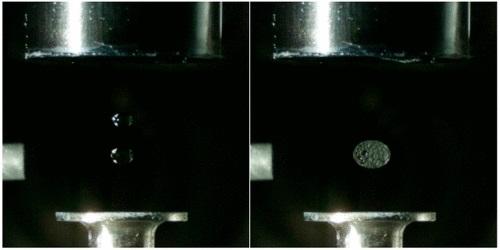
The team made an acoustic levitator and suspended two droplets in it, one above the other. Then, they made the upper droplet oscillate by varying the amplitude of the sound wave. The oscillating upper droplet merged with the lower droplet, and the resulting chemical reaction was monitored with infrared, Raman and ultraviolet-visible spectroscopies. The researchers tested the technique by combining different droplets. In one experiment, for example, they merged an ionic liquid with nitric acid, causing a tiny explosion. The new levitation method could help scientists study many different types of chemical reactions in areas such as material sciences, medicinal chemistry and planetary science, the researchers say.

###

The authors acknowledge funding from the Office of Naval Research.

The abstract that accompanies this paper can be viewed here.

The American Chemical Society (ACS) is a nonprofit organization chartered by the U.S. Congress. ACS’ mission is to advance the broader chemistry enterprise and its practitioners for the benefit of Earth and its people. The Society is a global leader in providing access to chemistry-related information and research through its multiple research solutions, peer-reviewed journals, scientific conferences, eBooks and weekly news periodical Chemical & Engineering News ACS journals are among the most cited, most trusted and most read within the scientific literature; however, ACS itself does not conduct chemical research. As a specialist in scientific information solutions (including SciFinder® and STN®), its CAS division powers global research, discovery and innovation. ACS’ main offices are in Washington, D.C., and Columbus, Ohio.

To automatically receive news releases from the American Chemical Society, contact [email protected].

Follow us: Twitter | Facebook

Media Contact
Katie Cottingham
[email protected]

Related Journal Article

http://dx.doi.org/10.1021/acs.analchem.0c00929

Tags: AcousticsBiomechanics/BiophysicsBiomedical/Environmental/Chemical EngineeringChemistry/Physics/Materials SciencesSpace/Planetary Science
Share12Tweet8Share2ShareShareShare2

Related Posts

Fischer’s Blue Butterflies Less Attractive on Non-Native Diet, Study Finds — Biology

Fischer’s Blue Butterflies Less Attractive on Non-Native Diet, Study Finds

May 19, 2026

How One Protein Uses Embryonic Brain Language to Maintain Plasticity in Adult Neurons

May 19, 2026

Scientists Can Now Monitor America’s Dolphin Populations Using DNA Floating in Seawater

May 19, 2026

New Insights into How Smoking Causes Lung Stiffness

May 19, 2026
Please login to join discussion

POPULAR NEWS

  • Research Indicates Potential Connection Between Prenatal Medication Exposure and Elevated Autism Risk

    845 shares
    Share 338 Tweet 211
  • New Study Reveals Plants Can Detect the Sound of Rain

    731 shares
    Share 292 Tweet 182
  • Salmonella Haem Blocks Macrophages, Boosts Infection

    62 shares
    Share 25 Tweet 16
  • Breastmilk Balances E. coli and Beneficial Bacteria in Infant Gut Microbiomes

    58 shares
    Share 23 Tweet 15

About

We bring you the latest biotechnology news from best research centers and universities around the world. Check our website.

Follow us

Recent News

Myelin Damage in Donor Skin Distinguishes Synucleinopathies

FGFR1, Not S6K1/2, Fuels BRAF Resistance

Fischer’s Blue Butterflies Less Attractive on Non-Native Diet, Study Finds

Subscribe to Blog via Email

Enter your email address to subscribe to this blog and receive notifications of new posts by email.

Join 82 other subscribers
  • Contact Us

Bioengineer.org © Copyright 2023 All Rights Reserved.

Welcome Back!

Login to your account below

Forgotten Password?

Retrieve your password

Please enter your username or email address to reset your password.

Log In
No Result
View All Result
  • Homepages
    • Home Page 1
    • Home Page 2
  • News
  • National
  • Business
  • Health
  • Lifestyle
  • Science

Bioengineer.org © Copyright 2023 All Rights Reserved.