


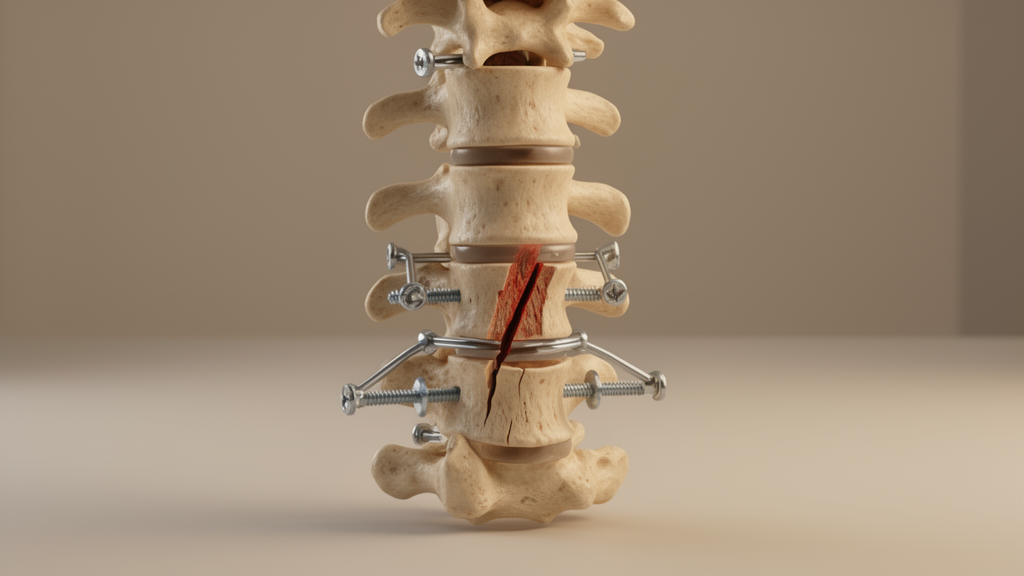
A letter published in the Egyptian Journal of Neurosurgery raises technical questions about a recent five-case series on the surgical management of vertebral fractures in patients with ankylosing spondylitis. The letter, authored by Kaan Kırımlı, MD, responds to the report by Basiony and Hamoud, which described five cases and discussed fracture recognition, neurological deterioration, perioperative complications, and fixation length. Rather than disputing the overall findings, the letter focuses on points of classification, surgical decision-making, and citation accuracy that the author argues would affect how the cases are interpreted.
The first issue concerns the classification of Case 5. All five injuries in the original series were classified as AO Spine Type C, but the letter notes that Case 5 was described as a hyperextension injury with anterior opening and disruption of the anterior longitudinal ligament, without canal compromise and with an intact posterior ligamentous complex. According to the letter, the AO Spine classification has changed over time: the 2013 revision included hyperextension injuries within the Type C1 category, whereas current terminology describes hyperextension injuries with anterior tension-band failure and no gross translation as Type B3. The letter adds that B3 injuries are well described in ankylosing spinal disorders, and asks the original authors to state which version of the classification was used and which specific imaging finding led to the Type C designation.
The second point addresses Case 4 and the choice of fixation length. The original report described no fracture, subluxation, or diastasis of the facets, laminae, or spinous processes, with an intact posterior ligamentous complex and no gross translational or rotational displacement. The patient was treated with a T11–L2 construct, spanning two levels above and two below the fracture, and no implant failure was reported during four years of follow-up. The letter observes that long-segment fixation is commonly used for fractures in ankylosed spines, although previous reports have questioned whether it should be considered an absolute rule.
In this context, the letter asks whether fracture displacement, posterior element integrity, posterior ligamentous complex integrity, bone quality, and intraoperative screw purchase were considered when the shorter construct was selected. The author suggests that Case 4 raises a useful question about whether a shorter construct can be considered in a carefully selected patient with preserved posterior structures, and that defining the imaging and clinical criteria behind such a decision would make the observations easier to compare with previous studies.
Bone quality forms a related point in the letter. The original authors attributed the successful outcome in Case 4 partly to the preserved posterior tension band and fused adjacent bone. The letter notes that poor bone quality may affect screw fixation in patients with ankylosing spondylitis, and asks whether bone mineral density, CT-based bone quality assessment, or intraoperative screw purchase was evaluated before the shorter construct was chosen.
The letter also comments on the death reported in Case 5. That patient had complete neurological injury and preoperative respiratory compromise, followed by hypotension, tachycardia, and cardiac arrest approximately three hours after surgery. The letter notes that ECG and troponin testing were not performed, meaning the exact mechanism of the arrest cannot be established from the available information. It suggests that describing the cause as undetermined may be more appropriate than attributing the event to a specific mechanism.
A further section of the letter concerns apparent bibliographic discrepancies in references 11 and 12 of the published article. According to the letter, the article cited as reference 11 appears in the indexed record under Kulkarni et al., with the DOI https://doi.org/10.14444/6029, rather than the author list given in the published reference. The article cited as reference 12 is, the letter states, indexed under Zhu et al., with the DOI https://doi.org/10.1097/MD.0000000000008462. Because both references are used in the discussion of fixation strategy, the letter argues that checking these entries would improve the accuracy of the reference list.
In closing, the letter states that clarification of the AO Spine classification used in Case 5, together with a definition of the imaging and clinical criteria behind the shorter construct in Case 4, would make the original authors’ observations easier to apply and compare with previous studies, and would add to the discussion of individualized fixation strategies in ankylosing spinal disorders. The letter is published as open access, and the original article it addresses was published on 4 September 2026.
Subject of Research: Surgical management of vertebral fractures in ankylosing spondylitis
Article Title: Re: “Fragile yet rigid: surgical management of vertebral fractures in ankylosing spondylitis—a five-case series and literature review”
Article References: Kırımlı, K. (2026). Re: “Fragile yet rigid: surgical management of vertebral fractures in ankylosing spondylitis—a five-case series and literature review”. Egyptian Journal of Neurosurgery, 41(1), Article 173. https://doi.org/10.1186/s41984-026-00685-w
Image Credits: AI Generated
DOI: 10.1186/s41984-026-00685-w
Keywords: ankylosing spondylitis, vertebral fractures, AO Spine classification, spinal fixation, hyperextension injury, posterior ligamentous complex, bone quality, letter to the editor, Egyptian Journal of Neurosurgery, surgical case series, Fragile, rigid
News Source: Ophelia Keating. (October 29, 2026). Letter Questions Classification and Fixation Choices in Ankylosing Spondylitis Fracture Series. Scienmag.



