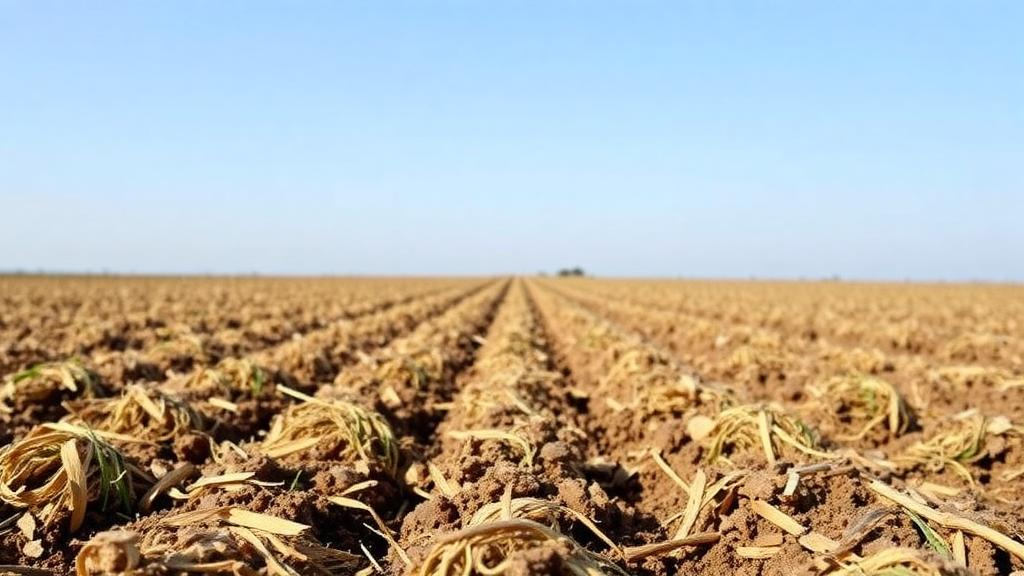
Salt-affected soils blanket more than one billion hectares of the Earth’s surface, a vast and often written-off expanse of farmland that farmers struggle to make productive and scientists have long struggled to understand. Now a three-year field experiment in China’s Yellow River Delta suggests that these marginal soils may hide an unexpected climate opportunity, and that unlocking it requires doing something counterintuitive: applying less fertilizer, not more. The study, published in the journal Plant and Soil, found that combining a modestly reduced dose of nitrogen fertilizer with a half-rate of incorporated crop straw pushed a coastal saline soil to sequester organic carbon more efficiently than the conventional high-input regime that farmers typically rely on.
The research team, led by Zhichang Jing of Qingdao Agricultural University together with colleagues from Shandong Huibang Bohai Agriculture Development Limited Company, ran their experiment under a winter wheat–summer maize rotation, the dominant double-cropping system of the region. They compared two nitrogen levels, a conventional 270 kilograms of nitrogen per hectare and a reduced rate of 210 kilograms per hectare, crossed with three straw incorporation rates: no straw at all, 5,000 kilograms per hectare, and 10,000 kilograms per hectare. Over three years they tracked how each combination reshaped the soil’s physical architecture, its chemistry, its enzyme machinery, and ultimately the bacterial communities that govern whether carbon entering the soil is locked away or breathed back out into the atmosphere as carbon dioxide.
The standout treatment was the one the researchers labeled N2S1, the reduced nitrogen dose paired with the half-rate straw application. This combination achieved the highest soil organic carbon sequestration efficiency of any treatment tested, outperforming the conventional high-input practice of full nitrogen with full straw by 6.4 percent. That margin may sound modest, but in the world of soil carbon accounting, where gains of even a few percent over whole rotations are considered meaningful, a 6.4 percent improvement achieved while cutting fertilizer use is a striking result. It means more of the carbon in the straw ended up stored in the soil rather than lost, and it was accomplished with 60 kilograms less nitrogen per hectare each year.
What makes the finding technically interesting is the mechanism the authors uncovered. The winning treatment did not simply dump more carbon into the ground. Instead, it changed the fate of the carbon that was already flowing through the system. Soils under the reduced-nitrogen, half-straw regime developed more large macro-aggregates, the soil clumps larger than two millimeters that act as tiny vaults, physically shielding organic matter from decomposer microbes. The team also detected a shift toward more recalcitrant carbon fractions, the chemically stubborn forms of organic matter that resist breakdown for years or decades. Infrared analysis of organic carbon functional groups confirmed this chemical hardening of the soil’s carbon stock.
The key to this transformation, the researchers argue, lies in microbial stoichiometry, the balancing act microbes perform between the carbon and nitrogen available in their food. When nitrogen became scarcer under the reduced application rate, soil enzymes told a clear story: the ratio of carbon-acquiring to nitrogen-acquiring extracellular enzyme activity rose from 0.393 under the conventional treatment to 0.414 under the reduced-nitrogen regime, signaling intensified microbial nitrogen limitation. Faced with a nitrogen shortage, the microbial community ramped up its carbon-cycling enzymes, with xylanase activity increasing by 15.9 percent and beta-glucosidase by 13.2 percent. This pattern fits what soil ecologists call microbial nitrogen mining, a strategy in which microbes invest extra enzymatic effort to extract nitrogen from organic matter, and in doing so process carbon more thoroughly and incorporate it more efficiently into their own biomass and residues.
DNA sequencing of the soil bacterial communities added a second layer of evidence. Under the optimal treatment, the community shifted toward oligotrophic taxa, the patient, slow-growing specialists such as Acidobacteriota and Chloroflexi that thrive when nutrients are scarce rather than abundant. These are precisely the organisms that tend to convert carbon into stable microbial necromass rather than releasing it quickly through respiration. Network analysis of the community revealed something equally telling: the bacteria under the reduced-input treatment formed a more complex and cooperative co-occurrence network, with more connections linking species to one another. A richer web of microbial interactions is often associated with more stable ecosystem functioning and more efficient resource cycling, suggesting the treatment did not just change who lived in the soil but how the residents worked together.
The broader significance of the study lies in the sheer scale of the resource at stake. Saline and salt-affected soils are among the most extensive degraded land types on the planet, and much of that area sits in agricultural regions where straw burning or removal is common practice. Incorporating straw into such soils has long been promoted as a way to build organic matter, but it carries a well-known risk: fresh crop residues can stimulate microbes to decompose existing soil organic carbon as well, a phenomenon called priming that can erase the intended gains. High nitrogen availability is thought to worsen this problem by relieving the microbial nitrogen limitation that would otherwise force careful, conservative carbon processing. The new results suggest that deliberately maintaining a degree of nitrogen scarcity, calibrated against the carbon-to-nitrogen ratio of the added straw, can tip the balance away from respiratory carbon loss and toward stabilization.
There are also practical and economic dimensions worth noting. Nitrogen fertilizer is one of the largest recurring costs in cereal production and a major source of agriculture’s greenhouse gas footprint, both from the energy used to manufacture it and from nitrous oxide emitted from fertilized fields. A management recipe that achieves better carbon sequestration while trimming nitrogen inputs by roughly 22 percent offers a rare double dividend: lower costs for farmers working marginal land and reduced emissions intensity for the cropping system as a whole. Because the approach relies on adjusting rates of two inputs that farmers already manage, rather than requiring new technologies or amendments, it could in principle be adopted widely across salt-affected wheat-maize regions without significant infrastructure investment.
The authors are careful to frame the strategy as biologically driven, and that framing matters. Rather than relying on chemical stabilization or mineral associations alone, the treatment works by steering the soil’s living community toward a metabolic regime that favors carbon retention. Aggregate formation provides the physical protection, recalcitrant carbon fractions provide the chemical durability, and a nitrogen-limited, cooperative microbial community provides the biological engine that channels straw carbon into both. As the researchers conclude, moderately reduced nitrogen input combined with half-dose straw incorporation optimized the carbon-to-nitrogen stoichiometric balance, redirecting microbial metabolism from respiratory carbon loss toward aggregate-mediated physical protection. For the billion-plus hectares of salt-affected soil worldwide, that is a recipe worth testing far beyond the Yellow River Delta.
Subject of Research: Soil organic carbon sequestration through straw incorporation and reduced nitrogen fertilization in saline soils
Article Title: Synergistic straw incorporation and reduced nitrogen application enhance soil carbon sequestration in saline soils
Article References: Jing, Z., Zhang, L., Han, J., Ma, C., Zhang, S., Sun, H., & Ding, X. (2026). Synergistic straw incorporation and reduced nitrogen application enhance soil carbon sequestration in saline soils. Plant and Soil. https://doi.org/10.1007/s11104-026-09056-8
Image Credits: AI Generated
DOI: 10.1007/s11104-026-09056-8
Keywords: soil organic carbon, saline soil, straw incorporation, nitrogen fertilization, microbial nitrogen mining, enzyme stoichiometry, soil aggregates, bacterial community, Yellow River Delta, carbon sequestration, soil microbiology, sustainable agriculture
News Source: Alan Morgan. (October 7, 2026). Less Nitrogen, More Carbon: Straw Trick Turns Saline Soils into Carbon Sinks. Scienmag.