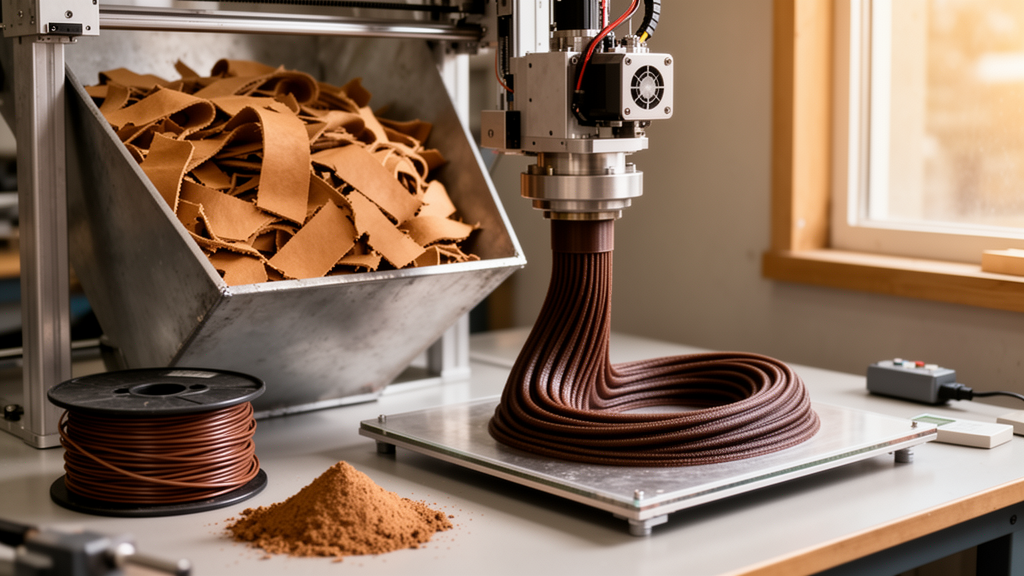
Ground-up leather shavings from tanneries can be turned into filament for 3D printing, but only up to a point. A new study published in the journal Collagen and Leather shows that wet-white leather shavings can be blended into thermoplastic polyurethane (TPU) to produce printable composite filaments, with composites containing up to 30 percent leather waste by weight maintaining good printability. At 40 percent filler content, the material became so brittle that the filament broke during spool preparation and handling in the printer feeding system, making it unusable. The researchers identified a printing speed of 50 millimeters per second at nozzle temperatures of 220 to 225 degrees Celsius as the optimal processing window.
The work, led by R. Mascolo with colleagues including L. Giorleo, addressed a substantial waste stream. During the Italian leather-producing cycle, 31 percent of solid waste is generated during tanning, amounting to roughly 0.5 kilograms of solid waste per square meter of finished leather. Globally, the tanning industry produces approximately 2.0 billion square meters of leather annually, resulting in about 1.0 million tons of solid waste. Leather shavings, the scraps removed to uniform the thickness of wet leathers, account for approximately 33 percent of total waste and 75 percent of the solid waste produced by tanneries. Finding higher-value outlets for this material is therefore a priority for an industry under pressure from fashion brands and automotive manufacturers to adopt more sustainable business models.
The raw material for the study was glutaraldehyde-tanned wet-white bovine automotive leather supplied by the Italian tannery Pasubio. Before any compounding, the team chemically and ecotoxicologically characterized the waste to verify that its use as a filler would comply with environmental and safety regulations. Although such requirements primarily apply to finished leather, the researchers applied them to the waste as a precaution. The shavings met the restrictions of Annex XVII of the European REACH Regulation, the EU regulation on persistent organic pollutants, and the Oeko-Tex Leather Standard. Tests for volatile, semi-volatile, and very volatile organic compounds confirmed compliance with both the Japan Automobile Manufacturers Association requirements and the Oeko-Tex standard, indicating no hazardous volatile substances at the conditioning, printing, and extrusion temperatures used in the process.
Preparation of the filler involved drying the shavings in an oven at 50 degrees Celsius for 16 hours to remove excess moisture, prevent particle agglomeration and collagen hydrothermal denaturation, and improve grindability. The shavings were then ground into a fibrous powder with a 0.5 millimeter sieve at 400 revolutions per minute, keeping the temperature below 40 degrees Celsius in accordance with the ISO 4044:2017 standard for leather test sample preparation. Digital image processing of microscope images, based on 500 particle measurements, showed that more than 90 percent of the ground particles had a surface area below 1.3 times ten to the fifth square micrometers, corresponding to the area of the printer nozzle section, while 85 percent were smaller than 6.5 times ten to the fourth square micrometers. This relatively small particle size was judged sufficient to ensure smooth extrusion and avoid nozzle clogging during printing.
To make the composites, the team compounded TPU pellets and leather powder in a micro compounder at 100 revolutions per minute and 210 degrees Celsius for two minutes, producing five compositions with leather contents of 0, 10, 20, 30, and 40 percent by weight. The materials were then pelletized and extruded again into 1.75 millimeter filaments with a diameter controlled within plus or minus 0.02 millimeters. During this extrusion step, the 40 percent composite became embrittled and the filament could not be collected and rolled onto a reel for printing. The authors attribute this to excessive leather waste accumulating and disrupting the continuous TPU phase, restricting the movement of the polymer molecular chains. On this basis, 30 percent leather content was identified as the technological limit for producing filament suitable for fused filament fabrication.
Thermal analysis supported the processing choices. Differential scanning calorimetry of pure TPU revealed two glass-transition temperatures, at 0 and 118 degrees Celsius, associated with the soft and hard segments of the polymer, and small exothermic peaks at 183 and 204 degrees Celsius attributed to slight crystallinity in the hard segment region. Adding leather filler shifted the melting temperature of the TPU from 205 to 221 degrees Celsius, possibly due to reduced mobility of the polymer macromolecules, and raised the crystallization temperature from 106 to 162 degrees Celsius, which the researchers suggest may reflect a nucleating effect of the filler particles. The degree of crystallization itself remained constant across filler concentrations. Thermogravimetric analysis showed that pure TPU began to decompose at 323 degrees Celsius, well above the typical fused filament fabrication processing range of 200 to 240 degrees Celsius, indicating adequate thermal stability for printing.
Rheological measurements at 200 degrees Celsius showed that all the materials exhibited non-Newtonian behavior, with composite viscosity decreasing by approximately two to three orders of magnitude as angular frequency increased. The storage and loss moduli increased with filler content, indicating that the leather fibers restricted the mobility of the TPU chains and enhanced elastic energy storage. Pure TPU behaved mainly as a viscous liquid, with the loss modulus exceeding the storage modulus at all frequencies, whereas the composites showed the storage modulus dominating, a transition toward more solid-like behavior caused by the filler network. The authors note that this viscoelastic balance favors printing, promoting smooth flow under shear while helping the deposited material retain its shape.
Mechanical testing revealed clear trade-offs. Tensile tests on hot-pressed dog-bone specimens showed that elongation at break decreased significantly as filler content increased, and at 20 percent filler the composites lost most of the initial ductility of TPU and became more brittle, behaving similarly to the original leather measured parallel to the backbone. The original leather itself showed obvious anisotropy, with higher strength and Young’s modulus parallel to the backbone direction. As filler content rose, the elastic modulus increased, which the authors argue benefits dimensional stability during printing, since a higher modulus helps limit local deformation caused by nozzle pressure during deposition. Scanning electron microscopy confirmed good dispersion and adhesion of leather fibers in the TPU matrix after extrusion, although agglomeration and some voids appeared at 30 percent filler content, and filament surface roughness increased with filler concentration.
Printability was evaluated systematically through one-dimensional path tests and three-dimensional printing of test cubes on a commercial printer. In the 1D test, single 100-millimeter lines were extruded and their width compared against a nominal value with a tolerance of plus or minus 20 percent at a 95 percent confidence level, after statistical screening with Shapiro-Wilk normality tests and Grubbs outlier tests. Printing at 230 degrees Celsius produced filament widths exceeding the upper tolerance limit regardless of speed, so that temperature was excluded. At 220 and 225 degrees Celsius, both pure TPU and the 20 and 30 percent composites stayed within tolerance at 50 millimeters per second, but at 100 millimeters per second the width deviations became excessive, particularly for the composites. Higher filler content also reduced width uniformity and made the printed cube surfaces rougher and less well defined.
Interlayer cohesion, quantified by tensile testing of specimens cut perpendicular to the printed layers of the cubes, declined with filler loading. Analysis of variance identified leather waste percentage as the only significant factor. As the leather content increased from 20 to 30 percent, average welding strength fell from 2.52 to 1.12 newtons per millimeter, a 52 percent reduction, while elongation at break dropped by 75 percent, from 18 to 4.5 percent. Interestingly, the composites caused fewer printer interruptions than pure TPU, because the added stiffness of the filled filament improves feeding to the nozzle and reduces buckling, a known problem with soft TPU filaments. The authors conclude that composites with up to 30 percent leather waste can be reliably printed within a narrow processing window and are suitable for applications where high flexibility is not required, such as semi-rigid components under low mechanical stress, offering a potential eco-friendly route for repurposing industrial leather waste in fashion, automotive interiors, and design.
Subject of Research: Upcycling wet-white leather shavings as a filler in thermoplastic polyurethane filaments for fused filament fabrication 3D printing
Article Title: From waste to 3D printing material: upcycling leather shavings in thermoplastic polyurethane and determining the filament fabrication threshold
Article References: Mascolo, R., Calvanese, G., Nazir, M. U., Bilotti, E., & Giorleo, L. (2026). From waste to 3D printing material: upcycling leather shavings in thermoplastic polyurethane and determining the filament fabrication threshold. Collagen and Leather, 8(1), Article 26. https://doi.org/10.1186/s42825-026-00255-8
Image Credits: AI Generated
DOI: 10.1186/s42825-026-00255-8
Keywords: leather waste, thermoplastic polyurethane, 3D printing, fused filament fabrication, circular economy, tannery byproducts, composite filaments, printability, upcycling, collagen filler, sustainable manufacturing, waste
News Source: Denise Maddox. (October 30, 2026). Leather Waste Becomes 3D Printing Filament, With a 30 Percent Ceiling. Scienmag.