


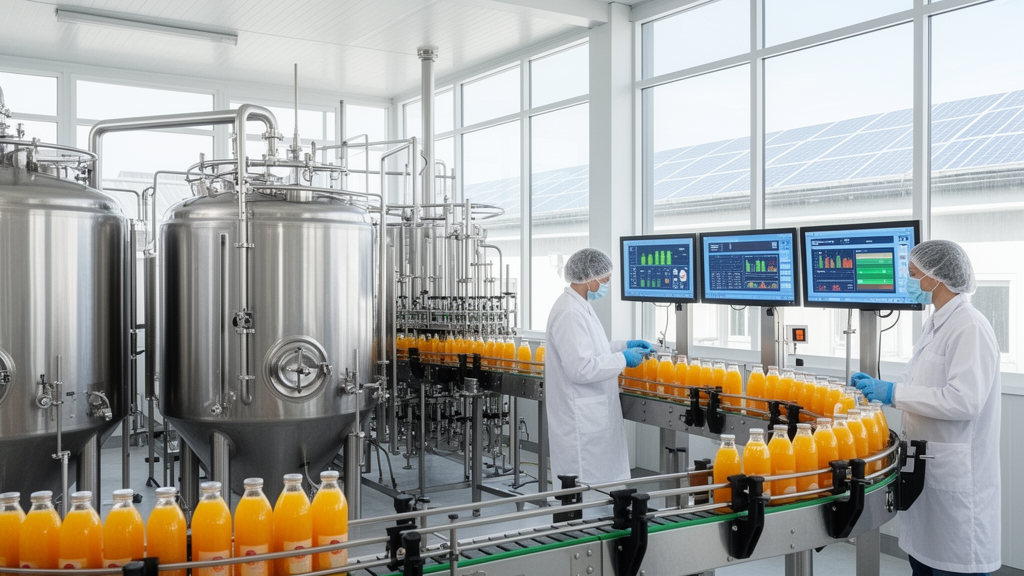
A year-long study of an industrial fruit juice plant has found that a widely used factory performance metric—overall equipment effectiveness, or OEE—tracks the facility’s Scope 1 and 2 carbon emissions with striking precision. As green–lean production practices lifted OEE from 58.5 to 71.6 percent, the plant’s carbon intensity fell from 0.1198 to 0.1006 kgCO2e per liter of mixed fruit juice packed in glass bottles at the factory gate, according to the study published in Clean Technologies and Environmental Policy.
The research, conducted by Dila Beşen and Murat Reis Akkaya, evaluated the operational and environmental effects of implementing green–lean production (GLP) practices, drawing on twelve months of industrial operational data. The practices included kaizen continuous improvement, 5S workplace organization, SMED rapid changeover techniques, and total productive maintenance (TPM). Together, these interventions were associated with reductions in waste and unplanned downtime, alongside improvements in operational efficiency.
The plant's most energy-intensive processes were pasteurization and clean-in-place (CIP) operations, which strongly influence the facility's Scope 1–2 carbon emissions. As OEE rose, electricity and natural gas consumption per unit of product declined in parallel. The plant produces approximately 1.06 million liters of finished product per month, giving the efficiency gains a substantial footprint in absolute terms.
Linear regression analysis revealed a strong negative relationship between OEE and monthly Scope 1–2 carbon emissions, with an R² of 0.934 and a p-value below 0.01. In practical terms, each one-percentage-point increase in OEE was associated with an approximate reduction of 3.409 tonnes of CO2 equivalent per month at the plant. The authors report that uncertainty and sensitivity analyses confirmed the robustness of the OEE–emissions regression model.
Rather than replacing pasteurizers or electrifying thermal processes, the plant achieved measurable emissions reductions through better organization, faster changeovers, and preventive maintenance—changes that also reduced waste and downtime. The authors position OEE as a practical plant-level indicator for monitoring Scope 1–2 carbon emissions, allowing managers to track decarbonization progress using data they already collect for production control.
The study frames its contribution in terms of Sustainable Development Goals 12 and 13, which cover responsible consumption and production and climate action, respectively. Because the analysis rests on a single plant over one year, the reported associations describe this facility’s experience rather than a demonstrated effect across the industry, and the regression captures a relationship observed in the data rather than a controlled experimental result. Even so, the tight statistical fit and the concurrent drop in both energy intensity and emissions intensity offer a concrete, quantified case that operational discipline and carbon performance can move together in food processing.
Subject of Research: The relationship between overall equipment effectiveness and Scope 1–2 carbon emissions in a fruit juice plant implementing green–lean production practices.
Article Title: Operational decarbonization in a fruit juice plant: relationship between overall equipment effectiveness and Scope 1–2 carbon emissions through green–lean production
Article References: Beşen, D., & Akkaya, M. R. (2026). Operational decarbonization in a fruit juice plant: relationship between overall equipment effectiveness and Scope 1–2 carbon emissions through green–lean production. Clean Technologies and Environmental Policy, 28(11), Article 285. https://doi.org/10.1007/s10098-026-03620-7
Image Credits: AI Generated
DOI: 10.1007/s10098-026-03620-7
Keywords: overall equipment effectiveness, green-lean production, Scope 1-2 emissions, fruit juice plant, kaizen, 5S, SMED, total productive maintenance, carbon intensity, operational decarbonization, pasteurization, clean-in-place
News Source: Denise Maddox. (October 29, 2026). Leaner factories, lower emissions: efficiency metric tracks fruit juice plant carbon footprint. Scienmag.



