• HOME
  • NEWS
  • EXPLORE
    • CAREER
      • Companies
      • Jobs
    • EVENTS
    • iGEM
      • News
      • Team
    • PHOTOS
    • VIDEO
    • WIKI
  • BLOG
  • COMMUNITY
    • FACEBOOK
    • INSTAGRAM
    • TWITTER
Tuesday, May 5, 2026
BIOENGINEER.ORG
No Result
View All Result
  • Login
  • HOME
  • NEWS
  • EXPLORE
    • CAREER
      • Companies
      • Jobs
        • Lecturer
        • PhD Studentship
        • Postdoc
        • Research Assistant
    • EVENTS
    • iGEM
      • News
      • Team
    • PHOTOS
    • VIDEO
    • WIKI
  • BLOG
  • COMMUNITY
    • FACEBOOK
    • INSTAGRAM
    • TWITTER
  • HOME
  • NEWS
  • EXPLORE
    • CAREER
      • Companies
      • Jobs
        • Lecturer
        • PhD Studentship
        • Postdoc
        • Research Assistant
    • EVENTS
    • iGEM
      • News
      • Team
    • PHOTOS
    • VIDEO
    • WIKI
  • BLOG
  • COMMUNITY
    • FACEBOOK
    • INSTAGRAM
    • TWITTER
No Result
View All Result
Bioengineer.org
No Result
View All Result
Home NEWS Science News Biology

‘Leaky’ activity of mutated enzyme underlies neurodegenerative disease

Bioengineer by Bioengineer
October 3, 2022
in Biology
Reading Time: 2 mins read
0
Patient with spinocerebellar ataxia
Share on FacebookShare on TwitterShare on LinkedinShare on RedditShare on Telegram

Spinocerebellar ataxias are a group of neurodegenerative diseases characterized by the degeneration of Purkinje cells, a major class of neurons in the cerebellum. The resulting cerebellar dysfunction leads patients to experience a loss of motor coordination and control.
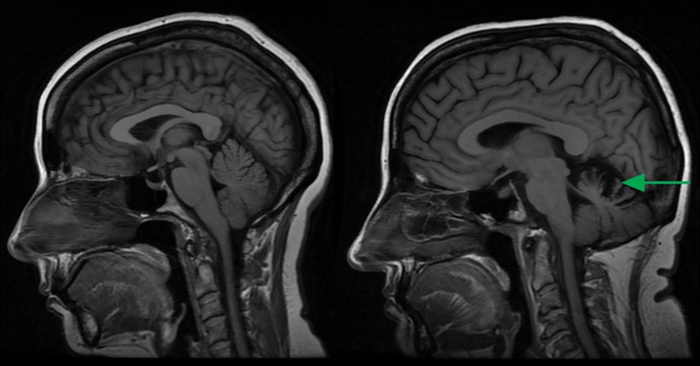
Patient with spinocerebellar ataxia

Credit: UC San Diego Health Sciences

Spinocerebellar ataxias are a group of neurodegenerative diseases characterized by the degeneration of Purkinje cells, a major class of neurons in the cerebellum. The resulting cerebellar dysfunction leads patients to experience a loss of motor coordination and control.

One subtype of the disease, spinocerebellar ataxia type 14 (SCA14), was found to be caused by mutations in protein kinase C-gamma (PKCγ), an enzyme that regulates other proteins in Purkinje cells. But exactly how these mutations alter the enzyme’s function to ultimately drive neurodegeneration remained unknown.

In a new study, published September 27, 2022 in Cell Signaling, researchers at University of California San Diego School of Medicine found that SCA14-associated mutations disrupt the autoinhibition and degradation of PKCγ, leading to elevated levels of enzyme activity. This sustained “leaky” activity alters the Purkinje cell phosphoproteome to drive cerebellar pathology.

“Our findings reveal important mechanisms underlying spinocerebellar ataxia and position PKCγ as a promising therapeutic target for this neurodegenerative disease,” said senior author Alexandra C. Newton, PhD, Distinguished Professor of Pharmacology at UC San Diego School of Medicine. 

To understand how the SCA14-associated mutations affect the enzyme’s function, researchers first measured activity levels of different PKCγ variants in cultured cells. Compared to more common PKCγ variants, those with SCA14 mutations in the protein’s C1A and C1B domains showed significantly enhanced enzymatic activity, which further experiments confirmed was due to conformational changes that impair the enzyme’s autoinhibition and degradation. 

Autoinhibition is an on-site regulatory mechanism in which certain domains within a molecule’s structure act to repress its own function.

Researchers then found the enhanced PKCγ activity led to a cascade of downstream changes to the phosphorylation state of the cellular environment, particularly dysregulating signaling pathways involved in axon development and cytoskeletal structure. 

The extent of disrupted PKCγ autoinhibition correlated with disease severity, and mutations that induced a particularly high level of PKCγ activity were also associated with an earlier age of disease onset. 

PKCγ is itself regulated by intracellular calcium, and many other types of spinocerebellar ataxia are driven by mutations that affect calcium homeostasis. Thus, the authors suggest that targeting PKCγ may correct this broader signaling pathway and prove effective in treating multiple forms of the disease. 

“This raises exciting possibilities for therapeutically targeting PKCγ not only in SCA14 but also in many other subtypes of spinocerebellar ataxia,” Newton said.

Co-authors of the study include: Caila A. Pilo, Timothy R. Baffi, Alexandr P. Kornev, Maya T. Kunkel, Mario Malfavon, Leigh-Ana Rossitto, David J. Gonzalez and Susan S. Taylor at UC San Diego; Dong-Hui Chen, Daniel X. Chen and Wendy H. Raskind at University of Washington; Liang-Chin Huang and Natarajan Kannan at University of Georgia; and Cheryl Longman and George Gorrie at Queen Elizabeth University Hospital.

# # # 


DOI

10.1126/scisignal.abk1147

Share12Tweet8Share2ShareShareShare2

Related Posts

GWAS Uncovers SUBER GENE1 Role in Suberization — Biology

GWAS Uncovers SUBER GENE1 Role in Suberization

May 5, 2026
New Study from The Morton Arboretum Reveals Why Mexico and Central America’s Mountain Forests Are Oak Tree Hotspots — Biology

New Study from The Morton Arboretum Reveals Why Mexico and Central America’s Mountain Forests Are Oak Tree Hotspots

May 5, 2026

Gerald Joyce Elected to Prestigious American Philosophical Society

May 5, 2026

Author Correction: Lipopeptide Immunity Linked to Membrane Remodelling

May 4, 2026

POPULAR NEWS

  • Research Indicates Potential Connection Between Prenatal Medication Exposure and Elevated Autism Risk

    834 shares
    Share 334 Tweet 209
  • New Study Reveals Plants Can Detect the Sound of Rain

    719 shares
    Share 287 Tweet 180
  • Scientists Investigate Possible Connection Between COVID-19 and Increased Lung Cancer Risk

    67 shares
    Share 27 Tweet 17
  • Salmonella Haem Blocks Macrophages, Boosts Infection

    61 shares
    Share 24 Tweet 15

About

We bring you the latest biotechnology news from best research centers and universities around the world. Check our website.

Follow us

Recent News

Brain Health Alert: Microplastic Accumulation in the Human Brain Linked to Stroke and Dementia; Apheresis Emerges as a Promising Removal Method

New Alcohol Warning Labels Could Encourage Reduced Consumption: Study Finds

Here’s a rewritten version of the headline for a science magazine post: “A Simple Model Explaining How AI Learns” Or, if you want it a bit more engaging: “Understanding AI Learning Through a Toy Model” Let me know if you want it shorter, more technical, or more casual!

Subscribe to Blog via Email

Enter your email address to subscribe to this blog and receive notifications of new posts by email.

Join 82 other subscribers
  • Contact Us

Bioengineer.org © Copyright 2023 All Rights Reserved.

Welcome Back!

Login to your account below

Forgotten Password?

Retrieve your password

Please enter your username or email address to reset your password.

Log In
No Result
View All Result
  • Homepages
    • Home Page 1
    • Home Page 2
  • News
  • National
  • Business
  • Health
  • Lifestyle
  • Science

Bioengineer.org © Copyright 2023 All Rights Reserved.