• HOME
  • NEWS
  • EXPLORE
    • CAREER
      • Companies
      • Jobs
    • EVENTS
    • iGEM
      • News
      • Team
    • PHOTOS
    • VIDEO
    • WIKI
  • BLOG
  • COMMUNITY
    • FACEBOOK
    • INSTAGRAM
    • TWITTER
Monday, July 13, 2026
BIOENGINEER.ORG
No Result
View All Result
  • Login
  • HOME
  • NEWS
  • EXPLORE
    • CAREER
      • Companies
      • Jobs
        • Lecturer
        • PhD Studentship
        • Postdoc
        • Research Assistant
    • EVENTS
    • iGEM
      • News
      • Team
    • PHOTOS
    • VIDEO
    • WIKI
  • BLOG
  • COMMUNITY
    • FACEBOOK
    • INSTAGRAM
    • TWITTER
  • HOME
  • NEWS
  • EXPLORE
    • CAREER
      • Companies
      • Jobs
        • Lecturer
        • PhD Studentship
        • Postdoc
        • Research Assistant
    • EVENTS
    • iGEM
      • News
      • Team
    • PHOTOS
    • VIDEO
    • WIKI
  • BLOG
  • COMMUNITY
    • FACEBOOK
    • INSTAGRAM
    • TWITTER
No Result
View All Result
Bioengineer.org
No Result
View All Result
Home NEWS Science News Chemistry

Laser light makes a comeback (literally)

Bioengineer by Bioengineer
May 4, 2021
in Chemistry
Reading Time: 3 mins read
0
IMAGE
Share on FacebookShare on TwitterShare on LinkedinShare on RedditShare on Telegram

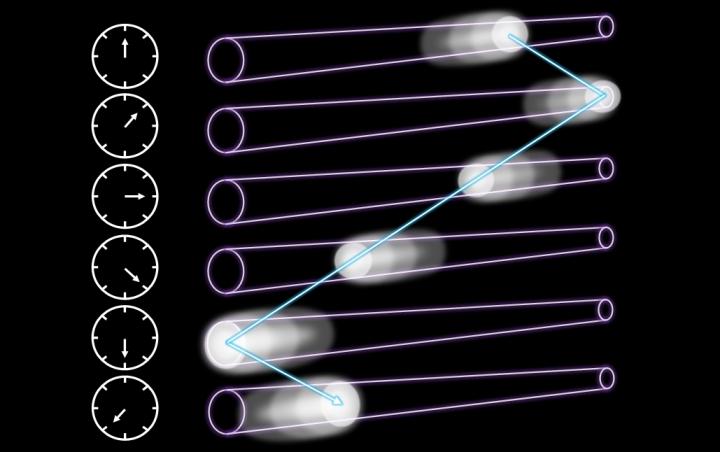
Researchers from Osaka University discover phenomenon of reciprocating propagation of laser pulse intensity in free space
IMAGE

Credit: Osaka University

Osaka, Japan –Straight-line constant-speed propagation in free space is a basic characteristic of light. In a recent study published in Communications Physics, researchers from Osaka University discovered the phenomenon of reciprocating propagation of laser pulse intensity in free space.

Spatiotemporal couplings have been recently used to produce light with tunable group-velocity, direction, and trajectory in free space. For example, the flying focus (a moving laser pulse intensity in the extended Rayleigh length), where longitudinal chromatism and temporal chirp are combined to control the spectrum-dependent focus-separation in space and spectrum-dependent pulse-location in time, respectively, has arbitrarily tunable propagating group-velocity and direction in space and time.

However, in the previous result, the flying focus can only propagate along a certain direction either forward or backward, although the propagating group-velocity can be freely controlled.

In this study, by dramatically increasing the Rayleigh length in space and the temporal chirp in time, the newly created flying focus propagates along a reciprocating straight-line trajectory in free space. A clear reciprocating flying focus with a high spatial resolution is also possible by further increasing the temporal chirp.

“The newly created flying focus propagates along the longitudinal axis first forward, then backward, and lastly forward again, showing a reciprocating straight-line trajectory in space and time. The forward-propagating velocity is the light speed in the vacuum, while the backward-propagating velocity is subluminal,” explains corresponding author Zhaoyang Li.

This intriguing phenomenon changes the traditional understanding of light propagation and may be applied in both fundamental and applied physics.

“For example, in our radiation pressure simulation, it can produce an on-axis reciprocating trapping or pushing force for a small or big sphere, respectively, in the Rayleigh scattering regime,” says Zhaoyang Li.

###

The article, “Reciprocating propagation of laser pulse intensity in free space,” was published in Communications Physics at DOI: https://doi.org/10.1038/s42005-021-00590-8

About Osaka University

Osaka University was founded in 1931 as one of the seven imperial universities of Japan and is now one of Japan’s leading comprehensive universities with a broad disciplinary spectrum. This strength is coupled with a singular drive for innovation that extends throughout the scientific process, from fundamental research to the creation of applied technology with positive economic impacts. Its commitment to innovation has been recognized in Japan and around the world, being named Japan’s most innovative university in 2015 (Reuters 2015 Top 100) and one of the most innovative institutions in the world in 2017 (Innovative Universities and the Nature Index Innovation 2017). Now, Osaka University is leveraging its role as a Designated National University Corporation selected by the Ministry of Education, Culture, Sports, Science and Technology to contribute to innovation for human welfare, sustainable development of society, and social transformation.

Website: https://resou.osaka-u.ac.jp/en

Media Contact
Saori Obayashi
[email protected]

Related Journal Article

http://dx.doi.org/10.1038/s42005-021-00590-8

Tags: Chemistry/Physics/Materials SciencesOptics
Share12Tweet8Share2ShareShareShare2

Related Posts

Melting Icebergs Threaten Stability of Distant Ocean Current System

Melting Icebergs Threaten Stability of Distant Ocean Current System

July 13, 2026
New Method Transforms Oxetane Rings into Azetidines in Molecular Structures

New Method Transforms Oxetane Rings into Azetidines in Molecular Structures

July 13, 2026

Terahertz Spectroscopy Reveals Vacancy Oscillations in Amorphous Oxide Films

July 13, 2026

Artificial Intelligence Transforms Chemical Engineering from Design to Manufacturing

July 13, 2026
Please login to join discussion

POPULAR NEWS

  • Detection of EDCs in Breast Milk and Infant Urine Up to Six Months Highlights Early Exposure Risks

    77 shares
    Share 31 Tweet 19
  • New Drug Candidate Developed at McMaster Shows Potential for Treating Brain Cancer

    58 shares
    Share 23 Tweet 15
  • KTU Researchers Explore Ultrasound’s Role in Enhancing Blood Flow Beyond Diagnostics

    53 shares
    Share 21 Tweet 13
  • Experimental Therapy Simultaneously Destroys Prostate Tumor Cells and Reactivates Antitumor Immunity

    46 shares
    Share 18 Tweet 12

About

BIOENGINEER.ORG

We bring you the latest biotechnology news from best research centers and universities around the world. Check our website.

Follow us

Recent News

SUNY Optometry Boosts Research with Two Leading Vision Scientists’ Arrival

Melting Icebergs Threaten Stability of Distant Ocean Current System

New Guidelines Released for Prolactinoma Treatment by Chinese Neurosurgical Journal

Subscribe to Blog via Email

Enter your email address to subscribe to this blog and receive notifications of new posts by email.

Join 85 other subscribers
  • Contact Us

Bioengineer.org © Copyright 2023 All Rights Reserved.

Welcome Back!

Login to your account below

Forgotten Password?

Retrieve your password

Please enter your username or email address to reset your password.

Log In
No Result
View All Result
  • Homepages
    • Home Page 1
    • Home Page 2
  • News
  • National
  • Business
  • Health
  • Lifestyle
  • Science

Bioengineer.org © Copyright 2023 All Rights Reserved.