In an in-vitro dental biomechanics investigation evaluating post-space conditioning strategies, surface pretreatment using an erbium, chromium:yttrium-scandium-gallium-garnet laser or a two-point-five percent chitosan biopolymer solution significantly enhanced the push-out bond strength of fiber posts cemented with self-adhesive resin cement compared to conventional saline irrigation. Published in Head and Face Medicine, the laboratory study conducted by researchers at Alexandria University demonstrated that conditioning radicular dentin prior to luting fiber posts directly governs interfacial retention and micromechanical stability. The research team evaluated forty-five extracted human single-rooted mandibular second premolars across five experimental surface conditioning regimens, tracking both mechanical dislodgement resistance and morphological dentin alterations. Both the erbium laser system and the natural chitosan chelator achieved the highest bond strength values recorded in the investigation, showing statistically equivalent performance while outperforming diode laser irradiation, apple vinegar rinses, and untreated control specimens.
Restoration of endodontically treated teeth presenting substantial coronal tissue loss frequently depends upon intraradicular fiber posts to anchor core foundations, yet post dislodgement at the root dentin-cement interface represents the most common failure mode observed in clinical practice. The adhesive connection between radicular dentin walls and self-adhesive resin luting agents constitutes the weakest link across the entire intracanal restorative assembly. During post-space preparation, rotary mechanical cutting instruments generate a thick, amorphous smear layer containing fragmented mineral crystals, denatured collagen fibrils, residual gutta-percha, sealer fragments, and potential microbiological contaminants. This compacted debris adheres tenaciously to the canal walls, occluding dentinal tubule apertures and preventing direct contact between resin monomers and intact dentin. Because self-adhesive resin cements rely upon acidic functional monomers to achieve chemical bonding with underlying hydroxyapatite, an uncleared smear layer acts as a physical and chemical barrier that severely restricts monomer diffusion, prevents mechanical tag formation, and compromises bond longevity.
Traditional endodontic cleansing protocols rely heavily on sequential irrigation with sodium hypochlorite solutions alongside ethylenediaminetetraacetic acid to dissolve organic tissue and solubilize mineral components. However, chemical irrigants introduce distinct drawbacks that complicate subsequent adhesive bonding within the confined space of root canals. Sodium hypochlorite breaks down into residual oxygen and chloramine-derived free radicals that persist on dentinal substrates, inhibiting free-radical polymerization of adhesive resin systems and leaving poorly cured interfacial layers. Concurrently, synthetic ethylenediaminetetraacetic acid chelators cause progressive peritubular and intertubular dentin erosion when contact times are prolonged, and the substance exhibits cytotoxic properties when extruded past the apical constriction. Furthermore, synthetic chelators form exceptionally stable, non-biodegradable organometallic complexes that persist in aquatic environments as environmental pollutants. These cumulative chemical limitations, paired with conflicting clinical literature regarding whether synthetic chelators reliably enhance intraradicular push-out bond strength, have driven dental researchers to explore biocompatible natural chelating agents and laser energy modalities as viable conditioning alternatives.
Among potential natural alternatives, chitosan stands out as a biodegradable, non-toxic biopolymer derived from the alkaline deacetylation of natural chitin found in crustacean shells. Composed of linear chains of beta-linked N-acetylglucosamine and glucosamine subunits, chitosan exhibits abundant protonated amino and hydroxyl reactive groups under mild acidic conditions. These functional groups interact selectively with negatively charged root dentin surfaces, chelating divalent calcium ions to facilitate gradual smear layer clearance without triggering unrestrained structural demineralization. Beyond its cleansing capability, chitosan stabilizes dentinal collagen matrices through bio-modification and fibrillar cross-linking, preventing proteolytic breakdown mediated by matrix metalloproteinases and preserving interfacial integrity against hydrolytic degradation. Concurrently, natural apple fruit vinegar has surfaced as an accessible, cost-effective organic irrigant characterized by natural acetic and malic acid constituents. Prior endodontic reports demonstrated that apple vinegar solutions possess bactericidal activity against persistent root canal pathogens like Enterococcus faecalis while promoting canal wall debridement, prompting interest in evaluating its direct role as a post-space surface conditioner.
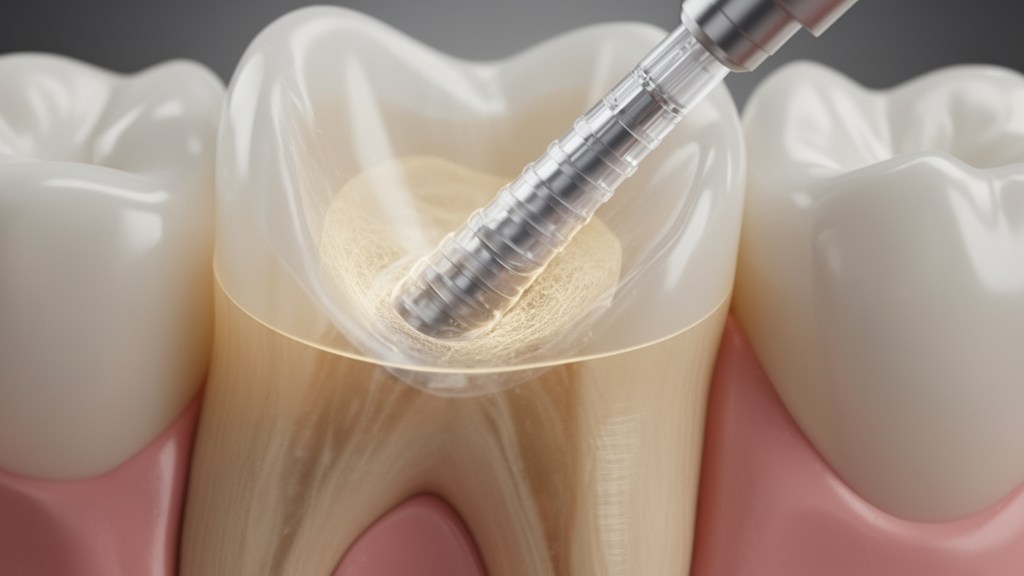
In tandem with biochemical irrigants, therapeutic dental lasers offer non-contact, energy-mediated conditioning mechanisms that physically alter hard tissue substrates within narrow root spaces. The erbium, chromium:yttrium-scandium-gallium-garnet laser operates at a wavelength of two thousand seven hundred eighty nanometers, coinciding with intense absorption peaks for water molecules and hydroxyapatite. When directed onto moist dentin, optical energy absorption instantly vaporizes subsurface water, generating explosive thermomechanical micro-explosions that ablate smear debris cleanly without melting sound substrate. This water-mediated photomechanical ablation leaves a clean, micro-roughened surface with open, unobstructed dentinal tubules and intact intertubular collagen scaffolding. Conversely, semiconductor diode lasers operating in the near-infrared spectrum at nine hundred seventy nanometers emit energy poorly absorbed by water and hydroxyapatite, relying instead on absorption by pigmented chromophores. Diode laser delivery generates thermal surface alterations and localized heating that can reduce bacterial contamination and soften smear deposits, but carries the potential risk of superficial carbonization, melting, or micro-cracking if thermal accumulation is unmanaged.
To rigorously compare these disparate surface conditioning modalities under uniform experimental conditions, the Alexandria University research team gathered forty-five freshly extracted human mandibular second premolars exhibiting mature, closed apices and single straight canals. Teeth presenting caries, root micro-fractures, prior endodontic manipulation, resorption, severe curvature, or calcification were excluded using visual loupe inspection and preoperative periapical radiographs. External root deposits were scaled ultrasonically before specimens were stored in thymol and physiological saline solutions. All roots were dimensionally verified using digital calipers, ensuring cross-sectional dimensions of seven millimeters buccolingually and six millimeters mesiodistally at the cervical margin, with fifteen millimeters of uniform root length established by decoronation at the cemento-enamel junction. Each root was instrumented using sequential nickel-titanium rotary files under copious five-point-two-five percent sodium hypochlorite irrigation, flushed with seventeen percent ethylenediaminetetraacetic acid for one minute, dried, and hermetically obturated via cold lateral condensation using epoxy-resin sealer and standardized gutta-percha cones.
Following one week of storage at full humidity to allow complete sealer setting, intraradicular post spaces were prepared to a standardized depth of eleven millimeters using calibrated drills, preserving a critical three-millimeter apical seal. Crucially, the investigators refrained from using intermediate common chemical flushes after post-space reaming, ensuring that subsequent cleansing observations were attributable solely to the assigned pretreatment protocols. The forty-five specimens were randomly partitioned into five groups of nine teeth each. The chitosan group received five milliliters of freshly prepared two-point-five percent chitosan dissolved in acetic acid for three minutes, followed by a distilled water rinse. The apple vinegar cohort was conditioned with five milliliters of commercial five percent apple vinegar for three minutes before water rinsing. The erbium laser group underwent non-contact helical irradiation for twenty seconds utilizing an RFT2-25 radial firing tip operating at one-point-five watts, twenty hertz, and an energy density of ninety-three point two-five joules per square centimeter under water spray. The diode laser cohort received twenty seconds of continuous-wave spiral irradiation at nine hundred seventy nanometers, delivering two hundred thirty-eight point eight-five joules per square centimeter. The control group received one minute of physiological saline irrigation.
After drying the post cavities with sterile absorbent paper points, translucent glass-fiber posts were decontaminated with alcohol, coated with auto-mixed RelyX U200 self-adhesive resin cement, and seated to full depth under standardized gentle finger pressure without prior silane priming. The specimens were light-polymerized from occlusal, buccal, and lingual directions using an LED curing unit delivering at least one thousand milliwatts per square centimeter. Following twenty-four hours of humid incubation, specimens were mounted in acrylic resin and sectioned perpendicular to the root axis into one-point-five millimeter slices representing cervical, middle, and apical levels. A universal testing machine drove a one-millimeter cylindrical plunger against the post core at one millimeter per minute until dislodgement occurred, recording failure loads to calculate megapascal values.
Two-way analysis of variance revealed that the choice of surface conditioning protocol exerted a statistically significant influence on push-out bond strength (F equals twenty-five point three-seven, p less than zero point zero zero one). The erbium laser group achieved the highest mean bond strength at thirteen point four-five megapascals, closely matched by the chitosan group at thirteen point one-one megapascals, with no significant difference between these two top-performing conditioning strategies. The diode laser cohort produced an intermediate bond strength of eleven point two-eight megapascals, which did not differ significantly from chitosan or apple vinegar. Meanwhile, the five percent apple vinegar group achieved nine point nine-nine megapascals, showing significantly lower adhesion than the erbium laser but outperforming untreated controls. Every active experimental conditioning protocol delivered significantly higher push-out retention than the saline-irrigated control group, which registered a modest four point six-seven megapascals.
Evaluating root canal levels revealed that while the coronal third exhibited numerically higher bond strength values at eleven point seven-zero megapascals, differences among coronal, middle, and apical thirds were not statistically significant (p equals zero point zero six). The interaction between surface treatment and root canal third was likewise non-significant. Stereomicroscopic failure analysis showed a pronounced divergence in debonding mechanisms across groups. Mixed failure was the predominant pattern in the chitosan group at eighty-eight point nine percent and the erbium laser group at eighty-one point five percent, confirming robust interfacial integration. In sharp contrast, adhesive failure at the cement-dentin junction dominated the untreated control group at eighty-five point two percent, with zero cohesive failures recorded in any group.
Scanning electron microscopy confirmed these mechanical patterns, demonstrating extensive smear layer clearance and open dentinal tubules in the erbium laser and chitosan cohorts, whereas diode laser and apple vinegar showed partial tubule opening and controls remained obstructed. While these controlled in-vitro findings cannot fully simulate intraoral thermomechanical fatigue, they establish erbium laser conditioning and natural chitosan irrigation as potent, biocompatible post-space conditioning strategies.
Subject of Research: Post-space dentin pretreatment modalities and fiber post push-out bond strength
Article Title: Impact of laser-assisted and different pre-treatment modalities on dentin surface interface and bond strength of fiber posts (In-vitro study)
Article References: AboElhassan, R. G., & Eltaweel, A. M. (2026). Impact of laser-assisted and different pre-treatment modalities on dentin surface interface and bond strength of fiber posts (In-vitro study). Head & Face Medicine, 22(1), Article 58. https://doi.org/10.1186/s13005-026-00632-y
Image Credits: AI Generated
DOI: 10.1186/s13005-026-00632-y
Keywords: dental biomechanics, fiber posts, root dentin, push-out bond strength, Er,Cr:YSGG laser, diode laser, chitosan, apple vinegar, smear layer removal, self-adhesive resin cement, scanning electron microscopy, failure mode analysis, endodontic restoration, dentinal tubules, mandibular premolars, interfacial adhesion
News Source: Ophelia Keating. (November 19, 2026). Laser Conditioning and Chitosan Boost Root Dentin Fiber Post Bonding Strength. Scienmag.