A single cough, a deep breath, or a shift in posture can be enough to push blood, debris, and tissue backward into the ultra-fine catheters that doctors use to deliver drugs into some of the body’s most delicate targets. When therapies must reach the brain, the retina, or the inner ear, physicians depend on flexible tubes narrower than three human hairs, and at these sub-millimeter scales the body’s ordinary pressure fluctuations become a serious hazard: reverse flow can suddenly block the channel, contaminate the drug reservoir, and cut off treatment without warning. A team at Shanghai Jiao Tong University and Beijing Institute of Technology now reports a way to make these fragile conduits defend themselves, by carving tiny self-regulating one-way valves directly into the catheter tip.
Writing in the International Journal of Extreme Manufacturing, Prof. Zhuo-Chen Ma, Prof. Bing Han and their co-workers describe three-dimensional Tesla microvalves inscribed inside 100-micrometer channels using ultrashort femtosecond laser pulses. The valves are entirely passive: they regulate flow through geometry alone, with no moving flaps, batteries, or electronic sensors. In the team’s measurements, the architecture suppressed reverse pressure surges by 73.5 percent during flow initiation and by 82.0 percent during flow shutdown, moments when the risk of backflow is greatest.
Stopping reverse flow in artificial micro-conduits has long been a stubborn physics and engineering problem. Human veins solve it with flexible leaflets that flap shut against backflow, but artificial moving parts built at the scale of a single cell quickly jam, suffer material fatigue, and fail. Traditional passive valves that rely on looping channels to resist reverse motion also break down inside ultra-thin tubes, because at microscopic dimensions liquids move in a low-speed regime where they behave less like rushing water and more like thick syrup, creeping symmetrically through channels without generating the turbulence needed to block reverse motion.
Manufacturing such structures inside slender, flexible tubing posed an equally difficult barrier. Fragile tubes bend and sag under the microscope, causing 3D-printing lasers to miss their focal mark, cure the resin unevenly, and produce structures that detach under pressure. The team overcame this by pairing an optical alignment algorithm with an energy-dissipating micro-architecture. Their Concentric Diffraction Ring-based Axial Alignment Algorithm reads the circular, target-like diffraction patterns naturally reflected through the catheter’s cylindrical tip, pinpointing the tube’s three-dimensional tilt and instantly recalculating the laser toolpath to match it. A high-precision femtosecond laser then solidifies liquid resin directly into complex 3D valves along the curved inner wall, achieving alignment accuracy within one degree and a 90 percent fabrication success rate.
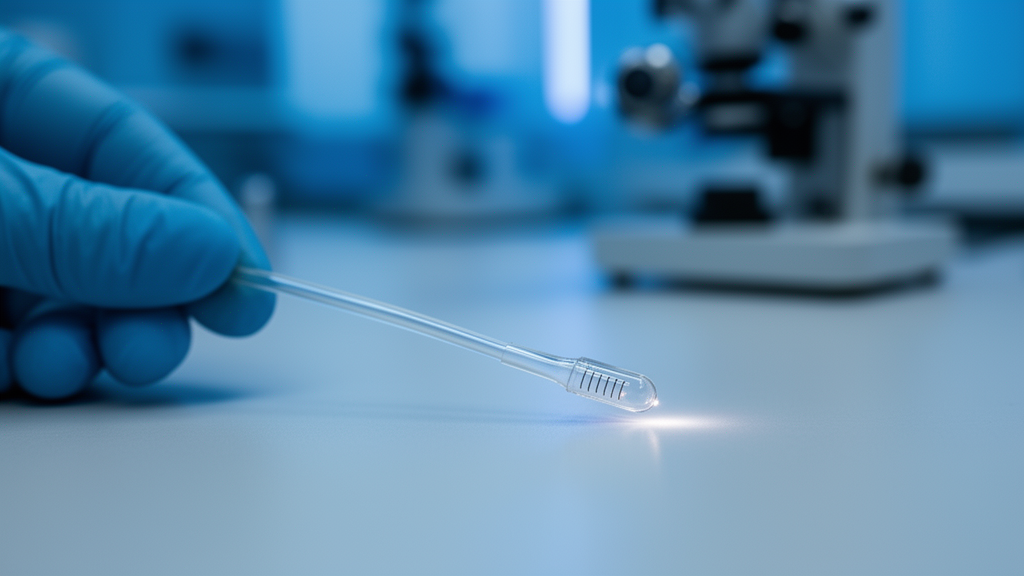
The finished microvalve works as a passive liquid brake. When medication flows forward, it cruises smoothly down a central lane with minimal resistance. When bodily pressure tries to force fluid backward, the valve’s 45-degree channels split the reverse stream and steer it into tight loops that crash head-on into the incoming reverse flow, generating localized fluid whirlpools that choke off the channel. The result is up to 2.2 times higher resistance to reverse flow than to forward motion, all achieved without any actuation or control electronics.
The valve also doubles as a physical gatekeeper against biological contamination. In five-day laboratory trials with proliferating human HepG2 cells, standard open catheters clogged completely as dense tissue grew into the opening. Catheters bearing the laser-carved microvalves remained completely clear, with cell growth restricted strictly to the outer shell. Even under five minutes of direct backward suction in fluid thick with cellular debris, the valve-protected channels stayed clear while conventional open needles choked instantly.
According to the researchers, the on-tip laser integration method offers a direct blueprint for building smart, self-regulating microfluidics into ultra-thin medical devices without complex mechanical assembly. Because the valve itself requires no external actuation, power cables, or delicate mechanical flaps, the design eliminates some of the most common failure points in chronic drug delivery systems.
The work remains at the laboratory stage, and the authors outline what must happen before clinical adoption. Future research will assess how the printed polymer withstands prolonged pressure pulsing in living tissue, evaluate long-term chemical durability in biological fluids, and validate anti-fouling performance against brain-specific neuronal and glial cells in animal models. Until those steps are completed, the technology’s performance in the human body remains untested.
Even so, the demonstration addresses a problem that has limited microcatheter-based therapy for years: at scales where fluid behaves like syrup and any moving part is too fragile to survive, geometry may be the only reliable control mechanism. By turning the catheter tip itself into a one-way street carved by light, the Shanghai and Beijing team has shown that the smallest components of a drug delivery system can be made to police their own flow, passively and continuously, using nothing more than the shape of the channel and the physics of the fluid moving through it.
Subject of Research: Femtosecond laser-fabricated 3D Tesla microvalves integrated into microcatheter tips for passive backflow suppression in drug delivery
Article Title: Tiny laser-carved "one-way streets" protect fragile brain catheters from backflow
Article References: Tiny laser-carved "one-way streets" protect fragile brain catheters from backflow. Original publication (Bibliographic details unavailable.)
Image Credits: AI Generated
DOI: Not provided
Keywords: microcatheter, Tesla microvalve, femtosecond laser, backflow, drug delivery, microfluidics, liquid diode, 3D printing, Shanghai Jiao Tong University, anti-fouling, passive valve, International Journal of Extreme Manufacturing
News Source: Cassandra Pierce. (October 27, 2026). Laser-carved microvalves turn brain catheters into one-way streets against backflow. Scienmag.