Knotted Chemistry From the Soil: Lariocidin, the Lasso Peptide That Could Outflank the Superbugs
In the quiet chemistry of the world’s soils, a bacterium called Paenibacillus sp. M2 has been manufacturing one of the most structurally cunning antibiotic molecules scientists have encountered in decades. The compound, named lariocidin, belongs to a family of peptides that literally tie themselves into knots: each molecule threads its own tail through a closed loop to form a molecular lasso that destructive enzymes and harsh conditions cannot easily undo. A review published in The Journal of Antibiotics on 24 August 2026 now argues that lariocidin — and the wider class of ribosome-targeting lasso peptides it represents — deserves a central place in the search for new drugs against multidrug-resistant bacteria. Its most tantalizing feature is not simply potency, the authors contend, but a mode of attack on the bacterial ribosome that occupies a binding site no major antibiotic in clinical use has claimed. If the evidence holds, lariocidin could become the template for an entirely new generation of peptide antibiotics engineered directly from microbial genomes.
The urgency behind that claim is hard to overstate. Antimicrobial resistance is now linked to millions of deaths worldwide each year, and the World Health Organization has placed carbapenem-resistant Acinetobacter baumannii at the top of its list of critical priority pathogens — a Gram-negative bacterium notorious for shrugging off nearly every drug clinicians can deploy against it. The deeper problem is architectural: most antibiotics introduced over the past half-century are chemical variations on a handful of molecular scaffolds, so bacteria that acquire resistance to one member of a family frequently resist its relatives as well. Because established drugs converge on the same targets and the same binding sites, a single resistance mechanism — an altered ribosomal protein, a methylated RNA residue, an overactive efflux pump — can neutralize entire classes at once. New chemical classes that hit old targets in genuinely new ways are therefore among the most valuable commodities in infectious-disease research, and lasso peptides, the review argues, may be exactly that.
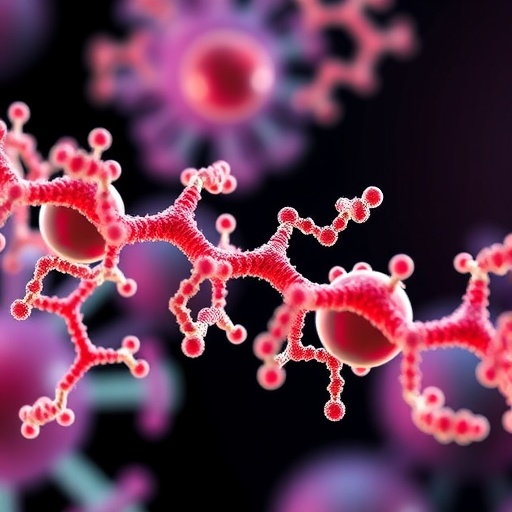
Lasso peptides belong to the ribosomally synthesized and post-translationally modified peptides, or RiPPs — a vast family of natural products in which the starting material is made by the ribosome as a linear precursor and then sculpted by dedicated enzymes into something far more elaborate. In lasso peptides, that sculpting produces a mechanical marvel: the N-terminal segment of the chain is stitched into a closed ring through which the C-terminal tail is threaded and then trapped, creating an interlocked lasso fold. The tail is typically cinched in place by bulky amino acids acting as plugs, and in many family members an additional cross-link prevents the tail from slipping back out. The result is a compact, rigid structure with unusual resilience; lasso peptides routinely survive proteases that would dismantle ordinary peptides, as well as temperatures and pH extremes that destroy most proteins. That mechanical constraint also confers pharmacological advantages: the molecule arrives at its target pre-folded, which sharpens binding selectivity and slows chemical degradation inside living systems.
Lariocidin, produced by Paenibacillus sp. M2, is a recently discovered member of this family with an ambition that sets it apart: it is a peptide antibiotic that goes after the ribosome, the molecular factory every bacterium needs to build its proteins. Ribosome-targeting is old territory for antibiotics — aminoglycosides, tetracyclines and macrolides all work there — but lariocidin arrives with a completely different chemical body and, crucially, a different docking address. The review’s authors situate LAR within the emerging subgroup of ribosome-targeting lasso peptides and argue that the class should be treated as a platform of microbial peptide antibiotic scaffolds for future discovery rather than a one-off curiosity. Their synthesis of the evidence gathered so far describes a compound with broad antibacterial activity, an unusual binding mode and a resistance profile that, in early testing at least, looks remarkably clean. If further work confirms that profile, the implications for drug discovery could be considerable.
To understand why that matters, it helps to picture the bacterial ribosome. In bacteria it is built from two subunits: the larger 50S subunit, which catalyzes the formation of peptide bonds, and the smaller 30S subunit, which reads the genetic message. The 30S subunit is organized around 16S ribosomal RNA, the molecular scaffold of the decoding center where messenger RNA codons are checked against the anticodons of incoming aminoacyl-tRNAs, the adaptor molecules that ferry amino acids into place. Classical inhibitors exploit this machinery in well-charted ways: aminoglycosides wedge into the decoding region of 16S rRNA and trick the ribosome into misreading the genetic code, while tetracyclines physically block aminoacyl-tRNA from entering its binding site. Lariocidin does neither. According to the review, it binds a distinct site within the 30S subunit, making contacts with both 16S rRNA and aminoacyl-tRNA — a binding mode that overlaps in function but not in geography with the established drugs. Because the docking site differs, resistance mechanisms tailored to aminoglycosides or tetracyclines do not automatically extinguish lariocidin’s activity.
Functionally, the peptide delivers a double blow. First, it inhibits translocation — the ratcheting step in which the ribosome, having linked one amino acid to the growing chain, must shift the entire messenger RNA and its paired transfer RNAs by exactly one codon to make room for the next. Jam that step and protein synthesis stalls. Second, lariocidin promotes miscoding, causing incorrect amino acids to be inserted into nascent proteins. A bacterium under lariocidin attack therefore faces a pincer movement: whatever proteins it manages to finish are increasingly likely to be garbled and nonfunctional, while the overall production line grinds toward a halt. This combination of translocation inhibition and miscoding, achieved through a binding site distinct from those used by aminoglycosides and tetracyclines, forms the mechanistic heart of the review’s argument and the primary reason the authors believe cross-resistance with established ribosome-targeting antibiotics may be reduced. In an era when resistance genes circulate freely between bacterial species, an unclaimed binding site is a strategic asset.
The preclinical evidence assembled in the review is, by the sober standards of early-stage antibiotic research, encouraging. Lariocidin displays broad antibacterial activity, including against multidrug-resistant pathogens such as Acinetobacter baumannii, one of the organisms for which new therapies are most desperately needed. In laboratory assays, spontaneous resistance arises at low frequency, a sign that the ribosomal binding site cannot be trivially mutated around. Safety signals from cell-based studies are similarly promising: mammalian cytotoxicity is limited, and the peptide causes minimal hemolysis, the rupture of red blood cells that serves as a standard early warning of membrane-damaging toxicity. Most significantly, the compound has shown efficacy in mouse infection models — a hurdle many antibiotic candidates never clear, because activity in a culture dish does not guarantee that a molecule will survive, reach its target and work inside a living host. Taken together, these findings sketch a compound that is simultaneously potent, selective and demonstrably active in vivo, a combination rare enough to turn heads.
Part of the excitement lies in what the lasso scaffold itself makes possible. Because RiPPs are genetically encoded, their sequences can be edited like software: individual amino acids in the ring or the threaded tail can be swapped to tune potency, spectrum or stability, while the knot-tying biosynthetic enzymes can be repurposed for the chemoenzymatic production of analogs that would be difficult to synthesize by chemistry alone. The same genetics that make lasso peptides engineerable also make them findable. Biosynthetic gene clusters for these molecules lie scattered across bacterial genomes and metagenomic datasets, meaning computational mining of sequence databases can point researchers toward previously hidden lasso peptides before anyone has cultured the producing organism. The review frames lariocidin as a flagship for this strategy — proof that searching the microbial pan-genome for ribosome-targeting lasso peptides can surface antibiotic scaffolds with properties that conventional small-molecule screening has struggled to deliver, and a starting point for engineering next-generation derivatives.
The authors are nonetheless explicit about how far the compound still has to travel. Lariocidin remains at an early developmental stage, and several fundamental questions are unresolved. Its pharmacokinetics and pharmacodynamics — how the molecule is absorbed, distributed, broken down and cleared, and how those behaviors translate into safe, effective dosing regimens — remain to be characterized. Formulation is untested at scale, and scalable production is a genuine obstacle for any RiPP, since fermentation yields, the efficiency of the knot-forming enzymes and downstream purification all require optimization before industrial manufacturing becomes realistic. Resistance surveillance will be essential as well: low spontaneous resistance in the laboratory does not guarantee that resistance will not emerge and spread under the intense selective pressure of clinical drug exposure. And like all early findings, the preclinical results await independent validation by research groups beyond the original discoverers. The review is careful to note that this body of work includes no clinical trial; the road from mouse models to medicine runs through years of further development.
Even with those caveats, the arrival of lariocidin marks a meaningful shift in emphasis for the field. For decades, antibiotic development has largely meant redecorating old scaffolds in a running battle to stay ahead of resistance. Lariocidin offers something different: a new chemical architecture — a self-knotting peptide — aimed at the oldest and most validated target in antibacterial therapy, the ribosome, through a binding site the existing armory does not touch. Whether it ultimately survives the gauntlet of pharmacokinetic testing, manufacturing scale-up and clinical trials remains an open question, and the review avoids promising a new medicine on pharmacy shelves. What it does argue is that genome mining, RiPP bioengineering and ribosome structural biology have matured into a discovery engine capable of surfacing candidates that the classical pipeline overlooked. If that engine keeps running, the knotted molecules hiding in the world’s soil may yet supply the next chapter in humanity’s fight against the superbugs.
Subject of Research: Lariocidin, a ribosome-targeting lasso peptide antibiotic produced by Paenibacillus sp. M2, and the potential of ribosome-targeting lasso peptides as antimicrobial scaffolds against multidrug-resistant bacteria.
Subject of Research: Medicine
Article Title: Lariocidin and ribosome-targeting lasso peptides as emerging antimicrobial agents against multidrug-resistant bacteria
Article References: Mahdy, A., Alam-ElDein, K. M., Amin, I., Mohamed, H. H., Abuelhaded, K., Hamdy, M., Elhemiely, A., El-zahraa R.Saleh, F., Ibrahim, A. K., Gadelmawla, M. H. A., Elkhawanky, M., Abdelkhalek, A., & Faraag, A. H. I. (2026). “Lariocidin and ribosome-targeting lasso peptides as emerging antimicrobial agents against multidrug-resistant bacteria”. The Journal of Antibiotics. https://doi.org/10.1038/s41429-026-00954-8
Image Credits: AI Generated
DOI: 10.1038/s41429-026-00954-8
Keywords: lariocidin, lasso peptides, RiPPs, antimicrobial resistance, ribosome-targeting antibiotics, 30S ribosomal subunit, 16S rRNA, Acinetobacter baumannii, multidrug-resistant bacteria, translocation inhibition, miscoding, Paenibacillus
Cite Scienmag News
APA MLA Chicago
Arden W. (August 29, 2026). Lariocidin and lasso peptides emerge as potent weapons against drug-resistant bacteria. Scienmag. https://scienmag.com/lariocidin-and-lasso-peptides-emerge-as-potent-weapons-against-drug-resistant-bacteria/
Arden W. “Lariocidin and lasso peptides emerge as potent weapons against drug-resistant bacteria.” Scienmag, 29 August 2026, https://scienmag.com/lariocidin-and-lasso-peptides-emerge-as-potent-weapons-against-drug-resistant-bacteria/. Accessed 29 August 2026.
Arden W. “Lariocidin and lasso peptides emerge as potent weapons against drug-resistant bacteria.” Scienmag. August 29, 2026. https://scienmag.com/lariocidin-and-lasso-peptides-emerge-as-potent-weapons-against-drug-resistant-bacteria/
Copy citation Download RIS
Tags: Antibiotic resistanceAntimicrobial resistance crisis solutionsbacterial enzyme resistancedrug-resistant bacteria treatmentLariocidinLariocidin antibiotic potentialLasso peptide stability and durabilitylasso peptidesLasso peptides mechanism of actionmicrobial genome engineeringMicrobial genome-derived antibioticsmultidrug-resistant bacterianew drug developmentNew drug development for multidrug-resistant infectionsNovel antibiotics from soil microbesnovel antimicrobial agentspeptide antibioticsPeptide antibiotics against superbugsribosome-targeting antibioticsRibosome-targeting peptidesSoil bacteria as antibiotic sourcessoil-derived antibioticsstructural biology of lasso peptidesStructural features of lariocidin