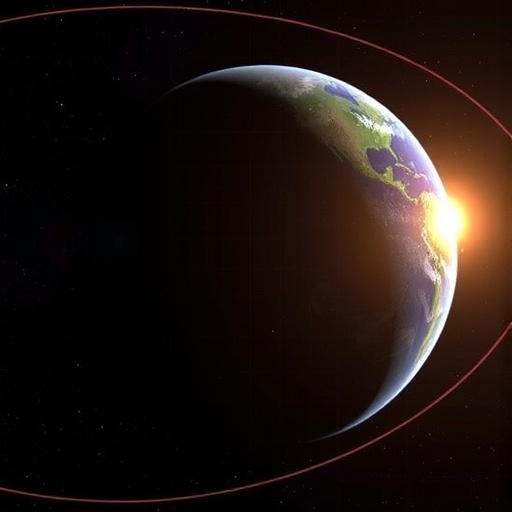
A recent breakthrough in the precise measurement of gravitational effects has been achieved using the Laser Relativity Satellite 2 (LARES-2), which marks a significant advance in testing Einstein’s general theory of relativity. This satellite, equipped with a highly optimized orbit, a remarkably low surface-to-mass ratio, and an exquisitely uniform distribution of retroreflectors, has allowed scientists to probe the frame-dragging phenomenon—the subtle warping and dragging of spacetime caused by the Earth’s rotation—with an unprecedented level of accuracy.
Frame-dragging, a prediction of general relativity, describes how a rotating mass influences the fabric of spacetime around it. Although this effect is incredibly small and challenging to detect, it plays a crucial role in understanding the dynamic behavior of gravitational fields near massive bodies. Previous tests within our Solar System managed to measure frame-dragging but with uncertainties that limited their precision.
By utilizing LARES-2 in conjunction with its predecessor, the LAGEOS satellite, and data from the GRACE spacecraft, researchers have refined these measurements to an impressive relative uncertainty of just one part in a thousand. This order-of-magnitude improvement stands as one of the most stringent confirmations of general relativity’s predictions in Earth’s vicinity.
The methodology hinges on laser-ranging techniques, where laser pulses are sent from Earth to satellites equipped with retroreflectors and then bounced back to ground stations with exquisite timing. Minute shifts in the satellites’ orbits induced by frame-dragging are detected and analyzed, disentangling these signals from other gravitational influences such as Earth’s irregular shape and gravitational field perturbations.
Importantly, the precision of these measurements also imposes strong constraints on alternative gravity theories. Models that extend Einstein’s framework, including certain scalar–tensor theories and proposals like Chern–Simons gravity, often predict deviations specifically in frame-dragging effects. The new LARES-2 data sharply limit the parameter spaces of such theories, reinforcing Einstein’s legacy.
Beyond purely fundamental physics, the combined data from LARES-2 and LAGEOS improve our understanding of Earth’s geophysical properties, particularly the characterization of lunisolar tidal effects. This cross-disciplinary benefit highlights how advances in relativistic satellite experiments contribute not only to cosmology but also to planetary science and geodesy.
The results showcase the power of combining cutting-edge satellite design and orbital mechanics with precision laser technology. With continuous improvements anticipated in Earth-based tracking systems and satellite instrumentation, future experiments stand poised to push further the boundaries of our gravitational knowledge.
In summary, LARES-2 establishes a new benchmark in testing general relativity, delivering a robust empirical vindication of frame-dragging while enhancing our grasp of Earth’s gravity field. This achievement exemplifies how innovative space missions continue to illuminate the subtleties of the cosmos in ways that ground-based studies cannot match.
Subject of Research: Measurement of frame-dragging effect in the Earth’s gravitational field using satellite laser-ranging.
Article Title: LARES-2 satellite measures frame-dragging effect around the Earth.
Article References:
Ciufolini, I., Paolozzi, A., Pavlis, E.C. et al. LARES-2 satellite measures frame-dragging effect around the Earth. Nature 655, 332–335 (2026). https://doi.org/10.1038/s41586-026-10715-0
Image Credits: AI Generated
DOI: 10.1038/s41586-026-10715-0 (09 July 2026)
Tags: Earth’s frame-draggingEarth’s rotation effectsframe-dragging confirmationgeneral relativity testingGRACE spacecraft datagravitational field measurementLARES-2 satellitelaser-ranging techniqueslow surface-to-mass ratio satellitesprecise gravitational effect detectionsatellite-based gravity experimentsspacetime curvature