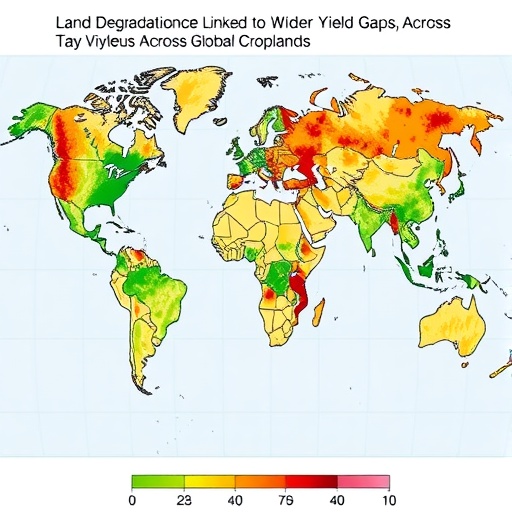
Land degradation may be doing more than shrinking ecosystems—it could also be quietly widening the distance between what crops could produce and what they actually do. In a new analysis published in Nature Food, researchers report that degraded land is linked to larger yield gaps across croplands worldwide, suggesting that soil and land quality losses are turning into measurable agricultural underperformance.
The team combined satellite-informed land-cover and soil-related indicators with crop yield datasets to estimate how far farmers’ outcomes fall below attainable production under prevailing conditions. By comparing patterns across many regions and crop types, they were able to test whether land degradation correlates with consistently larger shortfalls rather than isolated, local effects.
A key result is that the relationship persists at global scale: where land degradation is stronger—through processes such as nutrient depletion, erosion, or declining vegetation vigor—yield gaps tend to expand. This implies that land degradation can reduce both the effective productivity of fields and the resilience of crops to stressors, including dry spells and heat extremes.
Importantly, the findings frame yield gaps not only as an issue of management or inputs, but also as an environmental constraint embedded in the landscape. When soils lose structure and fertility, plant-available water and nutrients decline, forcing crops to run at lower physiological efficiency even if seed varieties and farming practices remain comparable.
The study also points to a feedback loop. As yields fall, farming systems often respond by extracting more from already stressed land—through shortened fallows, intensified cultivation, or reduced restorative inputs—potentially accelerating degradation and further enlarging the gap.
From a technical standpoint, the authors treat yield gaps as an outcome of interacting drivers: climate variability, land condition, and agricultural conditions. Their statistical modeling isolates the contribution of land degradation across a heterogeneous set of croplands, strengthening the case that soil-land degradation is a measurable lever on productivity.
The broader implication is urgent. If degraded landscapes are associated with systematically higher yield losses, interventions that rebuild soil health and protect land—such as erosion control, improved nutrient management, and restoration of vegetative cover—could narrow yield gaps while also strengthening long-term food security.
For policymakers, the work suggests that targeting land degradation is not just an environmental objective; it is also a productivity strategy. Turning “potential” into “realized” yields may depend as much on the health of the land as on improvements in agronomy.
Subject of Research: Land degradation and global crop yield gaps
Article Title: Land degradation is associated with larger crop yield gaps across global croplands.
Article References: Hadi, H., Ray, D.K., Borrelli, P. et al. Nature Food 7, 678–687 (2026). https://doi.org/10.1038/s43016-026-01382-5
Image Credits: AI Generated
DOI: 10.1038/s43016-026-01382-5
Keywords:
Tags: crop resilience to stresscrop yield gapsenvironmental constraints on agricultureglobal cropland productivityLand degradationland management and yieldmeasurable agricultural underperformancenutrient depletion effectssatellite land-cover analysissoil erosion impactsoil fertility declinesoil health and food security