


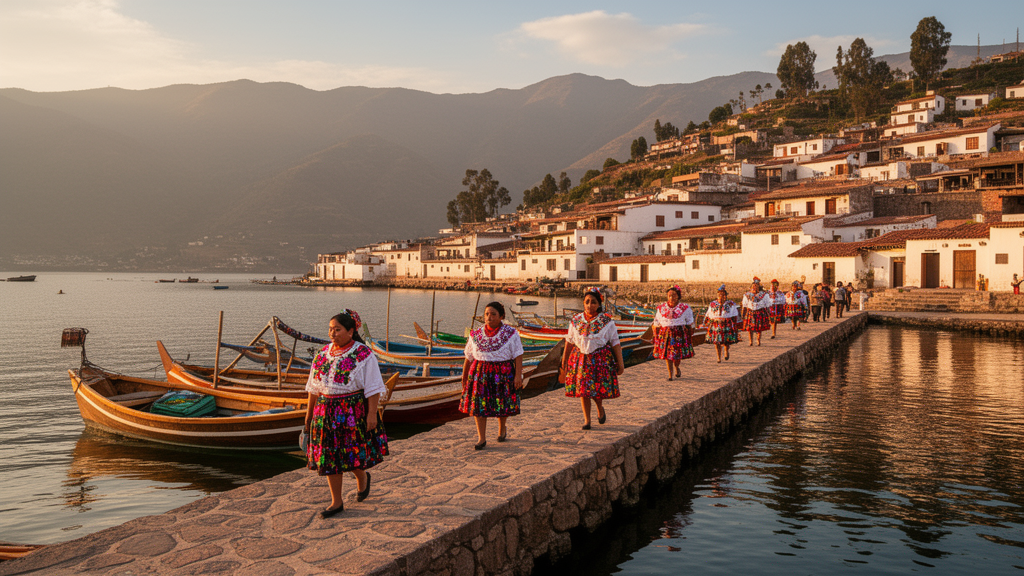
A new study of the Purépecha Lake region of Michoacán, Mexico, argues that heritage in rural indigenous territories functions not as a collection of monuments or tourist attractions but as a living, territorially embedded system sustained by everyday practices, community governance, and translocal networks. The research, published in the journal Built Heritage, introduces the concept of the “lacustrine heritopolis” as an analytical model for interpreting how cultural sustainability emerges in places where official heritage policies and community-driven practices coexist under markedly asymmetrical conditions.
The author, Gina Núñez-Camarena, developed the framework from doctoral research combining historical analysis, qualitative document analysis, and digital ethnography. Historical and archival sources traced the evolution of heritage and tourism policies in the lake region from the Cardenista period to the present, while document analysis examined institutional narratives associated with the Pueblos Mágicos programme, UNESCO-related initiatives, and state-led cultural promotion. A third strand of digital ethnography, with systematic observation spanning 2017 to 2022, focused on publicly accessible community radio websites, social media platforms including Facebook, YouTube, and Instagram, and digital broadcasts of cultural events and rituals, prioritising content produced by community actors over institutional sources.
The study’s central conceptual move is to extend the heritopolis idea, which has largely been grounded in metropolitan contexts where heritage assets, planning instruments, and formal governance converge, to a rural lacustrine setting. In the Purépecha Lake region, heritage does not coalesce around a single urban nucleus. Instead, it is distributed across lakeside communities such as Patzcuaro, Tzintzuntzan, Quiroga, Erongaricuaro, Janitzio, and Santa Fe de la Laguna, all organised historically around Lake Patzcuaro as the material and symbolic core of the regional system. The model foregrounds four dimensions: cultural landscapes integrating tangible and intangible heritage, community governance as constitutive of heritage sustainability, translocal and diasporic networks, and environmental interdependence between the lake and cultural practice.
Empirically, the analysis documents a dense web of community-based initiatives operating beyond municipal boundaries and site-based classifications. Artisanal production in textile, wood, and copper workshops serves not only tourism markets but also knowledge transmission and intergenerational learning; in Santa Fe de la Laguna, women-led textile collectives and cooperatives sustain cultural practices and local forms of organisation beyond commercial production. Contemporary initiatives in the region are largely led by women, particularly in language revitalisation, food traditions, crafts, and environmental care, which the study links to inclusive governance and to interpretative readings of Sustainable Development Goals 11 and 16.
Language itself emerges as both intangible heritage and social infrastructure. Recent examples include the expansion of the Universidad de las Lenguas Indígenas de México into communities such as Comachuén and Santa Fe de la Laguna under the Plan de Justicia Purépecha, alongside community-based linguistic initiatives connected to Purépecha New Year celebrations and local intercultural education programmes. Community-led projects involving rural schools, local teachers, and Purépecha youth transmit language and territorial knowledge through intercultural pedagogies, reinforcing cultural identity and intergenerational inclusion.
Environmental stewardship around Lake Patzcuaro illustrates the entanglement of culture and nature in the regional system. Drawing on ancestral lake management knowledge and symbolic understandings of the lake as a living entity, community-driven initiatives integrate ecological care into cultural practice, framing environmental restoration as a form of heritage governance. The study argues that such actions reinforce the inseparability of cultural and environmental sustainability in indigenous landscapes, where the lacustrine environment is simultaneously shaped by and shapes practices including artisanal fishing, ceremonial cycles, and everyday territorial interaction.
Migration extends this system well beyond the physical boundaries of the lake. The Purépecha diaspora in the United States maintains active cultural, economic, and symbolic ties with communities of origin through remittances, digital communication, and the re-enactment of rituals abroad. Rather than representing a rupture, the study interprets migration as an extension of the heritage system, producing cultural value through sustained social relations across borders. Community radio exemplifies this connective function: initiatives such as Radio Uekorhen, based in the Indigenous community of Huecorio and organised through Uekorheni A.C., broadcast in the Purépecha language, promote workshops and linguistic revitalisation, and link residents, regional educators, migrant academics, and Purépecha youth, while digital broadcasting allows the diaspora to remain engaged in community life.
Against this living heritage system, the study sets the institutional heritage regime. From the Cardenista period onwards, tourism policy promoted an idealised image of Mexican identity drawing on folklore and indigenous traditions, and in the twenty-first century programmes such as Pueblos Mágicos and UNESCO heritage designations became the principal institutional governance mechanisms in the region. While these initiatives have generated economic opportunities and symbolic recognition, the analysis finds they tend to concentrate heritage value within delimited historic centres and emblematic festivities, privileging visually codified urban spaces. Official cultural routes and heritage corridors, the research shows, prioritise linear and fragmented representations designed for tourism consumption, disconnecting cultural practices from their territorial contexts. This contrasts with earlier territorial representations, such as a 1987 arts and crafts map of the Lake Patzcuaro area, which visualised the region as an integrated cultural system structured by the lake.
The resulting asymmetry is the study’s key empirical finding: institutional recognition and community governance infrastructures coexist in the same territory, but the former relies on formal recognition, spatial delimitation, and tourism-oriented narratives, while the latter is sustained through everyday practices, collective organisation, and territorial relationships that remain largely invisible in official planning. Notably, the study does not measure sustainability through quantitative indicators. Sustainable Development Goals 11 and 16 are used strictly as interpretative lenses rather than benchmarks, and the author emphasises that findings are analytically transferable rather than statistically generalisable, offering an in-depth qualitative interpretation of selected practices and narratives rather than an exhaustive inventory or policy impact assessment.
The policy implications are correspondingly cautious but pointed. The study suggests that institutional visibility, international designations, and tourism branding do not automatically translate into cultural sustainability unless accompanied by mechanisms that redistribute decision-making power and support community-based management systems. Public institutions, it argues, could shift from acting as certifying authorities or tourism promoters towards recognising and strengthening community-driven heritage systems without subsuming them under standardised frameworks. The lacustrine heritopolis itself is offered as an analytical heuristic rather than a prescriptive planning model, a conceptual bridge intended to make visible the interactions, asymmetries, and negotiations between institutional heritage regimes and the living heritage systems that, according to this research, actually sustain cultural continuity and social cohesion in the region.
Subject of Research: A qualitative study proposing the lacustrine heritopolis model to interpret community-driven heritage governance and cultural sustainability in the Purépecha Lake region of Michoacán, Mexico.
Article Title: Resignifying heritage for sustainability: the lacustrine heritopolis of the Purépecha Lake region (Michoacán, Mexico)
Article References: Núñez-Camarena, G. (2026). Resignifying heritage for sustainability: the lacustrine heritopolis of the Purépecha Lake region (Michoacán, Mexico). Built Heritage, 10(1), Article 62. https://doi.org/10.1186/s43238-026-00302-7
Image Credits: AI Generated
DOI: 10.1186/s43238-026-00302-7
Keywords: Purépecha Lake region, Lake Patzcuaro, living heritage, cultural sustainability, heritage governance, lacustrine heritopolis, digital ethnography, Pueblos Mágicos, indigenous communities, translocal networks, community radio, Michoacán
News Source: Courtney Benton. (October 29, 2026). Lake Patzcuaro Communities Show Heritage as a Living Regional System. Scienmag.



