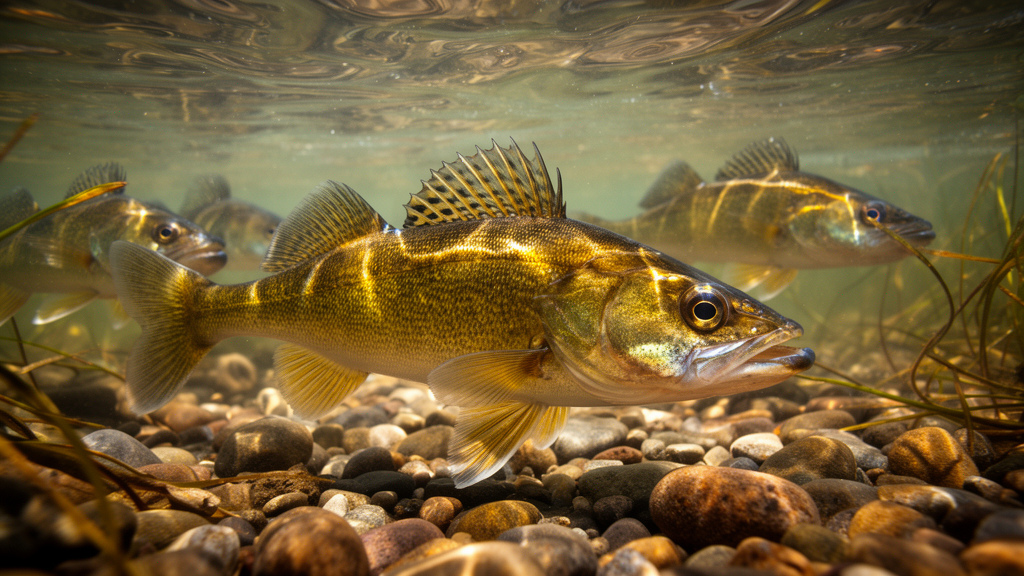
A genomic investigation of walleye (Sander vitreus) across four major spawning tributaries of Lake Champlain has revealed that strong spawning site fidelity and small effective population sizes are driving localized inbreeding, despite documented straying between river systems. Published in BMC Ecology and Evolution by researchers Peter T. Euclide, Bernard Pientka, Matt J. Thorstensen, Ken M. Jeffries, Wesley A. Larson, and J. Ellen Marsden, the study examined neutral population structure, pairwise kinship, and runs of homozygosity across the lake’s fragmented aquatic landscape. Lake Champlain represents a closed metapopulation where adult walleye mix in open foraging waters during the summer and autumn months but return to specific tributaries each spring to spawn. Contrary to the initial working hypothesis that natural straying among rivers would homogenize genetic diversity and maintain low relatedness across all spawning aggregations, researchers discovered marked population differentiation, unusually elevated kinship, and extensive runs of homozygosity concentrated within two specific tributaries, the Lamoille and Poultney rivers.
Metapopulation management frameworks often presume that physical waterways and moderate levels of dispersal provide sufficient genetic rescue to prevent the loss of genomic diversity within localized sub-populations. In migratory fishes, philopatry—the behavioral tendency of mature individuals to return annually to their natal or previous spawning locations—reduces reproductive variance by matching adults to suitable substrate, such as shallow cobble reefs and riverbeds. However, when populations decline or face demographic bottlenecks, persistent homing behavior can become an evolutionary liability by restricting gene flow and concentrating mating among close genetic relatives. Previous investigations into how straying buffers wild populations against inbreeding have predominantly evaluated anadromous salmonids, leaving significant knowledge gaps regarding temperate freshwater species. By combining decades of historical tagging records with multi-locus microsatellite genotyping and high-density restriction site-associated DNA capture sequencing, the investigative team evaluated how behavioral site fidelity interacts with demographic fluctuations and artificial hatchery propagation in a wild predatory fishery.
To establish baseline behavioral patterns within Lake Champlain, the researchers examined an archival Vermont Fish and Wildlife Department tagging dataset encompassing 1,261 angler-reported recapture events recorded between 1964 and 2008. Filtering these records to identify adult walleye tagged and subsequently recaptured during peak spring spawning months in April and May yielded 250 verified recapture events across the Lamoille, Winooski, and Missisquoi rivers. Spawning site fidelity was calculated at 91.5 percent in the Lamoille River, 92.3 percent in the Winooski River, and 88.6 percent in the Missisquoi River, corresponding to straying rates ranging from 7.9 to 11.4 percent. Because angling regulations in Vermont protect actively spawning fish, recaptures occurred during late spring when adults were lingering in rivers post-spawning, meaning these estimates represent conservative indicators of true fidelity. Notably, long-distance movement was confirmed by the documented capture of a Lamoille-tagged walleye within the southern Poultney River, demonstrating that physical distance of roughly 150 kilometers does not present an impassable barrier to dispersal throughout the basin.
For genetic assessment, biologists collected tissue samples via electrofishing during spring spawning migrations from 2015 to 2017 across four river systems: the Missisquoi River in 2015, the Winooski River in 2016, and the Lamoille and Poultney rivers in 2017. Tissue clips were harvested from euthanized specimens undergoing state-mandated health testing, yielding DNA for 165 individuals. The researchers amplified 13 microsatellite loci, removing one locus designated SviL 4 after quality screening revealed consistent deviations from Hardy-Weinberg equilibrium across all sampling locations. Analysis of the remaining 12 microsatellite markers using GenoDive revealed an overall effective number of alleles per locus of 4.02, an observed heterozygosity of 0.71, and a metapopulation-wide inbreeding coefficient of 0.043. However, divergence metrics including pairwise Jost’s D demonstrated statistically significant genetic differentiation separating each tributary from the others, while a permuted Mantel test revealed no significant signal of isolation by distance across the geographic expanse of the lake basin.
Bayesian clustering through STRUCTURE and principal component analysis indicated that walleye from the northern Missisquoi and Winooski rivers shared close genetic affinities, grouping into a unified genetic cluster, whereas the Lamoille and Poultney populations formed highly divergent, discrete clusters. Estimates of effective breeder size calculated via the linkage disequilibrium method highlighted stark disparities in demographic scale among the four spawning sites. While the Missisquoi River supported an estimated effective breeder size of 599.9 individuals, the Winooski River exhibited an effective size of 60.7, and both the Lamoille and Poultney rivers fell well below the critical conservation threshold of 50 individuals, registering effective breeder sizes of 33.7 and 29.5, respectively. These critically low effective population sizes in the Lamoille and Poultney tributaries signaled severe vulnerability to rapid genetic drift and accelerated inbreeding within their localized spawning runs.
Evaluation of pairwise kinship among individuals utilizing the Loiselle estimator revealed striking concentrations of close relatives within the Lamoille and Poultney sub-populations. When calculating kinship across the pooled dataset, researchers identified 55 pairs of putatively related individuals with kinship coefficients exceeding 0.25—the theoretical equivalent of full siblings in a randomly mating group—out of 741 comparisons in the Lamoille River, and 27 related pairs out of 990 comparisons in the Poultney River. Conversely, the Missisquoi and Winooski rivers each exhibited only 3 related pairs across hundreds of comparisons. Because population substructure can inflate identity-by-descent estimates in pooled analyses, the team recalculated kinship within each river collection independently; even under this strict within-collection model, the Lamoille and Poultney rivers maintained significantly higher numbers of closely related individuals compared to the two larger aggregations, confirming that mating among close kin occurs regularly within these constrained tributary habitats.
To determine whether high kinship translated into structural genomic inbreeding, the study evaluated runs of homozygosity using a high-density Rapture panel comprising tens of thousands of reference-aligned single nucleotide polymorphism markers. After enforcing strict filtering thresholds requiring at least 10X sequencing coverage per individual, 86 walleye were retained for comparative genomic analysis, including 43 fish from Lake Champlain and 43 specimens sampled from four major out-of-basin North American walleye populations. The comparative reference sites encompassed the naturally reproducing, highly abundant Sandusky River metapopulation in Lake Erie; the historically bottlenecked and stocked Tittabawassee River in Lake Huron; the feral-broodstock hatchery-supported Lake Winnipeg population in Manitoba; and the fully stocked, introduced population inhabiting Cedar Bluff Reservoir in Kansas. Runs of homozygosity were detected in PLINK using a scanning window of 100 SNPs, a maximum gap between adjacent markers of 500 kilobases, and a minimum density threshold of 75 kilobases per SNP marker.
The genomic analysis revealed that walleye from the Lamoille and Poultney rivers exhibited significantly higher inbreeding coefficients based on runs of homozygosity, known as FROH, than all other evaluated populations, including their within-basin counterparts in the Missisquoi and Winooski rivers and the four out-of-basin systems. In the Lamoille and Poultney rivers, multiple individuals possessed elevated counts of homozygous tracts and significantly greater total lengths of homozygous segments across their autosomal genomes. Specifically, six of eleven sequenced fish from the Lamoille River and four of twelve fish from the Poultney River contained more than 50 megabases of cumulative homozygous segments, with individual segments averaging between 2.4 and 2.5 megabases in length. In contrast, only a single individual across the combined 24 walleye sampled from the Missisquoi and Winooski rivers exceeded 50 megabases of homozygous tracts, with average segment lengths spanning only 1.7 to 1.9 megabases, matching the baseline levels observed in out-of-basin populations.
Because chromosomal recombination breaks down contiguous inherited blocks of DNA over successive generations, segments exceeding one megabase in length provide clear diagnostic evidence of recent inbreeding events involving closely related parents, such as matings between full siblings, half siblings, or parent-offspring pairs. The genomic distribution of FROH within the Lamoille and Poultney rivers exhibited a bimodal pattern: roughly half of the sampled individuals in each river possessed exceptionally high inbreeding metrics, while the remaining fish mirrored the lower, outbred levels characteristic of the broader metapopulation. In the Poultney River, this pattern aligns with historical stocking interventions initiated in the 1980s. Following the regional emergence of viral hemorrhagic septicemia in the Laurentian Great Lakes during the mid-2000s, hatchery guidelines restricted parental broodstock collections to a maximum of 25 male-female feral pairs to facilitate mandatory disease screening, yielding an effective breeder number of approximately 50. Repeatedly propagating offspring from a small parental pool over multiple cycles likely accelerated the unintended pairing of close relatives.
In contrast, the elevated inbreeding observed in the Lamoille River cannot be attributed to artificial propagation, as the state did not initiate a stocking program in that system until 2023. Instead, the authors conclude that demographic bottlenecks, low natural abundance, and potential year-round river residency have driven localized inbreeding under wild conditions. Although individual admixture proportions identified several walleye in the Lamoille and Poultney rivers with genetic profiles tracing to the Missisquoi and Winooski lineages—representing theoretical immigration rates between 8 and 17 percent—these strays appear to contribute minimally to reproductive recruitment. The authors emphasize that while philopatry stabilizes reproductive success during periods of high carrying capacity, it substantially increases vulnerability to localized inbreeding depression when local numbers collapse, illustrating that maintaining physical migration corridors alone is insufficient to protect genomic integrity in philopatric freshwater species.
Subject of Research: Population genetics and genomic inbreeding dynamics of walleye in Lake Champlain
Article Title: High kinship and runs of homozygosity characterize walleye Sander vitreus metapopulation diversity in Lake Champlain, USA
Article References: Euclide, P. T., Pientka, B., Thorstensen, M. J., Jeffries, K. M., Larson, W. A., & Marsden, J. E. (2026). High kinship and runs of homozygosity characterize walleye Sander vitreus metapopulation diversity in Lake Champlain, USA. BMC Ecology and Evolution, 26(1), Article 91. https://doi.org/10.1186/s12862-026-02558-0
Image Credits: AI Generated
DOI: 10.1186/s12862-026-02558-0
Keywords: walleye, Sander vitreus, Lake Champlain, runs of homozygosity, kinship, metapopulation, philopatry, microsatellites, RAD capture, effective population size, Lamoille River, Poultney River, Missisquoi River, Winooski River, inbreeding depression, fisheries management
News Source: Drew Townsend. (November 14, 2026). Lake Champlain Walleye Show Elevated Kinship and Local Inbreeding Across Tributaries. Scienmag.