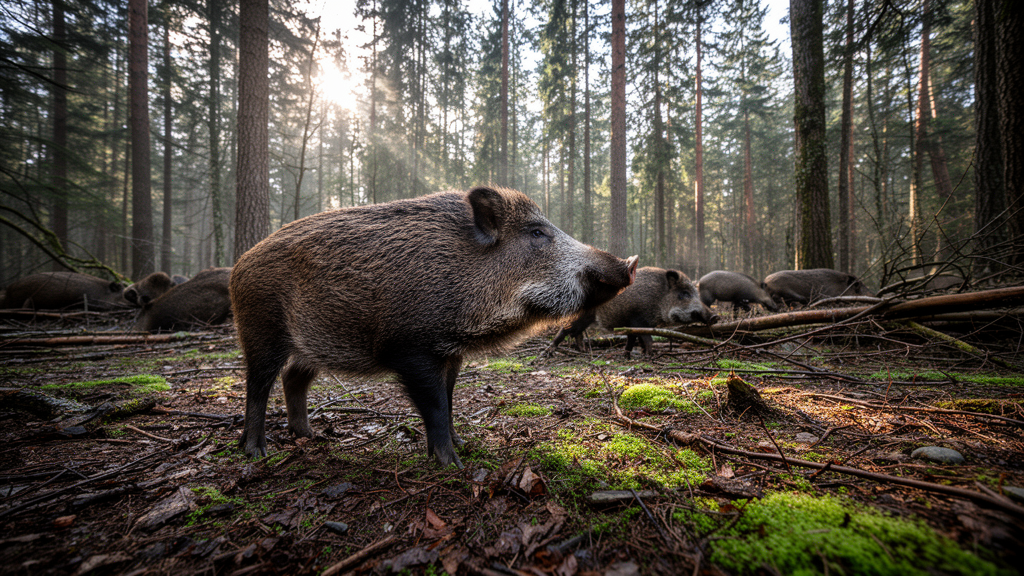
Invasive wild pigs exhibited dynamic behavioral reorganization rather than immediate dispersal after experiencing trapping-induced social disruption, according to a tracking study conducted in Alabama. Following the removal of sounder members, isolated individuals initially allocated a substantial proportion of their daily movement to encamped behavior, reflecting short-term spatial caution and anchoring to familiar areas before gradually altering their routine movement patterns.
Collective movement and social cohesion are central components of wild pig ecology, meaning partial sounder removal through trapping can destabilize established social structures and daily routines. Understanding how surviving individuals reallocate their movement over time is critical for refining invasive species control operations and improving emergency preparedness for wildlife diseases. To examine these post-disruption responses, researchers monitored collared individuals to evaluate how behavioral shifts unfold over time and whether prior group composition shapes subsequent movements.
The research team tracked 18 GPS-collared wild pigs (Sus scrofa) in Alabama following trapping-induced isolation events. Using a net square displacement analytical framework, the investigators classified daily movement segments into six distinct behavioral categories: encamped, round-trip, partial trip, ranging, wandering, and exploring. The study then evaluated how the daily proportion of time allocated to each movement type shifted following group disruption.
To analyze the behavioral trajectories, the researchers modeled the daily proportion of time allocated to each of the six behaviors as a function of elapsed time since isolation and the original sounder composition. The analysis employed multinomial mixed-effects regression, incorporating the individual animal as a random factor to account for variation among subjects while evaluating population-level trends across the monitoring period.
The multinomial mixed-effects model identified significant temporal and adult-composition effects across several movement categories. In addition to early encamped behavior, partial-trip and ranging movements represented major components of movement allocation throughout the post-trapping monitoring window. Crucially, the behavioral trajectories followed by isolated individuals differed depending on the specific adult composition of their original sounders prior to removal.
Wild pigs originating from adult-rich sounders displayed earlier transitions toward wandering and exploratory movement behaviors following isolation. In contrast, individuals that originated from sounders containing fewer adults sustained higher levels of encamped movement allocation much later into the post-trapping monitoring period, demonstrating that prior social structure directly moderates subsequent spatial responses.
Rather than triggering immediate long-distance dispersal, social disruption caused predictable temporal shifts in the movement behavior of invasive wild pigs. Initial spatial caution was followed by gradual behavioral restructuring that remained closely linked to prior social composition. Incorporating these spatial behavioral dynamics into invasive species management can help improve predictions of animal responses following population removals and strengthen both targeted control and disease preparedness strategies.
Subject of Research: Movement behavior allocation of isolated wild pigs following trapping-induced social disruption
Article Title: Return or roam? Trapping-induced social disruption reshapes movement behavior allocation in wild pigs
Article References: Gomez-Maldonado, S., Valente, J. J., McDonough, M. T., Smith, M. D., & Ditchkoff, S. S. (2026). Return or roam? Trapping-induced social disruption reshapes movement behavior allocation in wild pigs. Movement Ecology. https://doi.org/10.1186/s40462-026-00697-z
Image Credits: AI Generated
DOI: 10.1186/s40462-026-00697-z
Keywords: Sus scrofa, wild pigs, movement ecology, social disruption, trapping, GPS tracking, encamped behavior, exploratory movement, Alabama wildlife, invasive species management, net square displacement, multinomial mixed-effects models, sounder composition, spatial caution, ranging behavior, wildlife disease preparedness
News Source: Drew Townsend. (November 20, 2026). Trapping-Induced Social Disruption Temporarily Increases Spatial Caution in Wild Pigs. Scienmag.