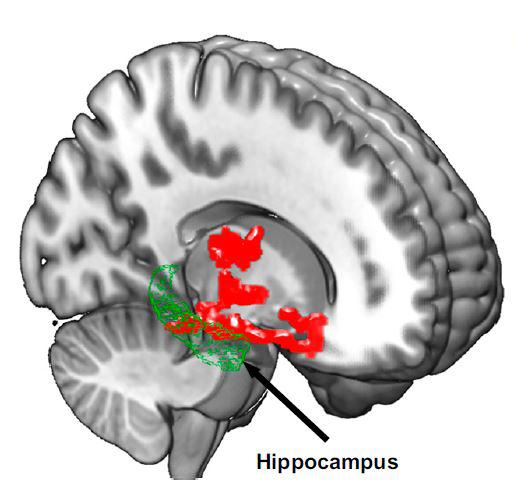
Credit: Proceedings of the National Academy of Sciences
Losing just one night of sleep led to an immediate increase in beta-amyloid, a protein in the brain associated with Alzheimer's disease, according to a small, new study by researchers at the National Institutes of Health. In Alzheimer's disease, beta-amyloid proteins clump together to form amyloid plaques, a hallmark of the disease.
While acute sleep deprivation is known to elevate brain beta-amyloid levels in mice, less is known about the impact of sleep deprivation on beta-amyloid accumulation in the human brain. The study is among the first to demonstrate that sleep may play an important role in human beta-amyloid clearance.
"This research provides new insight about the potentially harmful effects of a lack of sleep on the brain and has implications for better characterizing the pathology of Alzheimer's disease," said George F. Koob, Ph.D., director of the National Institute on Alcohol Abuse and Alcoholism (NIAAA), part of the National Institutes of Health, which funded the study.
Beta-amyloid is a metabolic waste product present in the fluid between brain cells. In Alzheimer's disease, beta-amyloid clumps together to form amyloid plaques, negatively impacting communication between neurons.
Led by Drs. Ehsan Shokri-Kojori and Nora D. Volkow of the NIAAA Laboratory of Neuroimaging, the study is now online in the Proceedings of the National Academy of Sciences. Dr. Volkow is also the director of the National Institute on Drug Abuse at NIH.
To understand the possible link between beta-amyloid accumulation and sleep, the researchers used positron emission tomography (PET) to scan the brains of 20 healthy subjects, ranging in age from 22 to 72, after a night of rested sleep and after sleep deprivation (being awake for about 31 hours). They found beta-amyloid increases of about 5 percent after losing a night of sleep in brain regions including the thalamus and hippocampus, regions especially vulnerable to damage in the early stages of Alzheimer's disease.
In Alzheimer's disease, beta-amyloid is estimated to increase about 43 percent in affected individuals relative to healthy older adults. It is unknown whether the increase in beta-amyloid in the study participants would subside after a night of rest.
The researchers also found that study participants with larger increases in beta-amyloid reported worse mood after sleep deprivation.
"Even though our sample was small, this study demonstrated the negative effect of sleep deprivation on beta-amyloid burden in the human brain. Future studies are needed to assess the generalizability to a larger and more diverse population," said Dr. Shokri-Kojori.
It is also important to note that the link between sleep disorders and Alzheimer's risk is considered by many scientists to be "bidirectional," since elevated beta-amyloid may also lead to sleep disturbances.
###
Reference: Shokri-Kojori E, et al. (2018). β-Amyloid accumulation in the human brain after one night of sleep deprivation. Proceedings of the National Academy of Sciences.
http://www.pnas.org/content/early/2018/03/29/1721694115.full
About the National Institute on Alcohol Abuse and Alcoholism (NIAAA): The National Institute on Alcohol Abuse and Alcoholism, part of the National Institutes of Health, is the primary U.S. agency for conducting and supporting research on the causes, consequences, prevention, and treatment of alcohol use disorder. NIAAA also disseminates research findings to general, professional, and academic audiences. Additional alcohol research information and publications are available at: https://www.niaaa.nih.gov.
About the National Institutes of Health (NIH): NIH, the nation's medical research agency, includes 27 Institutes and Centers and is a component of the U.S. Department of Health and Human Services. NIH is the primary federal agency conducting and supporting basic, clinical, and translational medical research, and is investigating the causes, treatments, and cures for both common and rare diseases. For more information about NIH and its programs, visit http://www.nih.gov.
Media Contact
NIAAA Press Office
[email protected]
301-443-3860
http://www.niaaa.nih.gov
Original Source
https://www.nih.gov/news-events/lack-sleep-may-be-linked-risk-factor-alzheimers-disease http://dx.doi.org/10.1073/pnas.1721694115