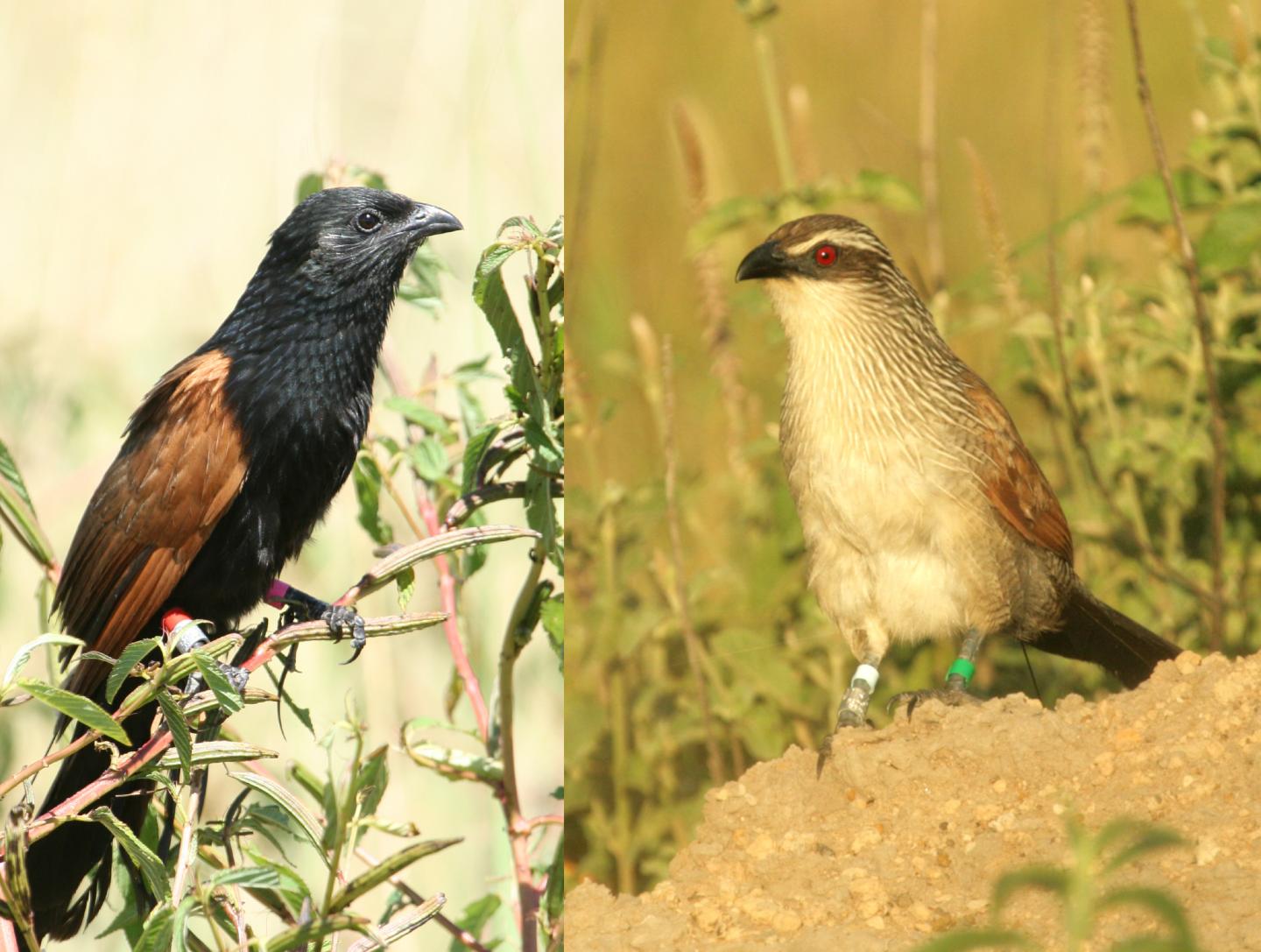
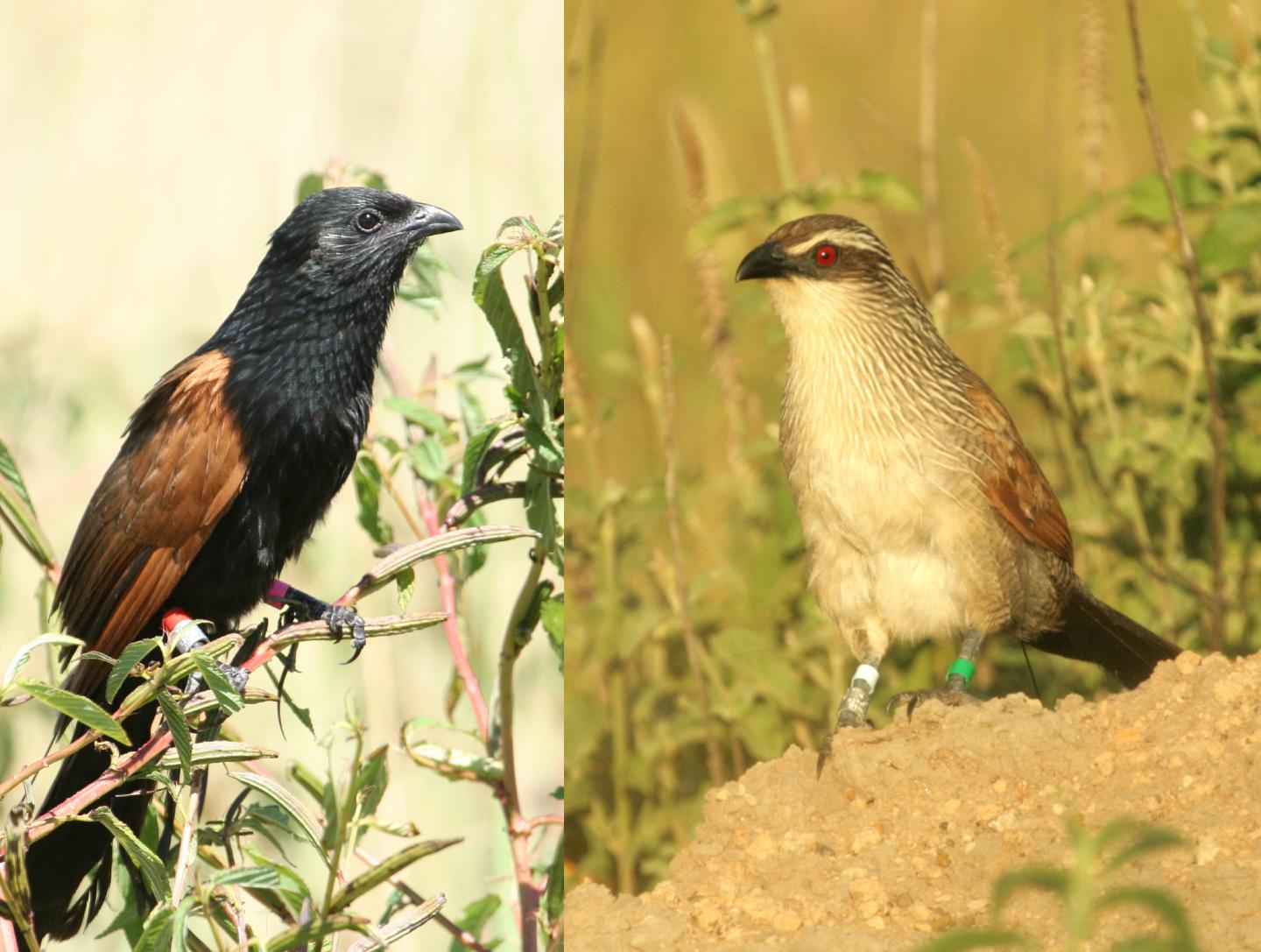
Credit: Wolfgang Goymann/ MPI for Ornithology
Male black coucals who care for their broods alone are just as successful as pairs of the closely related white-browed coucal, where partners share parental duties. Researchers from the Max Planck Institute for Ornithology in Seewiesen discovered that a single white-browed coucal parent would be sufficient to raise the brood; they believe that females share the job primarily because they are unlikely to find another mate. In white-browed coucals the sex-ratio is relatively balanced, whereas in black coucals there are more than twice as many males than females.
In most animals, females take a larger share in caring for their young than males – but there are exceptions: For example in about one percent of all bird species females compete for access to males, and the males rear the young without help from the female. Exceptions like these help biologists study the evolutionary processes that have shaped sex roles in nature.
One of these exceptions is the black coucal, a species in which a female mates with up to five different males during each season. Once the eggs have been laid, each of her mates takes care of his brood alone, while the female continues to defend her large territory and lays eggs for the next male in line. A closely related species, the white-browed coucal, displays a radically different behaviour. Even though both species occur in the same habitat and occupy a similar ecological niche, white-browed coucals form monogamous pairs and males and females share parental duties.
Researchers from the Max Planck Institute for Ornithology in Seewiesen have now examined the differences in parental effort between the two species and found that male black coucals invest far more into parental care than pairs of white-browed coucals. Black coucal fathers feed their young four to five times more often than either white-browed coucal parent. Even when the efforts of both partners are combined, a black coucal father still flies to the nest two to three times more frequently than a pair of white-browed coucals together – probably because white-browed coucals feed their young a higher proportion of frogs than insects. Unlike the black coucal, white-browed coucals also spend long periods just "hanging around" in bushes, even during the period when they are tending a nest. The parental effort required to raise their brood seems to be relatively low.
"A single white-browed coucal parent would probably be enough to successfully raise a brood, as is the case for black coucals", concludes Wolfgang Goymann, who headed the study. The scientists believe that white-browed coucals only form pairs and share parental duties because the females lack the opportunity to find additional male partners. The sex-ratio of black coucals is strongly biased towards males probably because females are more likely to die during adolescence. As a consequence there are about two and a half males for every female in the adult population. This means a female can easily find several partners, to whom she can then leave the parenting. In contrast, the sex-ratio is relatively even among white-browed coucals. Therefore, a female is unlikely to find additional partners and is better off investing in the brood together with her current mate.
###
Original publication:
Wolfgang Goymann, Ignas Safari, Christina Muck, Ingrid Schwabl
Sex roles, parental care and offspring growth in two contrasting coucal species.
Royal Society Open Science; 5 October, 2016
Media Contact
Prof. Dr. Wolfgang Goymann
[email protected]
49-815-793-2301
@maxplanckpress
http://www.mpg.de