• HOME
  • NEWS
  • EXPLORE
    • CAREER
      • Companies
      • Jobs
    • EVENTS
    • iGEM
      • News
      • Team
    • PHOTOS
    • VIDEO
    • WIKI
  • BLOG
  • COMMUNITY
    • FACEBOOK
    • INSTAGRAM
    • TWITTER
Tuesday, June 16, 2026
BIOENGINEER.ORG
No Result
View All Result
  • Login
  • HOME
  • NEWS
  • EXPLORE
    • CAREER
      • Companies
      • Jobs
        • Lecturer
        • PhD Studentship
        • Postdoc
        • Research Assistant
    • EVENTS
    • iGEM
      • News
      • Team
    • PHOTOS
    • VIDEO
    • WIKI
  • BLOG
  • COMMUNITY
    • FACEBOOK
    • INSTAGRAM
    • TWITTER
  • HOME
  • NEWS
  • EXPLORE
    • CAREER
      • Companies
      • Jobs
        • Lecturer
        • PhD Studentship
        • Postdoc
        • Research Assistant
    • EVENTS
    • iGEM
      • News
      • Team
    • PHOTOS
    • VIDEO
    • WIKI
  • BLOG
  • COMMUNITY
    • FACEBOOK
    • INSTAGRAM
    • TWITTER
No Result
View All Result
Bioengineer.org
No Result
View All Result
Home NEWS Science News Biology

Lack of functional eyes does not affect biological clock in zebrafish

Bioengineer by Bioengineer
March 7, 2024
in Biology
Reading Time: 2 mins read
0
Circadian clock works whether or not eyes do
Share on FacebookShare on TwitterShare on LinkedinShare on RedditShare on Telegram

Functional eyes are not required for a working circadian clock in zebrafish, as a research team1 including CNRS scientists has now shown.
Circadian clock works whether or not eyes do

Credit: © Elise Cau

Functional eyes are not required for a working circadian clock in zebrafish, as a research team1 including CNRS scientists has now shown.

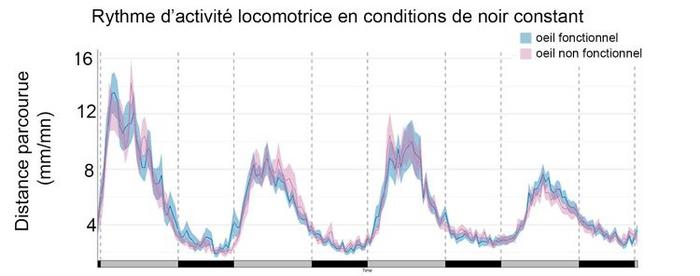
Though it is understood that the eye plays a key role in mammalian adaptation to day-night cycles, the circadian clock is most often studied in nocturnal vertebrates such as mice. The zebrafish, in contrast, is a diurnal vertebrate. Through observation of various zebrafish larvae lacking functional eyes,2 the team of scientists has demonstrated that the latter are not needed to establish circadian rhythms that remain synchronized with light-dark cycles in the laboratory. This suggests that, in some animal species, other neural circuits set the circadian clock.

In addition to molecular analyses, the researchers relied on video tracking of larval locomotion, the most reliable indicator in the study of the circadian clock. These findings, to be published in PLOS Genetics on 7 March, reveal major differences between organisms in the regulation of circadian rhythms.

Notes :

1 –  Laboratories involved in the study include the Molecular, Cellular, and Developmental Biology research unit (CNRS / Université Toulouse III–Paul Sabatier) and the Centre for Integrative Biology (CNRS/Université Toulouse Paul Sabatier).

2 – Larvae with mutated lak genes do not have functional retinal ganglion cells, which relay what is perceived by the eye to the brain: hence, the larvae cannot see.


Journal

PLoS Genetics

DOI

10.1371/journal.pgen.1011172

Article Title

Contribution of the eye and of opn4xa function to circadian photoentrainment in the diurnal zebrafish

Article Publication Date

7-Mar-2024

Share12Tweet8Share2ShareShareShare2

Related Posts

New Alliance Formed to Safeguard Atlantic Leatherback Turtles on World Sea Turtle Day — Biology

New Alliance Formed to Safeguard Atlantic Leatherback Turtles on World Sea Turtle Day

June 16, 2026
Single Amino Acid Mutation Could Enable Viruses to Leap from Bats to Humans — Biology

Single Amino Acid Mutation Could Enable Viruses to Leap from Bats to Humans

June 16, 2026

New Study Reveals Common Weed Killer Linked to Hormonal Changes Impacting Pregnancy and Fetal Development

June 15, 2026

Innovative Tool Advances Research on Essential Proteins

June 15, 2026

POPULAR NEWS

  • ESMO 2025: mRNA COVID Vaccines Enhance Efficacy of Cancer Immunotherapy

    325 shares
    Share 130 Tweet 81
  • Saying Goodbye to PGY-6: Pediatric Fellowship Realities

    101 shares
    Share 40 Tweet 25
  • Multi-Hospital Study Reveals Long Covid Burden Is Twice as High as Current Estimates

    91 shares
    Share 36 Tweet 23
  • Detection of EDCs in Breast Milk and Infant Urine Up to Six Months Highlights Early Exposure Risks

    75 shares
    Share 30 Tweet 19

About

We bring you the latest biotechnology news from best research centers and universities around the world. Check our website.

Follow us

Recent News

Cuddling Cats May Increase Stress Levels, New Study Finds

New Alliance Formed to Safeguard Atlantic Leatherback Turtles on World Sea Turtle Day

Nasal Spray’s Brain Impact Varies by Week, Shedding Light on Why a Promising Drug Seemed to Fail

Subscribe to Blog via Email

Enter your email address to subscribe to this blog and receive notifications of new posts by email.

Join 82 other subscribers
  • Contact Us

Bioengineer.org © Copyright 2023 All Rights Reserved.

Welcome Back!

Login to your account below

Forgotten Password?

Retrieve your password

Please enter your username or email address to reset your password.

Log In
No Result
View All Result
  • Homepages
    • Home Page 1
    • Home Page 2
  • News
  • National
  • Business
  • Health
  • Lifestyle
  • Science

Bioengineer.org © Copyright 2023 All Rights Reserved.