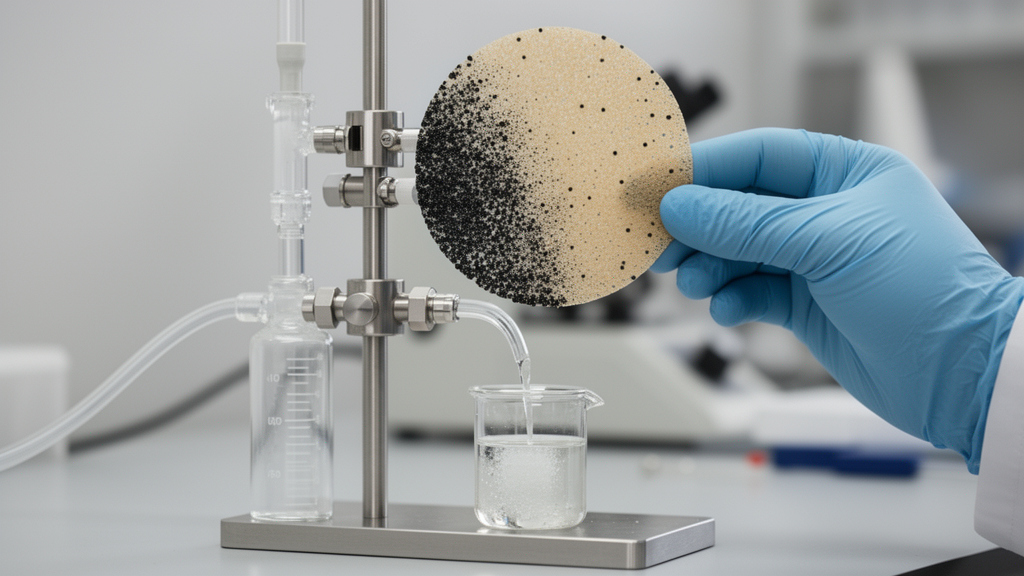
A chitosan-based mixed matrix membrane containing magnetically oriented Fe₃O₄ nanoparticles achieved enhanced pervaporation performance for removing water from isopropanol in a laboratory study. The researchers combined 5 wt% Fe₃O₄ nanoparticles, a magnetic field applied during fabrication, a porous substrate and cross-linking with 3 wt% sodium tripolyphosphate (STP). Under this optimized configuration, the supported membrane delivered a permeation flux of 0.13–0.65 kg/(m² h), a separation index of at least 725 kg/(m² h) and water permeance of at least 3,577 gas permeation units (GPU) when processing feeds containing 12–90 wt% water.
The membrane also maintained stable pervaporation performance during 14 days of continuous operation, including at elevated temperatures. Reported in the Journal of Materials Science , the research investigated how membrane-fabrication conditions influenced structure, characteristics and dehydration performance. Chitosan formed the principal polymer matrix, while Fe₃O₄ nanoparticles created a mixed matrix membrane.
The nanoparticles were oriented with magnetic assistance during preparation, and STP served as the cross-linking agent. The investigators varied three main parameters: magnetic-field application, Fe₃O₄ content and STP concentration. The best reported formulation incorporated 5 wt% Fe₃O₄ in the chitosan matrix under a magnetic field and used 3 wt% STP cross-linking on a porous support.
The study therefore examined a specific membrane design as well as the effects of the selected preparation variables. The team used an extensive analytical suite to characterize the modifier and resulting membranes. Fourier-transform infrared and nuclear magnetic resonance spectroscopy, X-ray powder diffraction, dynamic light scattering and X-ray photoelectron spectroscopy were employed to examine chemical and structural characteristics.
Swelling tests, contact-angle assessments and mechanical-property evaluations characterized other aspects of membrane performance. Together, these methods were used to validate the structure and properties of the chitosan-based membranes under different preparation conditions. Computational analysis was also conducted to investigate interactions between the membrane and components of the feed, adding an interpretation of the observed separation behavior to the experimental characterization.
The transport results were reported across a broad composition range of 12–90 wt% water in the isopropanol feed. The optimized cross-linked supported membrane combined a permeation flux range of 0.13–0.65 kg/(m² h) with a separation index of at least 725 kg/(m² h) and water permeance of at least 3,577 GPU. These are material-level measurements from laboratory pervaporation experiments.
The reported evidence concerns membrane preparation, characterization and operation under the tested conditions rather than performance in a complete industrial isopropanol-production system. Continuous testing showed that the membrane retained stable pervaporation performance for 14 days, and the test included operation at elevated temperatures. The results support magnetic-field-assisted Fe₃O₄ incorporation as a way to improve the measured pervaporation characteristics of chitosan membranes for isopropanol dehydration.
The optimized combination of 5 wt% Fe₃O₄, 3 wt% STP, a porous support and magnetic assistance produced the strongest reported separation parameters while preserving performance over the reported continuous test.
Subject of Research: Magnetic Fe₃O₄ mixed matrix membranes for pervaporative dehydration of isopropanol
Article Title: Chitosan-based mixed matrix membranes with magnetically oriented Fe3O4 nanoparticles for enhanced pervaporation dehydration of isopropanol
Article References: Kuzminova, A., Dmitrenko, M., Stepanova, A., Mazur, A., Lisovenko, A., & Penkova, A. (2026). Chitosan-based mixed matrix membranes with magnetically oriented Fe3O4 nanoparticles for enhanced pervaporation dehydration of isopropanol. Journal of Materials Science, 61(40), 31358-31394. https://doi.org/10.1007/s10853-026-13626-7
Image Credits: AI Generated
DOI: 10.1007/s10853-026-13626-7
Keywords: chitosan membranes, Fe₃O₄ nanoparticles, magnetic alignment, mixed matrix membranes, pervaporation, isopropanol dehydration, water separation, sodium tripolyphosphate, membrane transport, polymer membranes, Chitosan-based, mixed
News Source: Denise Maddox. (October 20, 2026). Lab study tests magnetic Fe3O4 chitosan membrane for isopropanol dehydration. Scienmag.