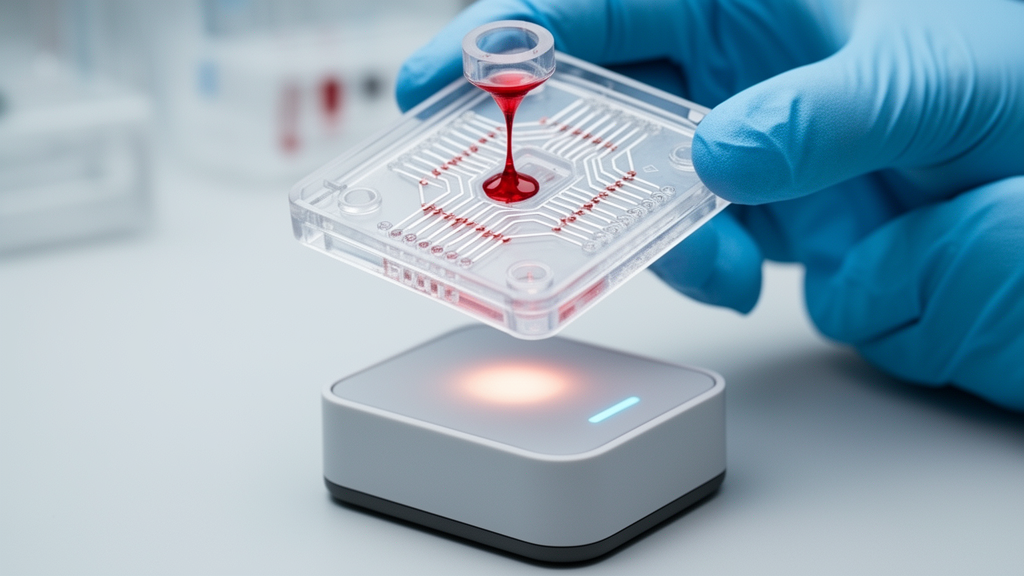
A study reported in the abstract of a 2026 Journal of Materials Science article describes a lab-on-chip device that detected C-type natriuretic peptide in whole blood, saliva and urine collected from people with confirmed heart disease. The device produced a reported response signature of 1.1 seconds and was tested over a concentration range of 1 × 10⁻¹⁶ to 1 × 10⁻⁷ g mL−1. The authors reported a limit of determination of 1 × 10⁻¹⁶ g mL−1 and average recoveries above 98.00% in the three biological fluids.
The researchers designed the device around a stochastic sensor comprising a matrix of Ti Al nitride MAX phase and graphite. They physically immobilized 4-tert-butylcalix[4]arene on this matrix, then designed, characterized and validated the resulting lab-on-chip platform with real samples of whole blood, saliva and urine from patients with confirmed heart disease. According to the abstract, the reported concentration range and limit of determination apply to the analytical method as tested; the abstract does not provide details about the number of participants, sample volumes, replicates or the procedures used to establish the range.
Validation results were compared with measurements obtained by a specialized clinical laboratory using an ELISA kit. A Student’s t test conducted at the 99.00% confidence level found no statistically significant difference between the lab-on-chip and ELISA results. The abstract therefore reports agreement between the two methods in the tested patient samples, rather than establishing the device’s performance in a broader population or in prospective clinical use. The abstract also states that average recoveries exceeded 98.00%, although it does not provide fluid-specific recovery values or uncertainty estimates.
Only the abstract and publisher-provided article information were available for this report, so the full experimental results could not be assessed. The abstract does not report the size and characteristics of the patient cohort, whether healthy or disease-control groups were included, or the device’s specificity, stability, reproducibility and performance outside the stated concentration range. It also does not state that the measurements were used to guide treatment or that the device changes clinical outcomes. The reported findings are limited to the design, analytical validation and sample comparison summarized in the abstract.
Subject of Research: Analytical validation of a lab-on-chip sensor for C-type natriuretic peptide in blood, saliva and urine
Article Title: 4-tert-butylcalix[4]arene/Ti Al nitride MAX phase@graphite-based lab-on-chip for fast ultrasensitive determination of natriuretic peptide C-type
Article References: Buzalin-Enache, M., Sava, T.-M., Stefan-van Staden, R.-I., Gheorghe, D.-C., Ilie-Mihai, R.-M., & Dan, A. (2026). 4-tert-butylcalix[4]arene/Ti Al nitride MAX phase@graphite-based lab-on-chip for fast ultrasensitive determination of natriuretic peptide C-type. Journal of Materials Science. https://doi.org/10.1007/s10853-026-13779-5
Image Credits: AI Generated
DOI: 10.1007/s10853-026-13779-5
Keywords: C-type natriuretic peptide, lab-on-chip, stochastic sensor, biological fluids, ELISA comparison, analytical validation, whole blood, saliva, urine, heart disease, tert-butylcalix, arene
News Source: Denise Maddox. (October 20, 2026). Lab-on-chip measures C-type natriuretic peptide in patient blood, saliva and urine. Scienmag.