• HOME
  • NEWS
  • EXPLORE
    • CAREER
      • Companies
      • Jobs
    • EVENTS
    • iGEM
      • News
      • Team
    • PHOTOS
    • VIDEO
    • WIKI
  • BLOG
  • COMMUNITY
    • FACEBOOK
    • INSTAGRAM
    • TWITTER
Thursday, July 2, 2026
BIOENGINEER.ORG
No Result
View All Result
  • Login
  • HOME
  • NEWS
  • EXPLORE
    • CAREER
      • Companies
      • Jobs
        • Lecturer
        • PhD Studentship
        • Postdoc
        • Research Assistant
    • EVENTS
    • iGEM
      • News
      • Team
    • PHOTOS
    • VIDEO
    • WIKI
  • BLOG
  • COMMUNITY
    • FACEBOOK
    • INSTAGRAM
    • TWITTER
  • HOME
  • NEWS
  • EXPLORE
    • CAREER
      • Companies
      • Jobs
        • Lecturer
        • PhD Studentship
        • Postdoc
        • Research Assistant
    • EVENTS
    • iGEM
      • News
      • Team
    • PHOTOS
    • VIDEO
    • WIKI
  • BLOG
  • COMMUNITY
    • FACEBOOK
    • INSTAGRAM
    • TWITTER
No Result
View All Result
Bioengineer.org
No Result
View All Result
Home NEWS Science News Chemistry

Lab in hollow MOF capsules beyond integration of homogeneous and heterogeneous catalysis

Bioengineer by Bioengineer
November 6, 2019
in Chemistry
Reading Time: 2 mins read
0
IMAGE
Share on FacebookShare on TwitterShare on LinkedinShare on RedditShare on Telegram

IMAGE

Credit: ©Science China Press


Homogeneous molecular catalysts are highly active and selective as they possess well-tailored structures and accessible sites. Unfortunately, the difficulty related to catalyst recovery impedes their practical application. The encapsulation of them inside hollow porous solid materials is a judicious solution. While a number of reports on stabilizing homogeneous catalysts to solid supports, including porous polymers/silica/carbons, and zeolites, etc., it remains significant challenge with regards to the dilemma in the integration of respective advantages of homogeneous and heterogeneous catalysts without compromised catalytic performance of the former and porosity of the latter.

Typically, the previous shells are usually assembled by imperfect particle packing and feature additional interparticle pores that are not able to encapsulate small homogeneous active guests. The attempts on endowing the resulting composite catalysts with additional features (for example, substrate enrichment, selective catalysis, cascade catalysis, etc.), beyond the simple recombination of classical merits of homogeneous and heterogeneous catalysts, has never been reported yet.

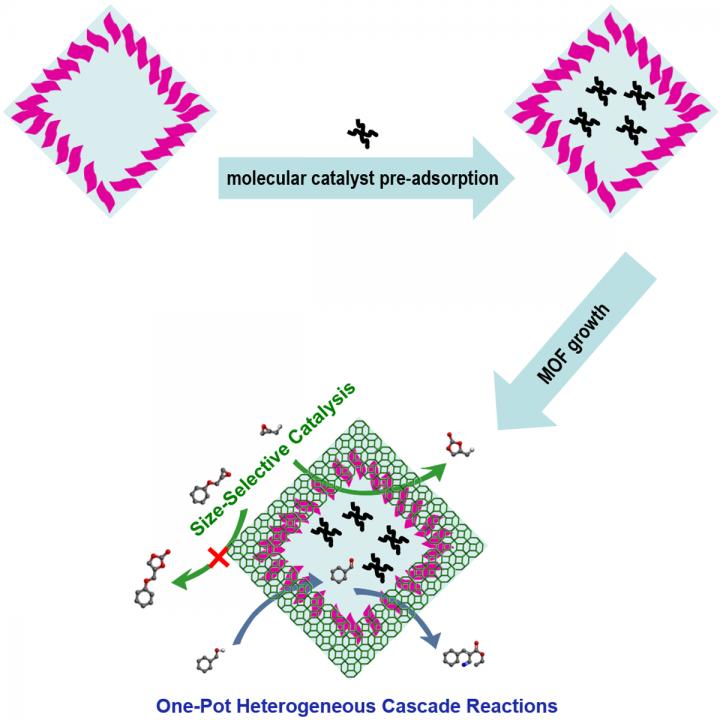
In the present work, the authors have developed a template-directed approach for the construction of various hollow metal-organic framework (MOF) capsules with a continuous shell and size-selective permeability, which are useful in sealing up diverse soluble active species.

This novel template-directed process is straightforward and versatile (diverse MOFs, such as ZIF-8, ZIF-67, MOF-74, etc., are applicable) for the fabrication of various MOF capsules with a dense, stable and thin MOF shell, which eliminate additional interparticle pores/defects in previous reports on hollow porous capsules. During the synthetic process, different soluble active species can be readily encapsulated into the interior cavity of the hollow MOF capsules, thus making the synthetic approach very powerful and extendable.

The resultant yolk-shell MOF capsules exhibit superior activity to the individual bulk MOF and the guest active catalyst, benefiting from the synergistic effects between the high intrinsic activity of the molecular catalyst and substrate enrichment effect of the crystalline MOF shell. Moreover, the perfect MOF shell endows the resultant composites with substrate enrichment, size-selectivity, great recyclability, and multifunctional cascade catalysis.

Such yolk (soluble)-shell (crystalline) MOF capsule-based composites not only integrate the respectively intrinsic merits of soluble active species (homogeneous catalysts) and MOFs (heterogeneous catalysts and crystalline porous materials), but also open up an avenue to the generation of additional catalysis features (substrate enrichment, selective catalysis, cascade catalysis, etc.), for synergistically enhanced applications, especially in high-performance catalysis.

###

See the article:

Guorui Cai, Meili Ding, Qianye Wu, Hai-Long Jiang

Encapsulating Soluble Active Species into Hollow Crystalline Porous Capsules beyond Integration of Homogeneous and Heterogeneous Catalysis

Natl Sci Rev (October 2019), nwz147

https://doi.org/10.1093/nsr/nwz147

Media Contact
Hai-Long Jiang
[email protected]

Related Journal Article

http://dx.doi.org/10.1093/nsr/nwz147

Tags: Chemistry/Physics/Materials Sciences
Share12Tweet8Share2ShareShareShare2

Related Posts

Graz University of Technology Deciphers the Structural Secrets of MOF Thin Films — Chemistry

Graz University of Technology Deciphers the Structural Secrets of MOF Thin Films

July 2, 2026
Breaking Thermodynamic Limits: Wavelength-Driven Catalysis Advances Ammonia Synthesis — Chemistry

Breaking Thermodynamic Limits: Wavelength-Driven Catalysis Advances Ammonia Synthesis

July 2, 2026

From Quantum Mechanics to AI-Powered Materials Discovery: MARVEL Marks 12 Years of Transforming Computational Science

July 2, 2026

Djire Recognized with National Award for Outstanding Contributions in Research and Teaching

July 2, 2026
Please login to join discussion

POPULAR NEWS

  • Detection of EDCs in Breast Milk and Infant Urine Up to Six Months Highlights Early Exposure Risks

    77 shares
    Share 31 Tweet 19
  • Saying Goodbye to PGY-6: Pediatric Fellowship Realities

    103 shares
    Share 41 Tweet 26
  • New Drug Candidate Developed at McMaster Shows Potential for Treating Brain Cancer

    58 shares
    Share 23 Tweet 15
  • KTU Researchers Explore Ultrasound’s Role in Enhancing Blood Flow Beyond Diagnostics

    53 shares
    Share 21 Tweet 13

About

BIOENGINEER.ORG

We bring you the latest biotechnology news from best research centers and universities around the world. Check our website.

Follow us

Recent News

Steatosis Drives Liver Metastasis Diversity in CRC

Unlocking the Mysteries of Alzheimer’s Disease

Pensoft Introduces New Peer-Reviewed Journal of Regeneration to Advance Restorative Biology Across Species

Subscribe to Blog via Email

Enter your email address to subscribe to this blog and receive notifications of new posts by email.

Join 83 other subscribers
  • Contact Us

Bioengineer.org © Copyright 2023 All Rights Reserved.

Welcome Back!

Login to your account below

Forgotten Password?

Retrieve your password

Please enter your username or email address to reset your password.

Log In
No Result
View All Result
  • Homepages
    • Home Page 1
    • Home Page 2
  • News
  • National
  • Business
  • Health
  • Lifestyle
  • Science

Bioengineer.org © Copyright 2023 All Rights Reserved.