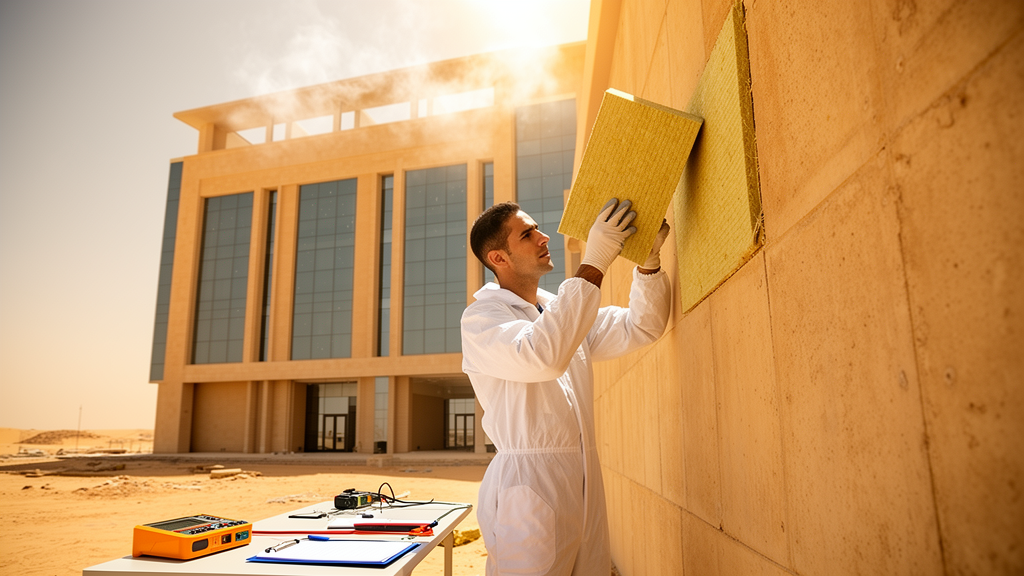
Kuwait’s punishing combination of extreme heat, intense solar radiation, dust storms, and near-constant air-conditioning places unusual demands on the materials that wrap its buildings, and a new narrative review argues that the country’s research community has so far focused almost exclusively on how well those materials save energy rather than on whether they might affect the air occupants breathe. The review, published in Frontiers in Public Health, examines building-envelope and insulation materials investigated in Kuwait or under Kuwait-like climatic conditions and proposes a structured framework for assessing their public-health relevance through measurable exposure pathways rather than through material type alone.
The authors, from the American University of the Middle East in Egaila, Kuwait, emphasize that their work is a source-pathway-measurement synthesis, not a health study. They explicitly avoid drawing Kuwait-specific health conclusions, noting that direct Kuwait evidence linking envelope materials to indoor chemical concentrations, occupant exposure, or health outcomes remains substantially limited. Instead, the review identifies what has been studied, what environmental and operational factors may modify material behavior over time, and which measurable indicators should be prioritized in future investigations.
The Kuwait-focused literature was identified primarily through Scopus searches combining terms related to Kuwait and buildings with materials such as thermal insulation, phase change materials, polyurethane panels, expanded polystyrene, rockwool, cool roofs, window films, smart windows, glazing, and walling materials. The final search was conducted in April 2026, and only English-language peer-reviewed journal articles and relevant conference proceedings were eligible. Studies on oil and petroleum applications, airport runway materials, and outdoor pollution without a building-envelope link were excluded. Because the Kuwait literature rarely included direct measurements of material-related indoor chemistry, particulate matter, fibers, or dampness, the authors supplemented their analysis with international evidence to identify plausible pathways and appropriate measurement methods, without assigning Kuwait-specific exposure levels.
The materials most frequently represented in the Kuwait evidence base are phase change materials, or PCMs, and Bio-PCMs, which store thermal energy as they melt and solidify. One numerical simulation added a 20 mm PCM layer to walls and roofs under Kuwait City climate conditions, comparing three formulations with different melting ranges; in a July model, the RT-42 material reduced modeled heat gain by 15.37 percent at the roof and approximately 13.78 percent at vertical walls. Another EnergyPlus simulation of low-rise air-conditioned residential buildings identified a 4 cm PCM wallboard with a 24 °C melting peak as the best configuration among those tested, yielding simulated annual cooling-energy savings of 4 to 5 percent and summer cooling-demand reductions of 5 to 7 percent. These are model estimates, not measurements from occupied buildings.
Polyurethane sandwich panels form a second recurring category, particularly in portable-cabin studies where 75 mm panels with insulation cores and galvanized-steel sheets were used to test cool-roof and Bio-PCM strategies. Reflective and solar-control systems, including cool-roof paints, aluminium foil roofs, finned roof tiles, solar window films, and low-e glazing, have also been examined. In one occupied-building field study, two similar offices in a Kuwait educational building with double-glazed windows were compared during June through August 2019; the office fitted internally with a window film generally showed indoor temperatures 2 to 5 °C lower than the comparable office with bare glazing, while humidity also differed. Advanced smart-window systems combining air gaps, photovoltaic layers, PCMs, vacuum glazing, and thermochromic hydrogels have been simulated for Kuwait City conditions but remain primarily prototype- or simulation-oriented, with no Kuwait field data on indoor environmental performance.
The review stresses that material behavior in Kuwait cannot be understood from nominal thermal properties alone. The Kuwait Meteorological Center reports average maximum temperatures of 42 to 46 °C during the hot summer period, along with humid summer intervals, meaning extreme heat and humidity episodes should be considered separately. High surface temperatures, solar exposure, dust deposition, thermal cycling, and prolonged air-conditioning may expedite surface aging and affect coatings, sealants, films, and temperature-responsive materials. Because air-conditioned interiors are kept cool while external surfaces face high solar loads, strong indoor-outdoor temperature and vapor gradients may influence heat transfer, vapor movement, drying potential, and joint or cavity operation. Failed sealants, roof leakage, cracks, thermal bridges, and workmanship defects may further alter how envelope assemblies behave over time.
A central analytical move in the review is the separation of four distinct transfer pathways: heat, air, moisture, and pollutants. Heat moves by conduction, radiation, and, for PCMs, phase change. Air moves through intentional ventilation and unintended leakage through joints, cracks, and penetrations. Moisture moves by vapor diffusion, air transport, capillary action, leakage, and condensation. Pollutants require an identifiable source or generation mechanism followed by transport to the occupied zone. The authors argue that associating a material with an envelope is not sufficient to attribute exposure; a material should be considered relevant to indoor exposure only when a reasonable route to the occupied space and a measurable indicator can be defined.
The review also distinguishes sharply between building stages. During normal occupancy, most insulation materials are concealed behind finishes, facings, or panels, and particle or fiber release from polyurethane panels, EPS, rockwool, and mineral-wool insulation is likely to be most relevant during cutting, installation, maintenance, removal, or renovation rather than during concealed use. These pathways have not been directly quantified in the reviewed Kuwait studies. Notably, the only occupied-building particulate evidence from Kuwait concerns outdoor particle infiltration rather than material release: a study of 10 residences between September 2017 and March 2018 reported particle penetration efficiencies of 20 to 30 percent during dust storms and 40 to 60 percent during non-dust-storm periods, demonstrating a measurable outdoor-to-indoor pathway but providing no evidence that particles originate from envelope materials.
On moisture, the authors caution that dampness should not be treated as an automatic indication of microbial development; microbial relevance requires persistent moisture, a susceptible substrate, and suitable conditions. They also highlight ventilation as an exposure modifier rather than a mere operational variable, since air exchange, recirculation, filtration, and infiltration determine whether material-related indicators accumulate, dilute, or reach occupied spaces, particularly in highly air-conditioned buildings where windows may remain closed for prolonged periods. Perceived indoor air quality, odor, dryness, and thermal comfort are framed as occupant-centered indicators that energy performance alone cannot capture.
The review’s principal contribution is a proposed integrated assembly-transport-IEQ-occupant framework, presented as a minimum set of recommended measurements. It combines assembly and thermal characterization, ventilation and airtightness assessment, moisture evaluation extending beyond room-average humidity to dew-point margin and material moisture, targeted VOC and carbonyl sampling only where a plausible material-source pathway exists, particulate and fiber-specific measurements where fibrous insulation is disturbed, and short occupant questionnaires paired in time and location with physical measurements. The authors identify four priorities for Kuwait: occupied-building studies pairing envelope characterization with indoor environmental measurements, coupled heat-air-moisture monitoring of complete assemblies, source-to-zone confirmation before attributing chemical or particulate indicators to envelope materials, and longitudinal aging and maintenance studies combined with occupant feedback. They acknowledge the review’s limitations, including a limited and heterogeneous Kuwait evidence base, the narrative rather than systematic design, the absence of formal risk-of-bias assessment, and reliance on Scopus as the principal database, which may have excluded relevant studies indexed elsewhere.
Subject of Research: A narrative review of building-envelope materials, indoor environmental quality, and exposure pathways in Kuwait's hot-arid climate
Article Title: Building envelope materials, indoor environmental quality and public-health relevance in Kuwait: a narrative review of exposure pathways in a hot-arid climate
Article References: Al Hallak, M., Ali-Ahmad, M., El-Sawda, C., Flity, H., & Alassaad, F. (2026). Building envelope materials, indoor environmental quality and public-health relevance in Kuwait: a narrative review of exposure pathways in a hot-arid climate. Frontiers in Public Health, 14, Article 1982898. https://doi.org/10.3389/fpubh.2026.1982898
Image Credits: AI Generated
DOI: 10.3389/fpubh.2026.1982898
Keywords: building envelope, indoor environmental quality, Kuwait, thermal insulation, phase change materials, exposure pathways, hot-arid climate, air-conditioning, public health, narrative review, ventilation, moisture
News Source: Ophelia Keating. (October 29, 2026). Kuwait’s Hot-Arid Climate Puts Building Envelope Materials Under Scrutiny for Indoor Health Risks. Scienmag.