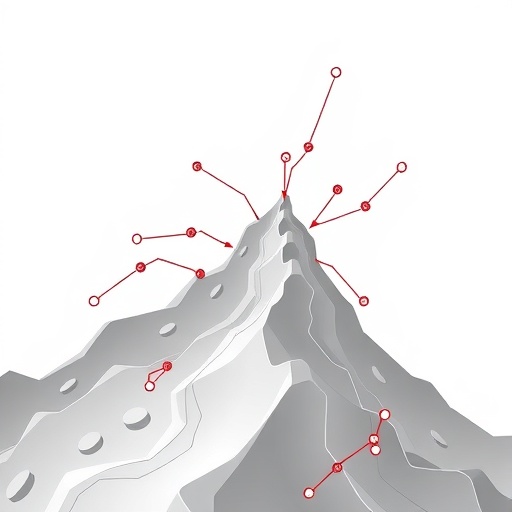
In the vast web of connections that makes up social networks, transportation systems, communication infrastructure, and even the human brain, some nodes matter far more than others. Finding these critical players—the individuals who can spark a viral marketing campaign, the airports whose closure would cascade into travel chaos, the proteins whose failure triggers disease—has been one of the central puzzles of network science for decades. Now, a team of researchers from Guangxi Normal University in China and Oakland University in the United States has unveiled a new algorithm that promises to solve a stubborn weakness in existing methods: the tendency to pick key nodes that are bunched together rather than spread strategically across the network. The algorithm, called KSvoterank, is described in a study published in the International Journal of Machine Learning and Cybernetics, and its creators report substantial gains in both the reach of information spreading and the robustness of networks under attack.
The problem the researchers set out to tackle is deceptively simple to state but notoriously difficult to solve. When analysts want to identify the most influential nodes in a network, the classic approach is to rank nodes by some centrality measure and select the top performers. Degree centrality, which simply counts a node’s direct connections, and betweenness centrality, which measures how often a node lies on the shortest paths between others, are the workhorses of this tradition, dating back to foundational work in social network analysis in the 1970s. But these measures share a blind spot: they ignore where a node sits spatially within the network’s structure. In many real-world networks, the highest-ranked nodes turn out to be neighbors of one another, clustered inside the same dense community. When those clustered nodes are used as seeds for spreading information, their spheres of influence overlap heavily, and much of the potential propagation power is wasted.
Network scientists have a name for one particularly troublesome version of this clustering: the “rich-club” effect. In many networks, the nodes with the most connections preferentially link to each other, forming a tightly interwoven core of hubs. Selecting several members of this rich club as key spreaders is like planting several billboards on the same city block—each one reaches largely the same audience, and the marginal benefit of each additional billboard shrinks dramatically. The KSvoterank algorithm, developed by HaiLong Chen, Jiafei Liu, and Eddie Cheng, attacks this problem head-on by combining two complementary ideas that have each proven powerful on their own: k-shell decomposition and voting-based ranking.
K-shell decomposition, which rose to prominence after a landmark 2010 paper in Nature Physics showed that a node’s location in the network’s core-periphery structure often predicts its spreading power better than its raw degree, works by peeling away layers of a network. First, all nodes with only one connection are removed, then nodes that become degree-one after that removal are removed in turn, and the process repeats until only nodes of degree two or higher remain—these form the innermost “shell.” The peeling continues, producing a series of nested shells labeled by their k-value, with the innermost shells representing the network’s structural core. The beauty of this method is that it captures a node’s global position: a node with modest degree but deep placement in the network core can be more influential than a high-degree node hanging on the periphery. By stratifying nodes according to their shell values, KSvoterank gains immediate access to this global structural hierarchy, something pure degree-based or path-based centrality measures cannot provide.
But shell information alone does not prevent clustering, because nodes within the same shell—or even the same neighborhood—can still be tightly connected to one another. This is where the second pillar of KSvoterank comes in: an enhanced voting mechanism inspired by the VoteRank algorithm, which was originally proposed as a way to iteratively select multiple influential spreaders. In the original voting approach, all nodes begin as voters, and each round of selection involves nodes casting votes for their most influential neighbors. The node that accumulates the most votes is chosen as a spreader, and crucially, the voting power of its neighbors is then reduced so that they are less likely to be chosen in subsequent rounds. This “de-voting” of the neighborhood is what pushes successive selections apart, dispersing the chosen spreaders across the network rather than allowing them to pile up in one region.
The KSvoterank team’s enhancement lies in how these votes are weighted and how the neighborhood contributions are computed. Rather than considering only direct, one-hop neighbors, the algorithm’s dynamic voting process accounts for both direct and indirect neighborhood contributions—effectively letting nodes feel the influence of nearby selections that may be two or more steps away in the graph. Combined with the shell stratification, which ensures that the pool of candidates is drawn from structurally meaningful layers of the network, this yields a selection procedure that maintains global structural information while minimizing influence overlap. In practical terms, the algorithm behaves like an election in which voters become progressively less impressed by candidates who stand too close to winners already declared, and in which candidates are judged not just by local popularity but by their standing in the network’s deeper architecture.
To test whether this theoretical elegance translates into real performance, the researchers evaluated KSvoterank on multiple real-world networks, comparing it against established baselines including degree centrality, betweenness centrality, k-shell alone, and various hybrid and voting-based competitors from the recent literature—a crowded field that includes entropy-based methods, gravity-model approaches, semi-local centrality metrics, and PageRank-shell hybrids. The evaluation used the standard metrics of the influence maximization trade. In the widely adopted susceptible-infected-recovered (SIR) spreading model, nodes selected by the algorithm are treated as initially infected seeds, the epidemic process is simulated, and the final outbreak size measures how far the influence actually propagated. The team also examined network robustness, asking how quickly a network disintegrates when its most important nodes are removed—a question with direct implications for protecting power grids, communication backbones, and other critical infrastructure.
The results, according to the study, demonstrated KSvoterank’s superior performance in both propagation scope and robustness compared with the traditional and state-of-the-art alternatives. The gains are exactly what the dispersion hypothesis would predict: by choosing seeds whose influence territories overlap less, the same number of seed nodes covers a substantially larger fraction of the network. And when the chosen nodes are removed to test robustness, spatially dispersed targets break the network into fragments faster, because they strike multiple structurally distinct regions rather than repeatedly hammering the same dense core. The authors argue that these results validate the algorithm’s utility for two of the most consequential applications in network science: influence maximization—the problem of selecting a small seed set that maximizes the spread of information, formalized in a celebrated 2003 paper by Kempe, Kleinberg, and Tardos—and network robustness analysis.
The implications stretch across an impressive range of domains. In public health, identifying dispersed key nodes could improve the design of vaccination campaigns or contact-tracing strategies, since immunizing strategically scattered individuals disrupts epidemic pathways more effectively than immunizing a cluster. In epidemiology more broadly, the work connects to a rich lineage of spreading research on scale-free networks that began with Pastor-Satorras and Vespignani’s influential 2001 paper showing that epidemic thresholds behave differently on heterogeneous topologies. In marketing and social media, the algorithm offers a principled way to select seed users for viral campaigns, avoiding the common failure mode of targeting influencers who all follow one another and therefore reach the same audience. In infrastructure engineering, dispersed node identification translates directly into better-informed decisions about which components to reinforce or monitor. The study’s reference list even touches on neuroscience, noting prior work on finding influential nodes for integration in brain networks using optimal percolation theory—suggesting that dispersion-aware selection could eventually inform how neuroscientists think about hub regions in the human connectome.
The methodological contribution also sits within a broader recent wave of hybrid approaches to influence identification. Researchers have increasingly recognized that no single centrality measure captures everything, and the past several years have produced a parade of combinations: k-shell fused with entropy measures, with Tanimoto correlation coefficients, with PageRank, with structural hole theory, and with game-theoretic frameworks. What distinguishes KSvoterank within this landscape is the specific pairing of a global structural stratification device with a local, iterative dispersion mechanism. The k-shell layer ensures candidates are evaluated in light of the network’s core-periphery anatomy, while the voting layer ensures that each new selection adds genuinely new coverage. It is a division of labor between global and local information, and the authors’ experiments suggest the combination is more than the sum of its parts.
The work was supported by the National Natural Science Foundation of China and the Guangxi Natural Science Foundation, and it emerges from the Guangxi Key Lab of Multi-Source Information Mining and Security, a hub for research on mining structure and meaning from large-scale relational data. Chen, Liu, and Cheng report no conflicts of interest, and the corresponding author, Jiafei Liu, notes that Liu and Eddie Cheng contributed equally to the work. As with any algorithmic contribution, future work will likely probe how the method scales to the largest networks, how it adapts to weighted and temporal networks where connections change over time, and how it performs under different spreading dynamics beyond the SIR framework. But for now, the message of the study is clear and actionable: when hunting for the most important nodes in a network, it is not enough to ask which nodes are strongest. One must also ask where they stand—and make sure the chosen few are scattered where their power can reach the farthest.
Subject of Research: Identification of dispersed key (influential) nodes in complex networks using k-shell decomposition combined with an enhanced voting mechanism.
Subject of Research: Technology and Engineering
Article Title: Ksvoterank: k-shell & voting for dispersed key node identification
Article References: Chen, H., Liu, J., & Cheng, E. (2026). Ksvoterank: k-shell & voting for dispersed key node identification. International Journal of Machine Learning and Cybernetics, 17(9), Article 444. https://doi.org/10.1007/s13042-026-03277-0
Image Credits: AI Generated
DOI: 10.1007/s13042-026-03277-0
Keywords: Key node identification, Complex networks, k-shell decomposition, Influence maximization, Voting mechanism, Rich-club effect, Network robustness, SIR spreading model, Centrality measures, Dispersed spreaders
Cite Scienmag News
APA MLA Chicago
Denise Maddox. (September 4, 2026). KSVoteRank: identifying dispersed key nodes through k-shell and voting methods. Scienmag. https://scienmag.com/ksvoterank-identifying-dispersed-key-nodes-through-k-shell-and-voting-methods/
Denise Maddox. “KSVoteRank: identifying dispersed key nodes through k-shell and voting methods.” Scienmag, 4 September 2026, https://scienmag.com/ksvoterank-identifying-dispersed-key-nodes-through-k-shell-and-voting-methods/. Accessed 4 September 2026.
Denise Maddox. “KSVoteRank: identifying dispersed key nodes through k-shell and voting methods.” Scienmag. September 4, 2026. https://scienmag.com/ksvoterank-identifying-dispersed-key-nodes-through-k-shell-and-voting-methods/
Copy citation Download RIS
Tags: algorithm for strategic node placementcommunication infrastructure resiliencecritical infrastructure network analysisdispersed key node detectiondispersed key nodes detectionidentifying critical nodes in complex networksinfluential nodes identificationk-shell decompositionk-shell decomposition in network analysiskey node identification in social networksmachine learning in network sciencenetwork analysisnetwork attack resiliencenetwork centralitynetwork robustness and vulnerabilitynetwork robustness under attacknetwork science algorithmssocial network influence maximizationspread of information in complex networkstransportation network vulnerabilityviral marketing and influence maximizationviral marketing optimizationvoting-based algorithms for network influencevoting-based node ranking