• HOME
  • NEWS
  • EXPLORE
    • CAREER
      • Companies
      • Jobs
    • EVENTS
    • iGEM
      • News
      • Team
    • PHOTOS
    • VIDEO
    • WIKI
  • BLOG
  • COMMUNITY
    • FACEBOOK
    • INSTAGRAM
    • TWITTER
Tuesday, October 27, 2026
BIOENGINEER.ORG
No Result
View All Result
  • Login
  • HOME
  • NEWS
  • EXPLORE
    • CAREER
      • Companies
      • Jobs
        • Lecturer
        • PhD Studentship
        • Postdoc
        • Research Assistant
    • EVENTS
    • iGEM
      • News
      • Team
    • PHOTOS
    • VIDEO
    • WIKI
  • BLOG
  • COMMUNITY
    • FACEBOOK
    • INSTAGRAM
    • TWITTER
No Result
View All Result
Bioengineer.org
No Result
View All Result
Home NEWS Science News Agriculture

Korla Fragrant Pear Genes and Metabolites Shift During Black Spot Infection

by
October 27, 2026
in Agriculture
Reading Time: 2 mins read
0
Korla Fragrant Pear Genes and Metabolites Shift During Black Spot Infection

Korla Fragrant Pear Genes and Metabolites Shift During Black Spot Infection

Share on FacebookShare on TwitterShare on LinkedinShare on RedditShare on Telegram

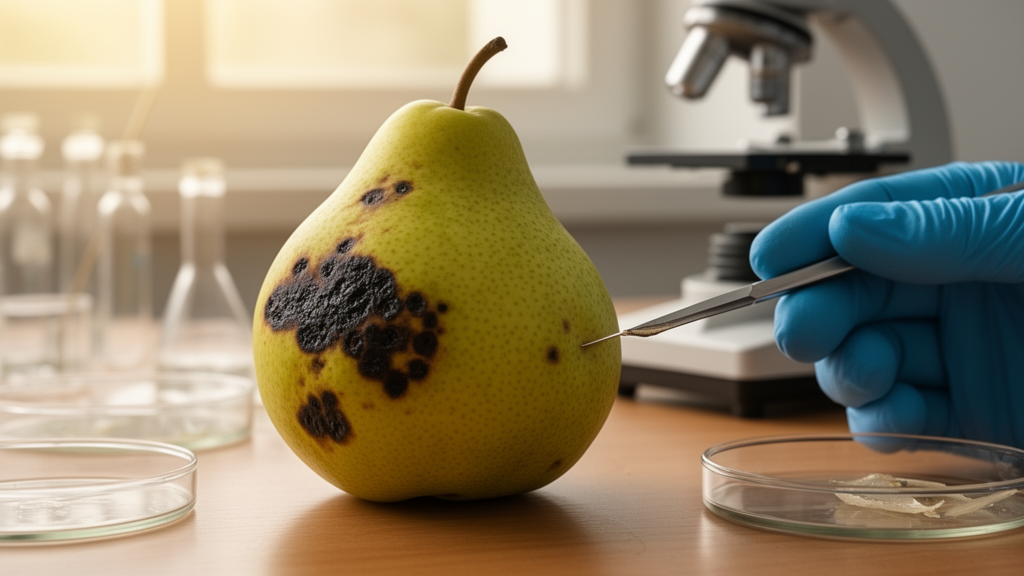
Researchers have mapped how Korla fragrant pear, a fruit tree native to Xinjiang, China, responds at the molecular level to black spot disease, a fungal infection caused by Alternaria alternata that triggers early defoliation and fruit rot and imposes significant economic losses in pear production. In a study published in BMC Plant Biology, the team combined transcriptome and metabolome profiling of pear leaves sampled at multiple time points after inoculation, aiming to fill a gap in understanding how pear species react to this pathogen — knowledge that has so far limited progress in breeding disease-resistant trees.

The dual approach revealed an extensive molecular response. Compared with the pre-inoculation baseline at 0 hours, the analysis identified 17,362 differentially expressed genes, while comparison against time-matched mock-inoculated controls yielded 9,840 such genes. A core set of 9,008 genes common to both comparisons was then clustered into six distinct expression profiles, with pathway enrichment analysis carried out for each cluster separately.

On the metabolic side, the profiling detected 2,596 differentially regulated metabolites relative to the 0-hour baseline and 2,616 relative to the mock controls, with 2,017 metabolites shared between the two comparisons. When the transcriptomic and metabolomic datasets were integrated, three major response-associated pathways stood out: flavonoid biosynthesis, photosynthesis-related processes, and plant hormone signal transduction, suggesting that the pear’s defense involves coordinated changes in gene expression, secondary metabolism, energy production, and hormonal signaling.

To narrow the field of candidates for further study, the researchers applied weighted gene co-expression network analysis, which identified 12 candidate hub genes. These include six transcription factors and three genes belonging to the flavonoid pathway, all flagged for subsequent functional validation. The authors emphasize that the work provides an integrated overview of the transcriptomic and metabolic changes associated with the Korla fragrant pear response to A. alternata infection and prioritizes candidate genes for future validation, rather than demonstrating function of the genes themselves. As an open-access, peer-reviewed study published on 27 October 2026, it offers a resource for breeders seeking resistance traits, though the identified hub genes remain candidates until experimental validation confirms their roles in defense against the pathogen.

Subject of Research: Transcriptomic and metabolomic responses of Korla fragrant pear to black spot disease caused by Alternaria alternata

Article Title: Integrated transcriptomic and metabolomic analysis of Korla fragrant pear responses to black spot disease caused by Alternaria alternata

Article References: Song, B., Xu, B., Zhang, L., He, T., & Zhu, X. (2026). Integrated transcriptomic and metabolomic analysis of Korla fragrant pear responses to black spot disease caused by Alternaria alternata. BMC Plant Biology. https://doi.org/10.1186/s12870-026-10072-0

Image Credits: AI Generated

DOI: 10.1186/s12870-026-10072-0

Keywords: Korla fragrant pear, black spot disease, Alternaria alternata, transcriptomics, metabolomics, differentially expressed genes, flavonoid biosynthesis, plant hormone signaling, WGCNA, hub genes, disease resistance, Xinjiang

News Source: Juliet Wilcox. (October 27, 2026). Korla Fragrant Pear Genes and Metabolites Shift During Black Spot Infection. Scienmag.


Tags: Alternaria alternatablack spot diseasedifferentially expressed genesdisease resistanceFlavonoid biosynthesishub genesKorla fragrant pearMetabolomicsplant hormone signalingTranscriptomicsWGCNAXinjiang
Share12Tweet7Share2ShareShareShare1

Related Posts

Genetic Diversity Study of 110 Green Super Rice Lines Reveals High-Yield, Disease-Resistant Candidates

Genetic Diversity Study of 110 Green Super Rice Lines Reveals High-Yield, Disease-Resistant Candidates

October 27, 2026
Arsenic and cadmium raise concern in Bangladesh farm soils and crops

Arsenic and cadmium raise concern in Bangladesh farm soils and crops

October 27, 2026

Brachypodium genome reveals conserved gene networks governing seed dormancy in temperate cereals

October 27, 2026

GWAS Pinpoints Candidate Genes Behind Wheat Stripe Rust Resistance

October 27, 2026

POPULAR NEWS

  • New blue-staining bolete species and new records of recently established genus emerge from Guizhou forests

    New blue-staining bolete species and new records of recently established genus emerge from Guizhou forests

    29 shares
    Share 12 Tweet 7
  • Genetic Diversity Study of 110 Green Super Rice Lines Reveals High-Yield, Disease-Resistant Candidates

    29 shares
    Share 12 Tweet 7
  • Switzerland’s Ladybirds Counted at Last: 81 Species, Seven Brand-New to the Country

    29 shares
    Share 12 Tweet 7
  • Gene expression tests for non-coding variants compared in neurodevelopmental disorders

    29 shares
    Share 12 Tweet 7

About

We bring you the latest biotechnology news from best research centers and universities around the world. Check our website.

Follow us

Recent News

New blue-staining bolete species and new records of recently established genus emerge from Guizhou forests

Genetic Diversity Study of 110 Green Super Rice Lines Reveals High-Yield, Disease-Resistant Candidates

Switzerland’s Ladybirds Counted at Last: 81 Species, Seven Brand-New to the Country

Subscribe to Blog via Email

Enter your email address to subscribe to this blog and receive notifications of new posts by email.

Join 85 other subscribers
  • Contact Us

Bioengineer.org © Copyright 2023 All Rights Reserved.

Welcome Back!

Login to your account below

Forgotten Password?

Retrieve your password

Please enter your username or email address to reset your password.

Log In
No Result
View All Result
  • Homepages
    • Home Page 1
    • Home Page 2
  • News
  • National
  • Business
  • Health
  • Lifestyle
  • Science

Bioengineer.org © Copyright 2023 All Rights Reserved.