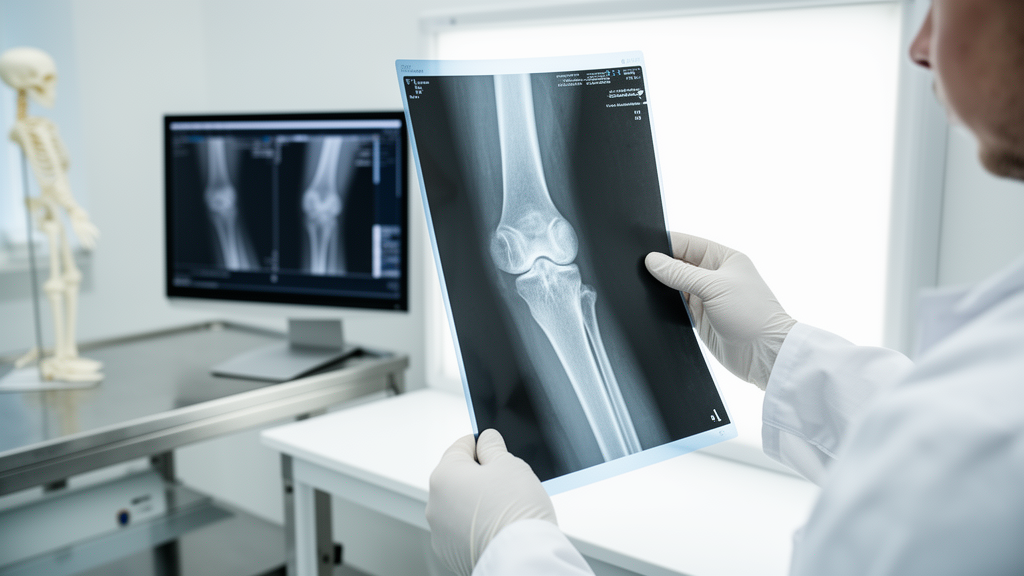
Forensic scientists searching for ways to identify human remains when the pelvis and skull are missing may soon have a new tool at their disposal: ordinary knee X-rays. A study published in the Egyptian Journal of Forensic Sciences has shown that simple linear measurements taken from anteroposterior knee radiographs can distinguish male from female individuals in a Brazilian sample with accuracy reaching roughly 80 percent, offering a potential auxiliary method for building the biological profile of unidentified persons.
The research, led by Mirela Cristina da Silva and colleagues at the University of São Paulo’s Ribeirão Preto Medical School, set out to test whether three linear measurements of the bones forming the knee could serve as the basis for sex estimation using binary logistic regression models. The work responds to a long-standing principle in forensic anthropology: because patterns of skeletal sexual dimorphism vary across populations, methods developed in one group cannot simply be transferred to another. Brazil, with its extensive admixture of Indigenous, European, African and Asian ancestries, requires population-specific validation of any new identification technique.
The knee region has attracted attention for this purpose for several reasons. The distal femur and proximal tibia are large, robust bones that resist diverse environmental conditions after death, and their muscle attachments experience heavy mechanical loading, a factor linked to greater sexual dimorphism. Previous studies have reported good results using the femoral epicondylar breadth, with accuracy rates between 86 and 95.4 percent, and maximum tibial epiphyseal height, with rates between 80.9 and 93.8 percent. Metric approaches also carry the advantage of reducing the subjective bias that affects visual assessments of skeletal traits.
To build their sample, the researchers initially collected 1,058 knee radiographs from Brazilian individuals of both sexes aged over 18 years, comprising 499 male and 559 female images. They then applied strict exclusion criteria, removing radiographs showing trauma, pathological conditions, developmental bone alterations, prostheses or artifacts that impaired visualization of the regions of interest, as well as images measured in pixels rather than a physical unit. To ensure that each observation corresponded to a unique individual, only the left knee radiograph was retained. The final analytical sample comprised 474 left knee images, 244 from females and 230 from males.
Using the ImageJ software, the team took three measurements in millimeters, following a protocol originally described by Squyres and Ruff for body mass estimation and later adapted to radiographic sex estimation by Maijanen and colleagues in a Finnish sample. Two measurements were taken at the distal femoral epiphysis: the femoral biepicondylar breadth, the maximum mediolateral width across the femoral epicondyles measured perpendicular to the long axis of the femoral shaft, and the mediolateral breadth of the articular surface of the femoral condyles, measured parallel to a tangent through the most inferior points of the condyles. The third measurement, taken at the proximal tibial epiphysis, was the mediolateral breadth of the tibial plateau articular surface, abbreviated TPML, defined as the maximum mediolateral width of the proximal articular surface measured parallel to the tibial plateaus.
Reliability was strong. Two examiners were trained before applying the technique, and intra- and inter-examiner reliability were assessed using the Intraclass Correlation Coefficient on a randomly selected 10 percent of the sample, 98 images, re-evaluated after one week under blinded conditions in a low-light environment. Both intra- and inter-examiner reliability were rated excellent for all three measurements, with ICC values above 0.9. Welch’s two-sample t-test, chosen for its robustness with unequal variances and sample sizes, confirmed that the mean values of all three measurements were significantly higher in males than in females, and Rosner’s test identified no statistical outliers, so all observations were retained.
Because multicollinearity was detected among the measured variables, the researchers constructed separate univariate binary logistic regression models for each measurement rather than combining them. In each model, sex was coded as 0 for female and 1 for male, with female as the reference category for odds ratios. All three models showed a statistically significant association between the measurement and sex, with p values below 0.001. Internal validation used 10-fold cross-validation, in which the dataset was partitioned into ten subsets and the model was trained on nine and tested on the remaining one at each iteration. Performance was evaluated with confusion matrices yielding accuracy, sensitivity, specificity, positive and negative predictive values, and with ROC curves and the area under the curve, all with 95 percent confidence intervals.
The TPML measurement emerged as the clear winner. The model based on the tibial plateau breadth achieved an accuracy of 0.80 during cross-validation, with a 95 percent confidence interval of 0.76 to 0.83, sensitivity of 0.71 and specificity of 0.88, meaning it classified females more reliably than males. The femoral biepicondylar breadth model followed with an accuracy of 0.78, sensitivity of 0.67 and specificity of 0.88, while the femoral condylar breadth model lagged at 0.63 accuracy, with sensitivity of only 0.39 but specificity of 0.86. Model comparison using Nagelkerke pseudo-R2, the Akaike Information Criterion and the Bayesian Information Criterion also favored the TPML model, with a pseudo-R2 of 0.58, an AIC of 385.68 and a BIC of 394.00, narrowly ahead of the biepicondylar breadth model and well ahead of the condylar model, whose pseudo-R2 was just 0.23. From the fitted TPML model, the team derived an equation in which higher TPML values correspond to a greater probability of classifying an individual as male.
Complementary analyses added a machine-learning dimension. Because TPML performed best among the logistic models, the researchers used only this measurement to develop a linear discriminant analysis model and a decision tree model, a supervised machine-learning method, both following the same 10-fold cross-validation strategy. The decision tree achieved the best performance of any analysis in the study, with an accuracy of 82 percent, sensitivity of 0.77 and specificity of 0.86, while the linear discriminant analysis reached 81 percent accuracy with sensitivity of 0.83 and specificity of 0.79. These complementary models showed more balanced performance between the two sex categories than the logistic regression model, and the authors note that in forensic applications, where classification bias can affect practical applicability, the balance between sensitivity and specificity matters as much as overall accuracy.
The study’s limitations are significant and the authors are candid about them. The radiographs were obtained retrospectively from an institutional database for therapeutic purposes and lacked scale markers, so measurements represent radiographic dimensions rather than true anatomical dimensions, and detailed information on acquisition parameters and positioning protocols was unavailable. This may partly explain why the accuracies reported here fall below those of the Finnish study by Maijanen and colleagues, which reported total-sample accuracies of 90.9 percent for the biepicondylar breadth, 93.6 percent for the condylar breadth and 93 percent for TPML using calibrated radiographs. The Brazilian equations should therefore be applied preferably to radiographs acquired under comparable imaging conditions and should not be extrapolated directly to osteometric measurements taken from dry bones with calipers without prior validation. Because the images came from living individuals, direct comparison with skeletal measurements was not possible. The authors call for further studies using calibrated images, scale markers and external validation in independent populations to strengthen the robustness, generalizability and forensic applicability of the models, which they position as an auxiliary tool for forensic investigations involving radiographic records rather than a standalone solution.
Subject of Research: Sex estimation from linear measurements on anteroposterior knee radiographs in a Brazilian sample using logistic regression and machine learning models
Article Title: Sex estimation from anteroposterior knee radiographs in a Brazilian sample
Article References: Silva, M. C. D., do Nascimento, I. D. S. M., Pinto, P. H. V., Pinto, A. S. B., & Silva, R. H. A. D. (2026). Sex estimation from anteroposterior knee radiographs in a Brazilian sample. Egyptian Journal of Forensic Sciences, 16(1), Article 87. https://doi.org/10.1186/s41935-026-00585-y
Image Credits: AI Generated
DOI: 10.1186/s41935-026-00585-y
Keywords: forensic anthropology, sex estimation, knee radiographs, binary logistic regression, tibial plateau, femur, Brazilian population, cross-validation, decision tree, linear discriminant analysis, human identification, sexual dimorphism
News Source: Ophelia Keating. (October 29, 2026). Knee X-rays can help identify sex in forensic cases, Brazilian study finds. Scienmag.