


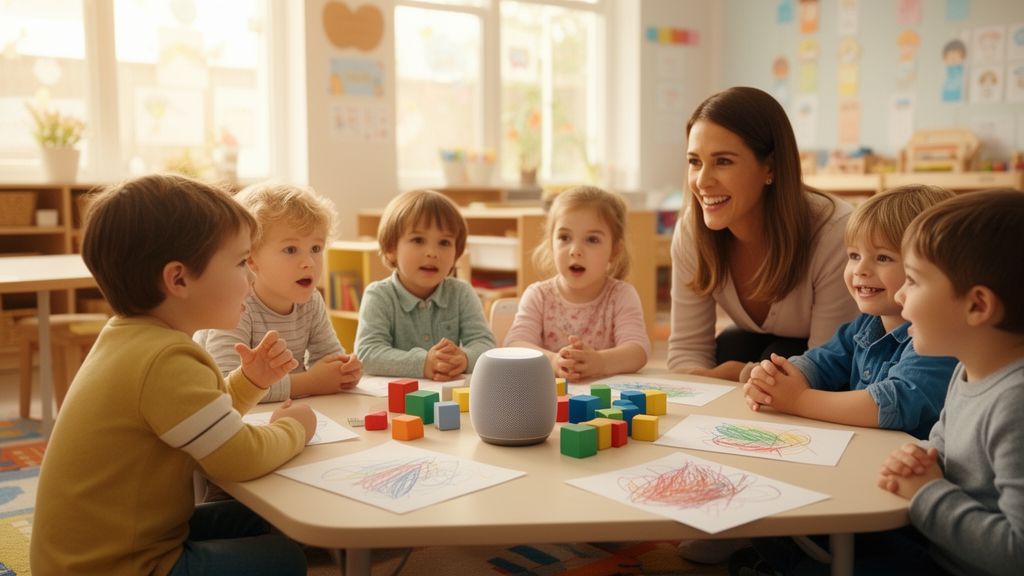
Four- and five-year-old children in a Shanghai kindergarten displayed strikingly uneven knowledge of the conversational AI app Doubao, ranging from no awareness at all to one child who could prompt the system to generate videos and then critique its output. That is the central finding of an exploratory qualitative study published in the journal AI, Brain and Child, in which researchers interviewed 23 kindergarten children in their own classrooms and invited them to demonstrate, on a smartphone, how they interacted with one of China’s most widely used voice-driven AI assistants.
The study, led by Jie Gao, a kindergarten teacher-researcher in Shanghai, together with Australian early childhood researcher Caroline Cohrssen, set out to fill a conspicuous gap. Although young children increasingly encounter generative AI at home and in early childhood settings, little research has examined whether they can actually use such technologies independently, and most existing work on generative AI in early childhood education remains theoretical or filtered through adult and teacher perspectives. The authors framed their inquiry with Navarro and Tudge’s neo-ecological theory, which adapts Bronfenbrenner’s classic Process-Person-Context-Time model to a world where a person can be simultaneously present in two microsystems: a physical, face-to-face one and a virtual one accessed through digital platforms. Within that framework, the researchers treated Doubao itself as a non-human “Person” potentially involved in reciprocal proximal processes with the child.
Data collection took place in September and October 2025, at the start of the 2025-2026 academic year in China, the same year that AI education became mandatory for children from age six. Using a purposive convenience sample, the team recruited eight girls and eight boys each from the second (K2, ages four to five) and third (K3, ages five to six) years of kindergarten, with parental consent and ongoing child assent. All 32 consented children agreed to talk, but nine did not know what Doubao was and did not take part in an interview, leaving 23 participants. Two boys who said they did not know Doubao specifically nonetheless described familiarity with other voice assistants, such as a smart speaker on a grandmother’s phone, and their data were retained. Interviews lasted no longer than ten minutes, were conducted in Mandarin, audio-recorded, transcribed and translated, and children were invited to ask Doubao anything they wanted so their natural interaction patterns could be observed.
Most participating children reported never having used Doubao before, although some had used it many times, and prior use differed by gender and age group: more boys than girls reported occasional use, while more girls reported frequent use. From the transcripts and fieldnotes, the researchers identified three themes. The first, “Physical Person facilitation of entry into AI interactions,” captured how an adult in the room, in this case the teacher-researcher, typically opened the door to the virtual world: locating the app, enabling audio, modelling voice input, prompting questions and helping children reflect on whether the AI’s answer had actually addressed what they asked.
The transcripts show how quickly that scaffolding could recede. One K2 boy who had never used Doubao, because he did not have a phone, moved from being unable to find the app or think of a question to interacting with it once the researcher had opened it and modelled a prompt. In another exchange, a girl asked whether dumplings came from Shanghai; Doubao replied with a long, meandering answer that noted Shanghai is a place, not a food. Prompted by the researcher to consider whether the answer matched her question, the child reformulated it, and the second, more targeted answer allowed her to draw a conclusion of her own. The authors note, however, that overly long and complex Doubao responses abounded in the data and were seldom challenged without adult prompting.
The second theme, “Children’s differing locations in virtual and physical worlds,” describes how children straddled the two settings. One K2 girl wove the researcher and Doubao into a single conversation, addressing the app, commenting to the adult about a video Doubao had offered, and then returning to the app. A K3 girl who described Doubao as “a pretend person you can chat with” listened to the AI’s riddle while whispering her guess, “I think it’s the moon,” to the researcher, then repeated it aloud to the app, which praised her for guessing in one. Other exchanges were sequential rather than synchronous, with children simply reporting to the adult what the virtual assistant had said.
The third theme, “The paradox of Person as human or non-human,” goes to the heart of the design question. Doubao, developed by ByteDance, is deliberately anthropomorphic: its icon is a friendly “little sister” character, and its voice is engineered to sound close to a real human, encouraging emotional connection. Some children treated it accordingly; one K2 boy insisted that using Doubao requires knowing how to ask questions and being polite. Yet the same transcripts reveal mismatches that seemed to undercut the illusion: children’s short statements met with disproportionately long, effusive replies, lengthy lags between prompt and response, and in one case a question about local rain answered with an excessively detailed weather report for Santa Clara County, California. The authors suggest that, for these participants at least, such mismatches appeared to subvert anthropomorphism, though they caution that the affiliative design may still encourage over-trust in children whose cognitive immaturity limits critical evaluation of AI output.
The analysis itself was deliberately human-led. Both authors coded the translated transcripts manually, producing an initial dataset of 235 coded excerpts plus 75 fieldnote codes capturing gestures and eye gaze, refined down to 303 items. An AI assistant built on Claude 4.5 Sonnet was then used to help cluster codes into patterns and themes, but only after the researchers had completed their own reflexive coding, and with permanent instructions never to present generated or speculative content as fact. The authors describe their stance as “human-throughout-the-loop,” with interpretive authority retained by the researchers throughout.
The findings come with clear limits. This was a convenience sample from a single Shanghai kindergarten, so results cannot be generalised, and the brief interviews captured only point-in-time demonstrations of skill; the design could not examine whether child-AI interactions grew more complex over time, a defining feature of proximal processes. Indeed, the authors report that in most instances there was insufficient evidence of increasing complexity to call the virtual interactions proximal processes at all, and that where reciprocity was sustained, the content stayed superficial. Non-verbal communication, crucial with young children, was only partially captured through fieldnotes rather than video.
Even so, the study offers a concrete message for educators and developers alike: children arrive at kindergarten with wildly different AI experience, learn the mechanics of voice assistants quickly, but frequently accept generated answers without questioning them. The authors argue that AI-literate adults need to mediate young children’s independent use of conversational AI, explicitly addressing its lack of genuine emotional understanding, the risk of anthropomorphism and the need for critical evaluation, ideally through small-group, teacher-guided activities, and they call for future research on how adults’ own cues, verbal and non-verbal, shape children’s engagement with these persuasive non-human interlocutors.
Subject of Research: Young children's independent use of a conversational AI app in kindergarten classrooms
Article Title: Four- and five-year-old children’s use of Doubao conversational artificial intelligence in kindergarten classrooms
Article References: Gao, J., & Cohrssen, C. (2026). Four- and five-year-old children’s use of Doubao conversational artificial intelligence in kindergarten classrooms. AI, Brain and Child, 2(1), Article 5. https://doi.org/10.1007/s44436-026-00027-5
Image Credits: AI Generated
DOI: 10.1007/s44436-026-00027-5
Keywords: conversational AI, Doubao, kindergarten, early childhood education, AI literacy, generative AI, neo-ecological theory, anthropomorphism, Shanghai, qualitative study, teacher scaffolding, voice assistants
News Source: Courtney Benton. (October 30, 2026). Kindergarteners Show Wide-Ranging Skills Talking to Doubao AI in Class. Scienmag.



