• HOME
  • NEWS
  • EXPLORE
    • CAREER
      • Companies
      • Jobs
    • EVENTS
    • iGEM
      • News
      • Team
    • PHOTOS
    • VIDEO
    • WIKI
  • BLOG
  • COMMUNITY
    • FACEBOOK
    • INSTAGRAM
    • TWITTER
Tuesday, November 17, 2026
BIOENGINEER.ORG
No Result
View All Result
  • Login
  • HOME
  • NEWS
  • EXPLORE
    • CAREER
      • Companies
      • Jobs
        • Lecturer
        • PhD Studentship
        • Postdoc
        • Research Assistant
    • EVENTS
    • iGEM
      • News
      • Team
    • PHOTOS
    • VIDEO
    • WIKI
  • BLOG
  • COMMUNITY
    • FACEBOOK
    • INSTAGRAM
    • TWITTER
No Result
View All Result
Bioengineer.org
No Result
View All Result
Home NEWS Science News Health

Kidney Function Linked to Vitrectomy Outcomes in Young Type 1 Diabetes Patients

by
November 7, 2026
in Health
Reading Time: 2 mins read
0
Kidney Function Linked to Vitrectomy Outcomes in Young Type 1 Diabetes Patients

Kidney Function Linked to Vitrectomy Outcomes in Young Type 1 Diabetes Patients

Share on FacebookShare on TwitterShare on LinkedinShare on RedditShare on Telegram

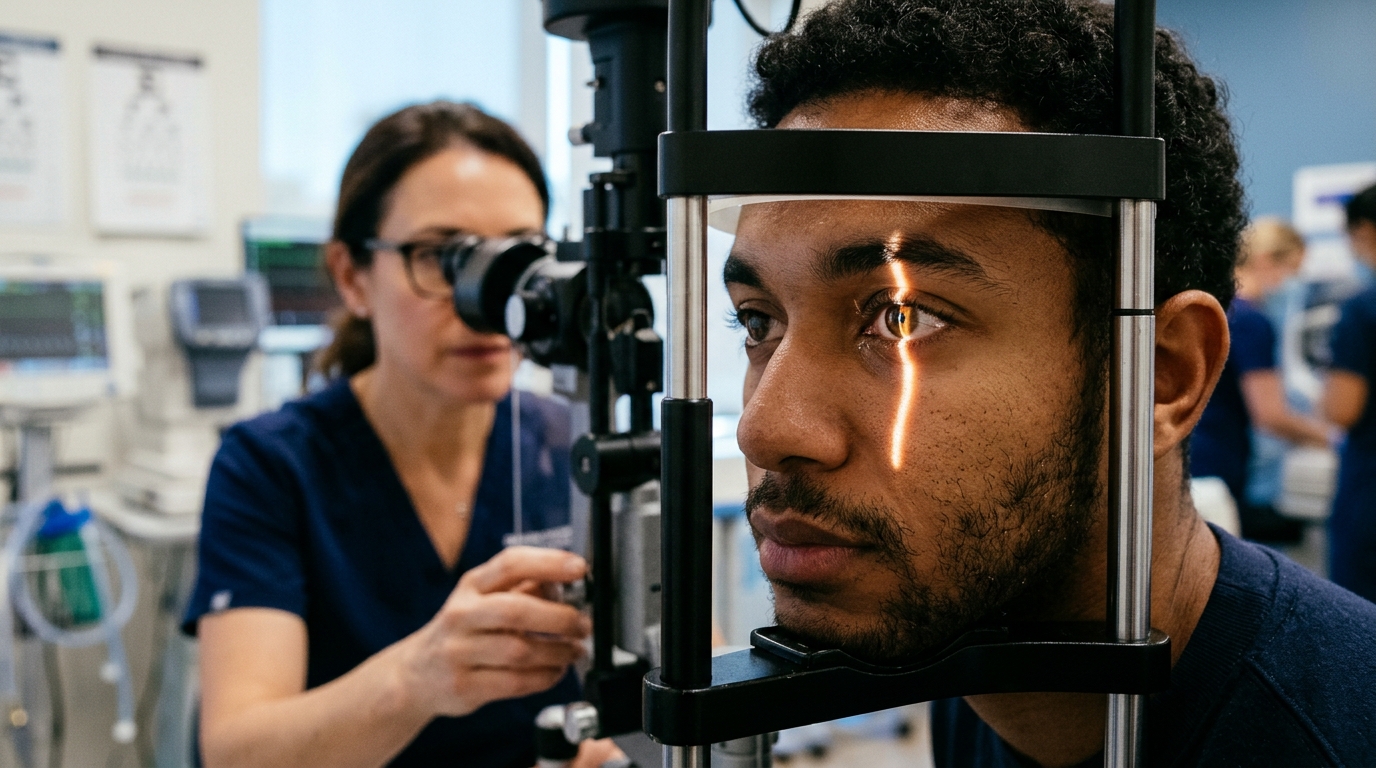
In young adults undergoing vitrectomy for type 1 proliferative diabetic retinopathy, renal function is closely associated with surgical prognosis and postoperative visual outcomes, according to a retrospective cohort study published in BMC Ophthalmology. The investigation, conducted by researchers at Jinan Mingshui Eye Hospital, evaluated clinical characteristics and surgical outcomes among patients aged 18 to 45 years, comparing 25 patients (31 eyes) with type 1 diabetes mellitus against 35 patients (42 eyes) with type 2 diabetes mellitus. While surgical outcomes were similar between both diabetes cohorts among individuals with preserved renal function, patients with type 1 diabetes and comorbid chronic kidney disease experienced the poorest prognosis.

At baseline, patients in the type 1 diabetes group were significantly younger than those in the type 2 diabetes group, with a mean age of 28.86 ± 6.62 years compared with 34.78 ± 6.85 years (P = 0.030), but had a longer duration of diabetes at 11.29 ± 4.57 years versus 8.13 ± 4.02 years (P = 0.011). Chronic kidney disease was present in 41.9% (13 of 31) of operated eyes in the type 1 diabetes group compared to 11.9% (5 of 42) in the type 2 diabetes group (P = 0.029). During surgery, intraoperative silicone oil tamponade was used in 87.1% (27 of 31) of eyes with type 1 diabetes versus 69.0% (29 of 42) of eyes with type 2 diabetes (P = 0.040).

Postoperative complication rates also diverged, with neovascular glaucoma occurring in 12.9% (4 of 31) of eyes in the type 1 diabetes group compared to 2.4% (1 of 42) of eyes in the type 2 diabetes group (P = 0.029). When stratified by estimated glomerular filtration rate (eGFR), patients with type 1 diabetes and an eGFR below 30 mL/min/1.73 m² had the worst postoperative best-corrected visual acuity at 1.65 ± 0.82 logMAR. Conversely, patients with an eGFR exceeding 60 mL/min/1.73 m² showed no statistically significant difference in postoperative visual acuity compared to the type 2 diabetes cohort (P = 0.187).

Correlation analyses within the type 1 diabetes cohort showed that higher postoperative logMAR best-corrected visual acuity—reflecting poorer vision—was positively correlated with glycated hemoglobin (r = 0.753, P = 0.002), preoperative panretinal photocoagulation history (r = 0.809, P < 0.001), postoperative neovascular glaucoma (r = 0.620, P = 0.002), and chronic kidney disease (r = 0.709, P < 0.001). The authors noted that the renal subgroup findings are based on small sample sizes and must be interpreted with caution. Given the exploratory nature of the study, the investigators concluded that confirmation in larger, longer-term studies is necessary and suggested that eGFR may serve as a useful component of preoperative risk assessment.

Subject of Research: Surgical outcomes and renal prognostic factors of vitrectomy in young adults with type 1 proliferative diabetic retinopathy

Article Title: Clinical characteristics and surgical outcomes of vitrectomy in young adults with type 1 proliferative diabetic retinopathy

Article References: Ke, N., Donglin, W., Yongbin, L., Huabin, Z., Chunxia, Z., & Yanhui, H. (2026). Clinical characteristics and surgical outcomes of vitrectomy in young adults with type 1 proliferative diabetic retinopathy. BMC Ophthalmology. https://doi.org/10.1186/s12886-026-05507-z

Image Credits: AI Generated

DOI: 10.1186/s12886-026-05507-z

Keywords: vitrectomy, proliferative diabetic retinopathy, type 1 diabetes, chronic kidney disease, estimated glomerular filtration rate, neovascular glaucoma, ophthalmology, retinal surgery, Clinical, characteristics, surgical, outcomes

News Source: Jerry Hayes. (November 7, 2026). Kidney Function Linked to Vitrectomy Outcomes in Young Type 1 Diabetes Patients. Scienmag.

Tags: characteristicsChronic Kidney DiseaseClinicalestimated glomerular filtration rateneovascular glaucomaOphthalmologyoutcomesproliferative diabetic retinopathyretinal surgerySurgicalType 1 diabetesvitrectomy
Share12Tweet7Share2ShareShareShare1

Related Posts

Staged Surgical Protocol Reconstructs Adolescent Mandible Following Ossifying Fibroma Resection

Staged Surgical Protocol Reconstructs Adolescent Mandible Following Ossifying Fibroma Resection

November 17, 2026
Comorbidities Associated With Lower RSV Humoral and Cellular Immunity in Older Adults

Comorbidities Associated With Lower RSV Humoral and Cellular Immunity in Older Adults

November 17, 2026

Visual Distraction Reduces Quantitative Light Touch Sensitivity in Healthy Adult Hand Testing

November 17, 2026

Herbal Iridoid Extract Relieves Fatty Liver Hemorrhagic Syndrome in Laying Hens

November 17, 2026

POPULAR NEWS

  • Staged Surgical Protocol Reconstructs Adolescent Mandible Following Ossifying Fibroma Resection

    Staged Surgical Protocol Reconstructs Adolescent Mandible Following Ossifying Fibroma Resection

    29 shares
    Share 12 Tweet 7
  • Microglia Study Identifies FKBP5 as a Regulator of Alzheimer’s Inflammation

    29 shares
    Share 12 Tweet 7
  • Holmium Substitution Improves SmFeO3 Supercapacitor Electrochemical Performance in KI/KOH Electrolyte

    29 shares
    Share 12 Tweet 7
  • Comorbidities Associated With Lower RSV Humoral and Cellular Immunity in Older Adults

    29 shares
    Share 12 Tweet 7

About

We bring you the latest biotechnology news from best research centers and universities around the world. Check our website.

Follow us

Recent News

Staged Surgical Protocol Reconstructs Adolescent Mandible Following Ossifying Fibroma Resection

Microglia Study Identifies FKBP5 as a Regulator of Alzheimer’s Inflammation

Holmium Substitution Improves SmFeO3 Supercapacitor Electrochemical Performance in KI/KOH Electrolyte

Subscribe to Blog via Email

Enter your email address to subscribe to this blog and receive notifications of new posts by email.

Join 88 other subscribers
  • Contact Us

Bioengineer.org © Copyright 2023 All Rights Reserved.

Welcome Back!

Login to your account below

Forgotten Password?

Retrieve your password

Please enter your username or email address to reset your password.

Log In
No Result
View All Result
  • Homepages
    • Home Page 1
    • Home Page 2
  • News
  • National
  • Business
  • Health
  • Lifestyle
  • Science

Bioengineer.org © Copyright 2023 All Rights Reserved.