


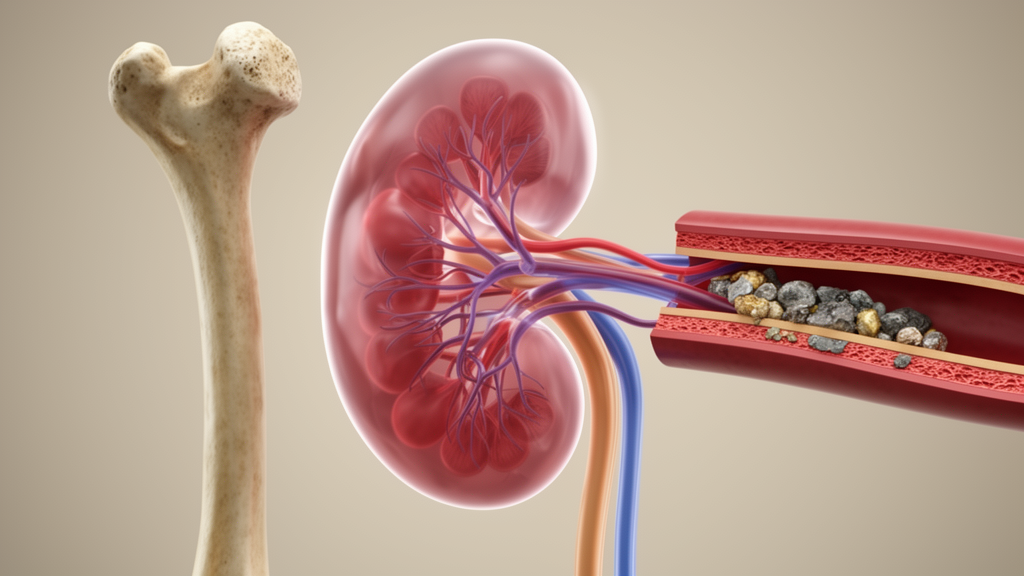
Chronic kidney disease does not wait until the kidneys fail to start damaging the skeleton and the cardiovascular system. According to a narrative review published in Frontiers in Endocrinology, the mineral and bone disorder that accompanies kidney disease begins early, as the glomerular filtration rate falls, and its seemingly mild biochemical abnormalities in phosphate, parathyroid hormone and vitamin D eventually translate into fractures, vascular and valvular calcification, heart failure, hospitalization and death. The review, authored by researchers at the First Affiliated Hospital of Henan University of Chinese Medicine and collaborators, argues that the field should stop treating this condition as an electrolyte problem and start treating it as multidimensional bone-vascular risk medicine.
The condition, known as CKD-MBD, is defined in KDIGO guidelines as a systemic disorder of mineral and bone metabolism caused by chronic kidney disease. It expresses itself through abnormal biochemistry, disordered bone turnover, mineralization, mass or strength, and vascular or soft-tissue calcification, alone or in combination. The review contends that decades of management organized around biochemical surrogate endpoints have underperformed, because serum phosphate, calcium and parathyroid hormone do not show simple or consistent relationships with fracture, cardiovascular events or mortality. Across cohorts, these markers relate to death in U-shaped or otherwise non-linear ways, meaning that lower is not reliably better.
To operationalize this shift, the authors propose a working framework of five partially overlapping phenotypes rather than a single undifferentiated syndrome: a high-phosphate and high-parathyroid-hormone pattern generally associated with high bone turnover; a low-turnover pattern seen in the context of diabetes, older age or sustained calcium loading; a calcification-dominant pattern with established vascular or valvular calcification; an inflammation-malnutrition pattern; and a post-transplant pattern shaped by persistent hyperparathyroidism, glucocorticoid exposure and hypophosphatemia. The authors stress that these categories are provisional and educational, not validated diagnostic classes, that they may coexist within the same patient, and that their prospective validation remains a research priority.
The mechanistic core of the framework is the bone-vascular axis. Bone is not merely a mineral reservoir but an endocrine organ that regulates phosphate, FGF23, parathyroid hormone and vitamin D, while the vessel wall, in the uremic milieu, can adopt an osteoblast-like phenotype and form calcified foci. Phosphate retention sits at the center: sustained excess stimulates osteocyte secretion of FGF23, drives phosphate into vascular smooth muscle cells through transporters such as PiT-1, switching on the osteogenic program that produces calcification, and forms calciprotein particles that injure the endothelium. The review also covers the FGF23-Klotho axis, vitamin D-parathyroid hormone dysregulation, Wnt/beta-catenin signaling, inflammation, gut dysbiosis and uremic toxins, while carefully distinguishing mechanistic plausibility from observational association and from evidence of hard-endpoint benefit.
That evidence grading is the review’s most sobering contribution. Phosphate binders lower serum phosphate, but adequately powered randomized evidence for mortality or cardiovascular benefit remains lacking or inconsistent. Calcimimetics such as etelcalcetide reliably lower parathyroid hormone in dialysis patients, yet the EVOLVE trial of cinacalcet did not significantly reduce death or major cardiovascular events in its unadjusted intention-to-treat analysis. Active vitamin D analogues lower parathyroid hormone but carry hypercalcemia risk, and KDIGO advises against their routine use in non-dialysis chronic kidney disease. Parathyroidectomy shows a possible survival signal only in observational data. SNF472, an inhibitor of hydroxyapatite crystallization, slowed coronary and aortic-valve calcification progression in a randomized phase 2b trial among hemodialysis patients, but its effects on cardiovascular events and survival remain unproven, leaving it investigational.
The skeletal side is equally fraught. Hip, vertebral and non-vertebral fractures are markedly more frequent in advanced kidney disease and on dialysis, and the hospitalization, disability and death that follow exceed those in the general population. The excess risk reflects more than low bone mineral density: increased cortical porosity, disrupted microarchitecture, sarcopenia, falls, inflammation, malnutrition, diabetes and drug exposure all contribute, so DXA alone may understate fragility. Among anti-osteoporotic drugs, denosumab is not renally cleared but carries a steep risk of severe hypocalcemia in advanced disease, prompting a boxed warning; romosozumab raised bone density and lowered vertebral fracture risk in women with osteoporosis and mild-to-moderate kidney disease, but evidence thins in advanced disease and cardiovascular safety remains unsettled; teriparatide may suit low-turnover disease with genuinely high fracture risk, but not uncontrolled severe secondary hyperparathyroidism.
Diagnosis presents its own mismatch between what is easy to measure and what patients face. Bone biopsy with histomorphometry remains the reference standard for renal osteodystrophy, but it is invasive and unavailable in most centers, so turnover must be inferred from serial parathyroid hormone, bone-specific alkaline phosphatase and other markers, with biopsy reserved for cases where the turnover state changes management. DXA predicts fracture but cannot define turnover; HR-pQCT resolves microarchitecture but is not validated for routine decisions; 18F-NaF PET/CT, calcification propensity testing and calciprotein particle analysis remain research tools. The review’s proposed clinical core is deliberately small: track serial calcium, phosphate and parathyroid hormone, assess fracture risk with DXA and vertebral imaging, screen for vascular calcification with a calcium score, lateral abdominal radiograph or echocardiography, and judge success by patient outcomes rather than normalized numbers.
On the vascular side, where calcification is already established, no drug has yet been shown convincingly to reverse calcification and improve hard endpoints. Strategy instead rests on controlling phosphate load, avoiding hypercalcemia, limiting calcium-containing binders, keeping parathyroid hormone in range and individualizing dialysate calcium. Vitamin K and magnesium supplementation cannot be regarded as established therapies for calcification, since randomized vitamin K trials have disagreed, and the review places gut microbiota, anti-inflammatory and senescence-targeting approaches firmly at the experimental end of the evidence ladder, noting that probiotics, fiber and similar strategies have not been shown to move hard endpoints.
The authors also examine why the evidence base itself is so thin. Clinical endpoints take time, the population is heterogeneous, and the patients who most need treatment are the most prone to hypocalcemia, hypercalcemia and cardiovascular events, which is why many osteoporosis trials excluded low kidney function or dialysis, leaving extrapolation shaky. Reliance on phosphate or parathyroid hormone as primary endpoints has made patient benefit hard to demonstrate, as EVOLVE illustrated. The remedy they propose is trial design that stratifies participants by phenotype, pairs short-term mechanistic endpoints with fractures, cardiovascular events and quality of life, and pre-defines safety endpoints such as hypocalcemia and low-turnover bone disease.
The review’s recurring theme is blunt: biochemical improvement is not itself benefit. Whether or not the five-phenotype framework survives validation, the authors argue, the underlying shift it embodies, from correcting a number toward stratifying risk and improving endpoints, is what will let the field deliver what patients with chronic kidney disease actually need: fewer fractures, better-protected hearts and vessels, and a better quality of life. As a narrative rather than systematic review, its selection of evidence was interpretive, focused on adults, and excluded pediatric disease, so readers seeking pooled effect estimates are directed to the cited systematic reviews and meta-analyses.
Subject of Research: A narrative review proposing a multidimensional bone-vascular framework for managing chronic kidney disease-mineral and bone disorder.
Article Title: Chronic kidney disease–mineral and bone disorder as multidimensional bone–vascular risk framework: from biochemical control to risk-and context-guided care
Article References: Chen, G., Li, T., Yang, K., Wang, Y., & Zhang, L. (2026). Chronic kidney disease–mineral and bone disorder as multidimensional bone–vascular risk framework: from biochemical control to risk-and context-guided care. Frontiers in Endocrinology, 17, Article 1954515. https://doi.org/10.3389/fendo.2026.1954515
Image Credits: AI Generated
DOI: 10.3389/fendo.2026.1954515
Keywords: CKD-MBD, chronic kidney disease, vascular calcification, secondary hyperparathyroidism, FGF23, renal osteodystrophy, osteoporosis, phosphate binders, fracture risk, bone biopsy, EVOLVE trial, KDIGO
News Source: Jerry Hayes. (October 29, 2026). Kidney Disease Damages Bones and Vessels Together, Review Argues for Risk-Based Care. Scienmag.



