Alzheimer’s disease and Parkinson’s disease, along with stroke, are among the top three neurodegenerative disorders, characterized by the malfunction and progressive degeneration of neurons, the nerve cells. Understanding the mechanisms underlying these neurological disorders and developing therapies requires labeling technologies that can visualize neuronal changes not only in normal conditions but also in disease states.
Credit: Korea Institute of Science and Technology
Alzheimer’s disease and Parkinson’s disease, along with stroke, are among the top three neurodegenerative disorders, characterized by the malfunction and progressive degeneration of neurons, the nerve cells. Understanding the mechanisms underlying these neurological disorders and developing therapies requires labeling technologies that can visualize neuronal changes not only in normal conditions but also in disease states.
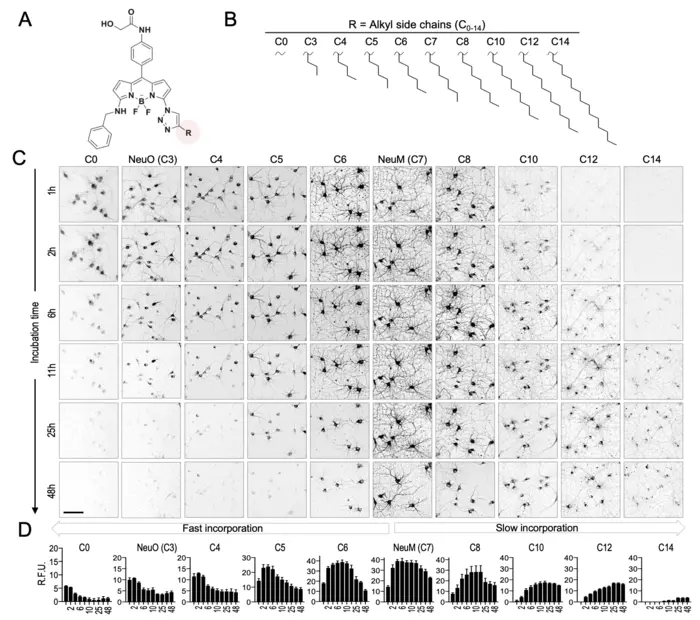
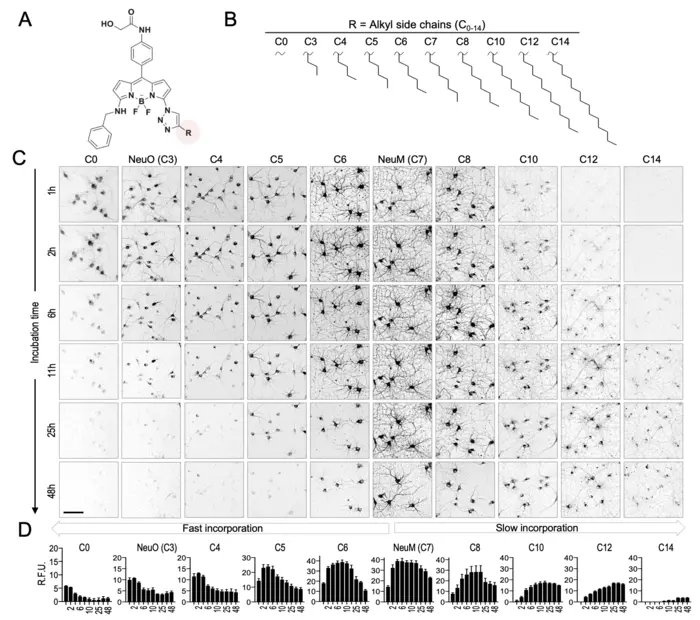
A research team led by Dr. Kim Yun Kyung from the Brain Science Institute at the Korea Institute of Science and Technology (KIST), in collaboration with Professor Chang Young-Tae’s team from Pohang University of Science and Technology, has announced the development of a next-generation neuron labeling technology called NeuM. NeuM (Neuronal Membrane-selective) selectively labels neuronal membranes, visualizing neuronal structures and allowing real-time monitoring of neuronal changes.
Neurons continuously modify their structure and function to transmit information from sensory organs to the brain, regulating thoughts, memories, and behaviors. Therefore, to overcome degenerative neurological diseases, it is essential to develop techniques that selectively label living neurons for real-time monitoring. However, current gene-based and antibody-based labeling technologies, commonly used to observe neurons, suffer from low accuracy and difficulty in long-term tracking due to their dependence on specific gene expression or proteins.
NeuM, developed by the research team through molecular design of neuronal cells, possesses excellent binding affinity to neuronal membranes, enabling long-term tracking and high-resolution imaging of neurons. The fluorescent probes within NeuM bind to neuronal membranes utilizing the activity of living cells, emitting fluorescent signals upon excitation by specific wavelengths of light. This visualization of neuronal membranes allows for detailed observation of neuronal terminal structures and high-resolution monitoring of neuronal differentiation and interactions.
NeuM, as the first technology to stain cell membranes through endocytosis in living neurons, exhibits selective reactivity towards living cells, excluding dead cells without internalization. Moreover, the research team has succeeded in extending the observation time of neurons from a mere 6 hours to up to 72 hours, enabling the capture of dynamic changes in living neurons over an extended period in response to environmental changes.
NeuM is expected to provide insights into research and therapy development for degenerative neurological diseases, for which there are currently no cures. These diseases, including Alzheimer’s, result from neuronal damage due to the production of toxic proteins such as amyloid and the influx of inflammatory substances. NeuM’s precise observation of neuronal changes can effectively facilitate the evaluation of candidate therapeutic compounds.
Dr. Kim stated, “NeuM, developed this time, can distinguish aging and degenerating neurons, becoming a crucial tool in elucidating the mechanisms of degenerative brain disorders and developing treatments.” He further added, “In the future, we plan to refine NeuM for even more precise analysis of neurons by designing fluorescence wavelengths to distinguish colors such as green and red.”
###
KIST was established in 1966 as the first government-funded research institute in Korea. KIST now strives to solve national and social challenges and secure growth engines through leading and innovative research. For more information, please visit KIST’s website at https://eng.kist.re.kr/
This research was supported by the Ministry of Science and ICT (Minister Lee Jong-ho) through KIST’s major projects and the Dementia Overcoming Project (RS-2023-00261784). The research results have been published in the latest issue of the international academic journal “Angewandte Chemie.”
Journal
Angewandte Chemie
DOI
10.1002/anie.202312942
Article Title
NeuM: A Neuron-Selective Probe Incorporates into Live Neuronal Membranes via Enhanced Clathrin-Mediated Endocytosis in Primary Neruons
Article Publication Date
15-Jan-2024