Technology for reducing the viscosity of lignin oil from wood wastes with a high potential for industrial applications. Potential for the mass-producing petroleum-replacing fuels and reducing greenhouse gas emissions through bio fuel
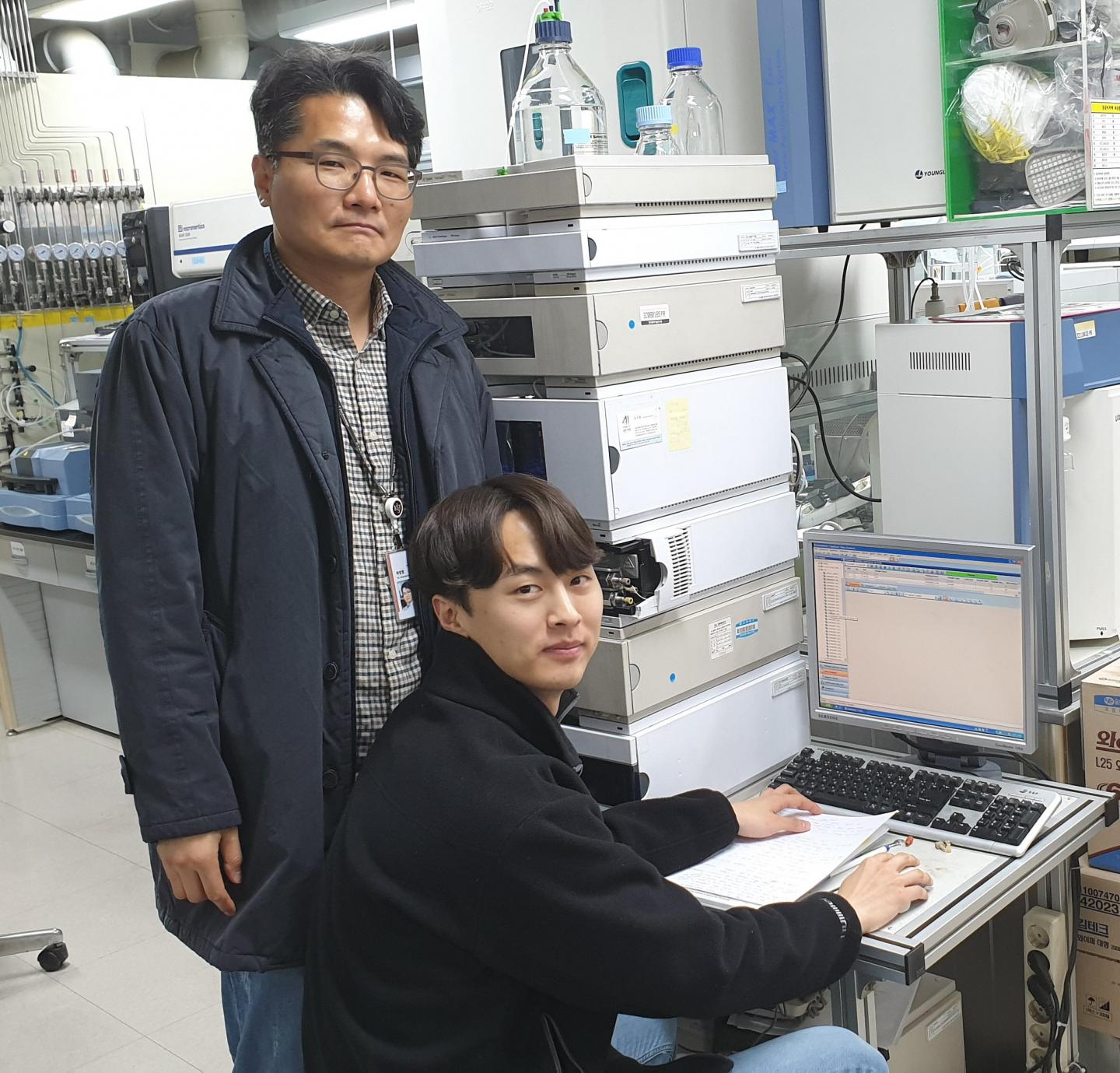
Credit: Korea Institue of Science and Technology(KIST)
A Korean research team has developed a key technology for the mass-production of bio-aviation fuels. The team, led by Dr. Jeong-Myeong Ha of the Clean Energy Research Center at the Korea Institute of Science and Technology (KIST), has announced its successful development of a technology that can be used to mass-produce aviation-grade fuels from wood wastes. The ability to produce aviation-grade fuel from oil derived from wood waste–which up until now has been difficult due to the high viscosity of the oil–is expected to help international aviation companies comply with the new strong
*emissions regulations, which are scheduled to go into effect in 2027.
*ICAO (the International Civil Aviation Organization) intends to regulate aviation industry greenhouse gas emissions starting in 2027.
Lignin constitutes 20 to 40 percent of lignocellulose including woods and grass, lignocellulose. Large volumes of lignin are generated as waste in the pulping processes that are used to produce paper. The pyrolysis of lignin produces an oil, which has little industrial utility due to its high viscosity. For this reason, lignin waste is typically used by paper mills as a low-grade boiler fuel, rather than as a high-grade fuel or as a raw material for chemical products.
The research team, led by Dr. Jeong-Myeong Ha of the KIST, used ‘**hydrocracking’ to prepare hydrocracked lignin oil, which was mixed at a ratio of (raw lignin oil:hydrocrackd oil =) 7:3 with raw lignin oil to substantially reduce the viscosity of the oil to 1/7 (from 750 cp to 110 cp; e.g. the viscosity of water is 1 cp, and the viscosity of cooking oil is 80 cp), allowing it to be used for industrial purposes.
** Hydrocracking: Technique used in the petrochemical and refining industry to break down crude oil which is difficult to use as fuel.
The mixed oil prepared in this manner can be recycled to ‘hydrocracking’ process for the continuous process to mass-produce the bio-aviation fuels. Further, the final fuel product, similar to the contents of jet fuel, has a low freezing point compared to gasoline and diesel, and has a high energy density, being sutiable to bio-aviation fuels.
Dr. Jeong-Myeong Ha of the KIST, who led the research, commented on the team’s research, saying, “Despite the digital revolution, a sharp increase in global parcel volumes supports the global paper production. Conventional chemical reaction methods were unable to convert the large volumes of lignin wastes from paper mills into high quality fuels, but our research has opened up the potential for the mass-production of jet fuels from the otherwise useless lignin wastes.” He added, “This achievement will allow Korea to proactively meet jet fuel greenhouse emissions regulations, which will go into effect starting from 2027.”
###
The research, backed by the Ministry of Science and ICT (MSIT), was conducted as an Institutional Research Program of the Korea Institute of Science and Technology (KIST) and as part of the Technology Development Program to Solve Climate Changes of the National Research Foundation (NRF) of Korea funded by the Ministry of Science and ICT. The results of the study were published in the latest issue of Energy Conversion and Management (JCR top 1.866%), an international academic journal in the field of energy science.
Media Contact
Kim, Do-Hyun
[email protected]
Related Journal Article
http://dx.