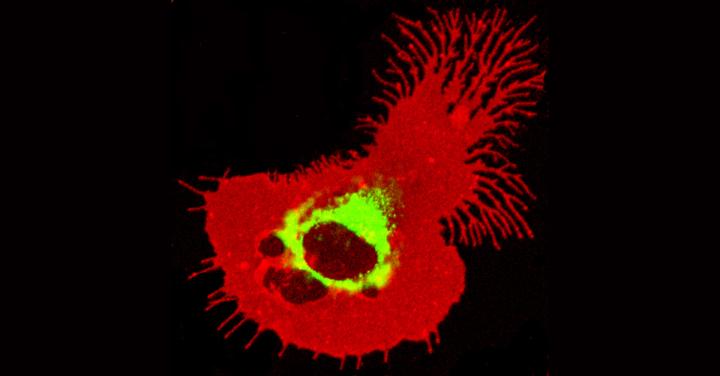
Credit: Courtesy of WEHI
WEHI researchers have uncovered a process cells use to fight off infection and cancer that could pave the way for precision cancer immunotherapy treatment.
Through gaining a better understanding of how this process works, researchers hope to be able to determine a way of tailoring immunotherapy to better fight cancer.
Led by Dr Dawn Lin and Dr Shalin Naik and published in Nature Cell Biology, the research provides new insight into the way cells adapt to fight infection.
This research lays the foundation for future studies into the body’s response to environmental stressors, such as injury, infection or cancer, at a single cell level.
At a glance
- WEHI researchers have studied dendritic cells, a crucial component of the immune system, to gain a deeper understanding of how the body produces these cells to fight cancer and infection.
- The study found how the Flt3L hormone increased dendritic cells numbers.
- Researchers will now apply this knowledge to improving immunotherapy techniques to create more personalised treatments.
Flt3L hormone plays vital role in fighting off infection
Dendritic cells are immune cells that activate ‘killer’ T cells, which are vital for clearing viral infections, such as COVID-19, but also for triggering a response to cancers such as melanoma and bowel cancer.
The Flt3L hormone can increase dendritic cell numbers, helping the immune system to fight off cancer and infection.
Dr Naik and his team studied developing immune cells at a single cell level to gain a deeper understanding of how the body uses these cells to trigger immune responses.
“There is one type of dendritic cell that the body uses to fight some infections and cancer. The Flt3L hormone increases numbers of this particular dendritic cell,” he said.
“We know quite well how the dendritic cell fights the cancer, but we don’t know how the Flt3L hormone increases the numbers of those dendritic cells.”
Single-cell barcoding provides vital clues to how dendritic cells function
Researchers used a single-cell ‘barcoding’ technique to uncover what happened when dendritic cells multiplied.
“By using cellular barcoding – where we insert short synthetic DNA sequences, we call barcodes inside cells – we were able to determine which cells produced dendritic cells in pre-clinical models,” Dr Naik said.
“As a result of this research, we now better understand the actions of the Flt3L hormone that is currently used in cancer immunotherapy trials, and how it naturally helps the body fight cancer and infection. This is a first step to design better precision immunotherapy treatments for cancer.”
Using single cell technology to improve immunotherapy treatment
This research answers a 50-year-long question as to what causes a stem cell to react in response to immense stress, such as infection or inflammation.
“We have known that the Flt3L hormone increases the number of dendritic cells for decades but now there is a focus on applying this knowledge to cancer immunotherapy and potentially to infection immunotherapy as well,” Dr Naik said.
“The next stage in our research is to create ‘dendritic cell factories’ using our new knowledge, to produce millions to billions of these infection fighting cells and then use those in immunotherapy treatments.”
“These findings are a vital first step to improving immunotherapy treatments for patients, to help them better fight cancer and infection.”
###
This work was made possible with funding from the National Health and Medical Research Council, the Australia Research Council, Gilead, the Victorian Cancer Agency and the Victorian Government.
Media Contact
Samantha Robin
[email protected]
Original Source
https:/
Related Journal Article
http://dx.