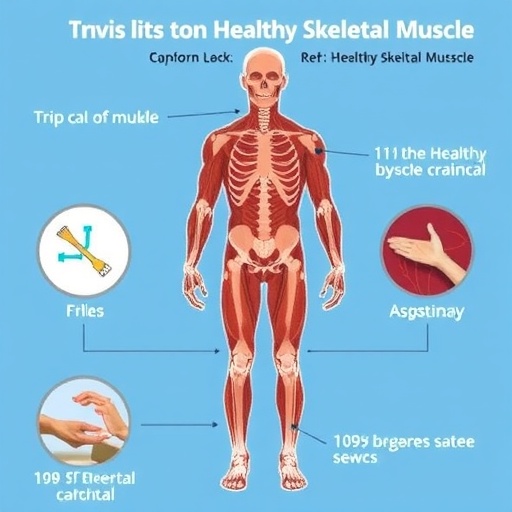
Skeletal muscle may be best known for producing movement, but its influence extends far beyond the ability to walk, lift or run. It is a major site of glucose disposal, a dynamic reservoir of amino acids, an important regulator of energy balance and a highly responsive tissue that adapts to exercise, injury, nutrition and disease. A new conceptual framework published in Nature Metabolism argues that preserving muscle health requires a broader view than measuring mass or strength alone. The framework identifies seven interconnected “hallmarks” of skeletal muscle health: metabolism and bioenergetics, proteostasis, genomics, excitability, structure, regeneration and cross-talk. Together, these properties are proposed to determine whether muscle can maintain its integrity, respond to stress and recover from damage across the lifespan.
The proposal addresses a long-standing problem in muscle biology. Clinical assessments often focus on relatively simple outcomes, such as muscle size, grip strength or physical performance. Although these measurements are valuable, they do not fully capture the biological condition of the tissue. A person may retain substantial muscle volume while harboring defects in mitochondrial energy production, impaired communication between nerves and muscle fibres, accumulated protein damage or a reduced capacity for repair. Conversely, relatively small changes in muscle mass may coexist with preserved function if the tissue remains metabolically flexible and structurally organized. The authors therefore present muscle health as a multidimensional state, shaped by several systems that operate simultaneously rather than as a single measurable trait.
The first hallmark, metabolism and bioenergetics, concerns how muscle generates, stores and uses energy. Muscle fibres rely on coordinated pathways that convert nutrients into ATP, the chemical energy required for contraction, ion transport, protein synthesis and cellular maintenance. Mitochondria are central to this process, but energy production also depends on substrate availability, oxygen delivery, glucose handling and the ability to switch between fuels. Ageing, inactivity and chronic disease can disturb this flexibility, contributing to fatigue and reduced exercise capacity even before major muscle loss becomes apparent. The framework places these defects alongside measurable features such as mitochondrial respiration, metabolic flexibility and energy-demand matching, suggesting that future diagnostics could distinguish between muscle that is merely large and muscle that is genuinely capable of meeting physiological demands.
A second hallmark is proteostasis, the network that maintains the quality, quantity and location of proteins inside muscle cells. Contractile fibres are exposed to constant mechanical stress, and their proteins must be continuously repaired, refolded, recycled or replaced. Systems including molecular chaperones, the ubiquitin–proteasome pathway, autophagy and lysosomal degradation help remove damaged or unnecessary proteins. When this quality-control machinery becomes overwhelmed, defective proteins can accumulate and interfere with contraction, signalling and cellular survival. The researchers frame proteostasis as a central determinant of resilience, because muscle must not only build proteins in response to training or injury but also remove them with precision. Measurements of protein turnover, organelle quality and degradation pathways could consequently reveal early dysfunction that conventional strength testing misses.
The genomics hallmark encompasses the information systems that regulate muscle identity, adaptation and long-term stability. It includes the genome itself, epigenetic marks, gene expression programs and the activity of regulatory molecules that determine how muscle cells respond to exercise, inflammation, nutritional stress or injury. Muscle fibres are multinucleated, meaning that a single fibre contains many nuclei whose local gene-regulatory environments can influence distinct regions of the cell. This arrangement allows highly specialized responses but may also create vulnerability when genomic regulation becomes disordered. Mutations, altered chromatin states, defective RNA processing and changes in gene expression can all affect muscle performance. By incorporating genomics into the framework, the authors emphasize that muscle health is partly an information-management problem: the tissue must accurately read, update and execute instructions as conditions change.
Excitability represents the electrical dimension of muscle function. Skeletal muscle fibres contract when signals from motor neurons trigger electrical changes across the cell membrane, leading to the release of calcium from the sarcoplasmic reticulum. Calcium then activates the molecular machinery that enables actin and myosin filaments to slide against one another. This process depends on ion channels, membrane pumps, neuromuscular junctions and intracellular calcium handling. Disruption at any point can weaken contraction, slow relaxation or produce abnormal fatigue. The framework treats the neuromuscular system as an essential component of muscle health rather than a separate concern. Assessments of nerve–muscle transmission, membrane excitability and calcium dynamics could help explain functional decline in conditions where muscle size alone offers little insight.
Structure forms another cornerstone of the proposed model. Muscle performance depends on the precise organization of fibres, sarcomeres, connective tissue, blood vessels, mitochondria and specialized membrane systems. The extracellular matrix provides mechanical support and transmits force, while the internal arrangement of myofibrils ensures that contraction is efficiently converted into movement. Structural changes can occur at multiple scales, from microscopic disruption of sarcomeres to fibrosis, fatty infiltration and altered fibre architecture. These changes may reduce force transmission and limit the ability of muscle to adapt to loading. Imaging, histological analysis and biomechanical measurements could therefore complement functional tests by revealing whether tissue organization remains intact. In this view, muscle quality is not simply a matter of how much tissue is present, but how effectively that tissue is assembled.
Regeneration captures the muscle’s capacity to repair damage and restore function. Skeletal muscle contains resident stem cells, commonly known as satellite cells, which normally remain quiescent but become activated after injury or intense physiological stress. They can proliferate, differentiate and fuse with existing fibres, contributing new nuclei and supporting repair. Regeneration also depends on immune cells, fibro-adipogenic progenitors, blood vessels, extracellular matrix remodelling and carefully timed inflammatory signals. An excessive or prolonged inflammatory response can promote fibrosis, whereas an insufficient response may delay debris clearance and repair. With ageing and chronic disease, satellite-cell activity and the surrounding regenerative environment may deteriorate. The framework therefore defines regenerative potential as a measurable and modifiable property, potentially informing therapies designed to improve recovery rather than simply prevent muscle loss.
The seventh hallmark, cross-talk, reflects the fact that muscle does not operate in isolation. It exchanges signals with the nervous system, immune system, endocrine organs, adipose tissue, liver, bone and cardiovascular system. Muscle-derived molecules, including myokines, can influence metabolism and inflammation elsewhere in the body, while hormones, nutrients and inflammatory mediators can alter muscle growth and function. Communication also occurs within the tissue, where fibres interact with satellite cells, blood vessels, nerves and connective-tissue cells. This network helps explain why systemic conditions such as diabetes, obesity, cancer and chronic inflammation can produce profound muscular effects. It also suggests that therapies aimed at improving muscle health may have consequences beyond movement, potentially influencing whole-body glucose regulation, immune balance and resilience to illness.
By linking the seven hallmarks, the researchers propose a blueprint for precision muscle medicine. The central idea is that decline may begin with subtle, interacting defects rather than a single dramatic failure. Impaired mitochondrial function could increase protein damage; defective proteostasis could disrupt excitability; altered extracellular structure could hinder regeneration; and abnormal cross-talk could reinforce inflammation and metabolic dysfunction. Each hallmark is described as mechanistically grounded, quantifiable and potentially modifiable, creating opportunities for biomarker development and targeted intervention. Future tools could combine imaging, molecular profiling, metabolic testing, electrical measurements and functional assessments to produce individualized muscle-health profiles. Such profiles might identify whether a patient would benefit most from exercise, nutritional support, mitochondrial therapies, anti-inflammatory strategies, regenerative approaches or combinations of these interventions. The framework does not replace established measures of strength and performance, but broadens the definition of what it means for muscle to remain healthy, adaptable and resilient throughout life.
Subject of Research: Skeletal muscle health and homeostasis
Article Title: The hallmarks of skeletal muscle health
Article References: Vainshtein, A., Blaauw, B., De Bock, K. et al. “The hallmarks of skeletal muscle health.” Nature Metabolism (2026). https://doi.org/10.1038/s42255-026-01595-9
Image Credits: AI Generated
DOI: https://doi.org/10.1038/s42255-026-01595-9
Keywords: skeletal muscle, muscle health, muscle homeostasis, metabolism, bioenergetics, proteostasis, genomics, excitability, regeneration, cross-talk, ageing, precision medicine
Tags: clinical assessment of muscle functioncomprehensive muscle health frameworkmitochondrial function in skeletal musclemuscle adaptation to exercise and nutritionmuscle aging and diseasemuscle genomics and excitabilitymuscle metabolism and bioenergeticsmuscle proteostasis and regenerationmuscle repair mechanismsmuscle response to injury and stressmuscle structure and cross-talkskeletal muscle health indicators