Credit: Eva Latorre
Key aspects of the ageing of human cells can be reversed by new compounds developed at the University of Exeter, research shows.
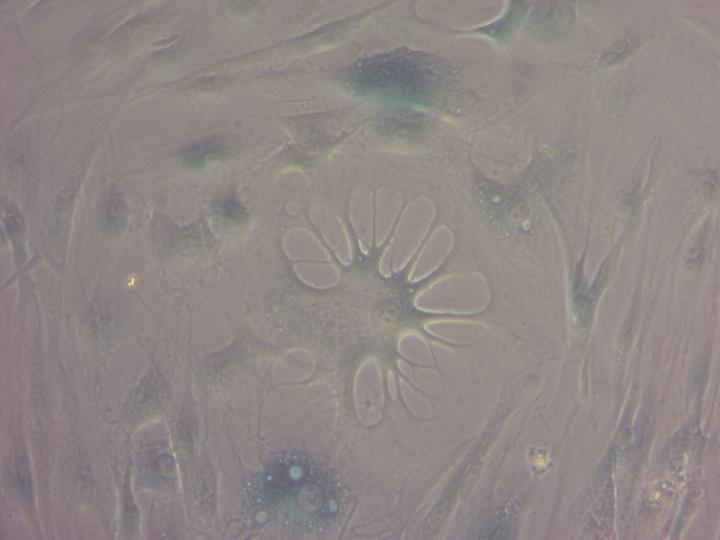
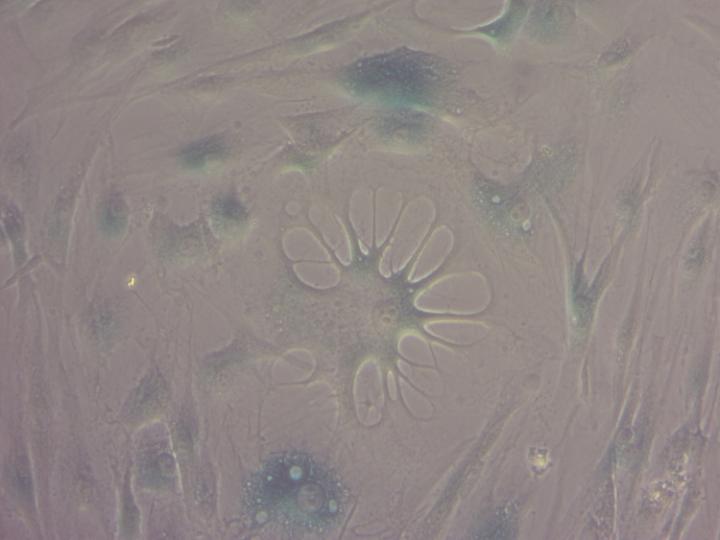
In a laboratory study of endothelial cells – which line the inside of blood vessels – researchers tested compounds designed to target mitochondria (the "power stations" of cells).
In the samples used in the study, the number of senescent cells (older cells that have deteriorated and stopped dividing) was reduced by up to 50%. The Exeter team also identified two splicing factors (a component of cells) that play a key role in when and how endothelial cells become senescent.
The findings raise the possibility of future treatments not only for blood vessels – which become stiffer as they age, raising the risk of problems including heart attacks and strokes – but also for other cells.
"As human bodies age, they accumulate old (senescent) cells that do not function as well as younger cells," said Professor Lorna Harries, of the University of Exeter Medical School.
"This is not just an effect of ageing – it's a reason why we age.
"The compounds developed at Exeter have the potential to tweak the mechanisms by which this ageing of cells happens.
"We used to think age-related diseases like cancer, dementia and diabetes each had a unique cause, but they actually track back to one or two common mechanisms.
"This research focuses on one of these mechanisms, and the findings with our compounds have potentially opened up the way for new therapeutic approaches in the future.
"This may well be the basis for a new generation of anti-degenerative drugs."
Professor Harries said the goal was to help people stay healthier for longer. She added: "This is about health span and quality of life, rather than merely extending lifespan."
In a paper published last year, the team demonstrated a new way to rejuvenate old cells in the laboratory.
However, the new research looked at precisely targeting and rejuvenating mitochondria in old cells.
Each one of our genes is capable of making more than one product, and splicing factors are the genes that make the decision about which of these products are made.
In this new work, using novel chemicals, the researchers were able to very specifically target two splicing factors (SRSF2 or HNRNPD) that play a key role in determining how and why our cells change with advancing age.
"Nearly half of the aged cells we tested showed signs of rejuvenating into young cell models," said Professor Harries.
The researchers tested three different compounds, all developed at the University of Exeter, and found each produced a 40-50% drop in the number of senescent blood vessel cells.
The compounds in question – AP39, AP123 and RT01 – have been designed by the Exeter team to selectively deliver minute quantities of the gas hydrogen sulfide to the mitochondria in cells and help the old or damaged cells to generate the 'energy' needed for survival and to reduce senescence.
"Our compounds provide mitochondria in cells with an alternative fuel to help them function properly," said Professor Matt Whiteman, also from the University of Exeter.
"Many disease states can essentially be viewed as accelerated ageing, and keeping mitochondria healthy helps either prevent or, in many cases using animal models, reverse this.
"Our current study shows that splicing factors play a key role in determining how our compounds work."
The research was funded by Dunhill Medical Trust and the Medical Research Council.
The paper, published in the journal Aging, is entitled: "Mitochondria-targeted hydrogen sulfide attenuates endothelial senescence by selective induction of splicing factors HNRNPD and SRSF2."
###
Media Contact
Alex Morrison
[email protected]
44-013-927-24828
@uniofexeter
http://www.exeter.ac.uk
Related Journal Article
http://dx.doi.org/10.18632/aging.101500