Ketamine has long occupied a strange dual position in medicine: an anesthetic powerful enough to keep surgical patients comfortable, and a mind-altering substance capable of producing a profound sense of detachment from the self. For decades, clinicians and researchers largely assumed these two effects were inseparable — that the drug blunted pain precisely because it made patients feel disconnected from their bodies and surroundings. Now, a new study from Tel Aviv University and the Tel Aviv Medical Center (Ichilov) has upended that assumption, presenting some of the strongest evidence yet that ketamine’s analgesic power and its consciousness-altering effects travel along entirely separate neural routes.
The research, led by Dr. Noam Goldway under the supervision of Prof. Talma Hendler and Dr. Haggai Sharon of Tel Aviv University’s Institute for Psychedelic Research at the Sagol School of Neuroscience, was published in the journal Neuropsychopharmacology. For the first time in humans, the team demonstrated that ketamine activates two distinct mechanisms in the brain: one responsible for pain relief and another responsible for the dissociative state the drug is famous for. The distinction is not merely a matter of subjective experience — it is visible in the brain’s activity patterns.
The question the researchers set out to answer is one of the most consequential in modern psychedelic medicine. In recent years, mind-altering substances have migrated from the fringes of culture to the center of serious clinical investigation. MDMA is being studied as a treatment for post-traumatic stress disorder; psilocybin, the active compound in magic mushrooms, is being tested primarily against depression; and ketamine has attracted considerable interest for its effectiveness in treating pain, depression and, more recently, PTSD. Yet a central unresolved debate shadows the entire field: is the alteration of consciousness produced by these drugs a necessary condition for their therapeutic benefit, or merely a side effect that happens to accompany it?
To address that question, the team turned to ketamine, a drug that relieves pain while simultaneously inducing dissociation — a temporary sense of detachment from one’s self, body or surroundings. For years, the working assumption had been that these two phenomena were causally linked: the more detached a patient felt, the less intense or threatening their pain would seem. If that were true, then the psychedelic experience itself would be an essential ingredient of the drug’s analgesic action, with major implications for how ketamine-based therapies should be designed.
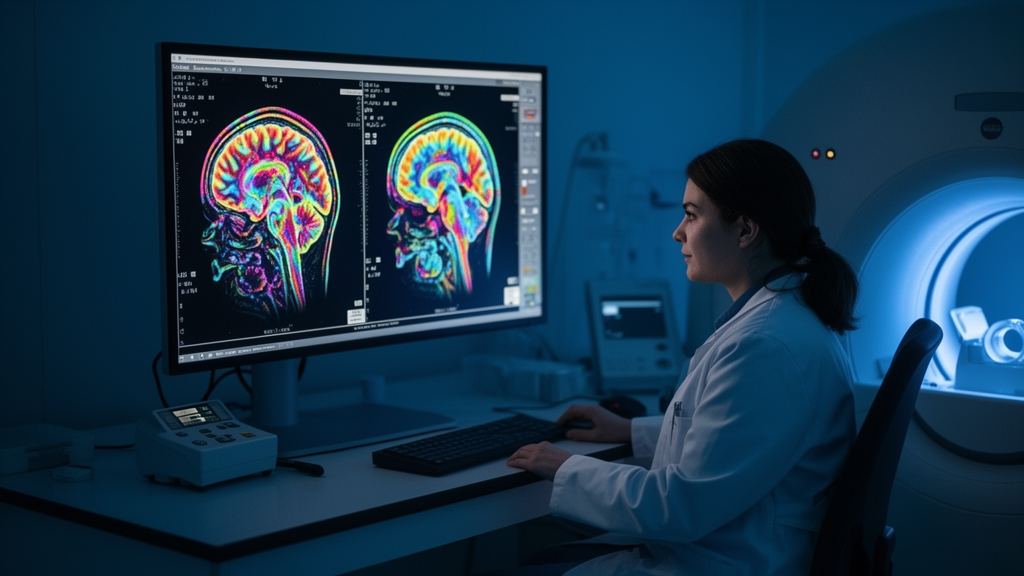
The study enrolled 37 healthy volunteers, both women and men, each of whom participated in two separate sessions. In one session they received a ketamine infusion; in the other, a placebo. While under the influence of each infusion, participants underwent functional magnetic resonance imaging (fMRI) and were exposed to carefully controlled pain stimuli. Throughout the experiment, they reported both the intensity of their pain and the depth of their dissociative experience, allowing the researchers to track the two phenomena independently and in real time.
The behavioral results were strikingly clear. As expected, ketamine reduced pain and increased dissociation. But when the researchers analyzed the relationship between the two effects, no connection emerged. Participants who experienced strong dissociation did not necessarily enjoy greater pain relief, and those with the most substantial analgesia were not necessarily the most detached. As Dr. Goldway explained, the sense of detachment is simply not the mechanism through which ketamine reduces pain. The two effects, long assumed to be two faces of the same process, appear to run in parallel without one driving the other.
The brain imaging data reinforced the behavioral findings at the neural level. Pain relief was accompanied by reduced activity in brain regions classically involved in processing pain, including the insula and the anterior cingulate cortex — structures that map the intensity and emotional salience of noxious stimuli. Dissociation, by contrast, was related to changes in a different network altogether: the default mode network, a set of interconnected regions implicated in, among other things, the construction of the sense of self. In other words, the study did not merely document two uncorrelated subjective experiences; it revealed two different brain mechanisms, both triggered by the same drug but operating on distinct neural circuitry.
Prof. Hendler, who heads TAU’s Institute for Psychedelic Research, framed the findings within the broader scientific controversy. “In recent years, there has been a lively scientific and clinical debate over whether the subjective experience produced by psychoactive drugs is an integral part of their therapeutic effect,” she said. “Our study shows that, at least in the case of ketamine and pain relief, the answer is apparently no. We were able to show that the drug’s effect on pain is separate from its effect on consciousness — both behaviorally and in terms of brain activity.” She was careful, however, to draw a boundary around the conclusion: “It is important to note that this cannot be generalized to other psychedelic drugs, such as magic mushrooms. In this case, the burden of proof still rests with us, the scientists.”
Dr. Sharon, Deputy Head and Medical Director of the Institute and a specialist in pain medicine, emphasized what the results reveal about the brain itself. The study, he noted, provides further evidence of the complexity of the brain’s representation of the pain experience and of the many different ways the brain can regulate and alter it. Pain, in this view, is not a single signal to be switched off but a multidimensional construct assembled across multiple networks — and different drugs, or different mechanisms within the same drug, can intervene at different points in that assembly process.
The clinical implications could be far-reaching. If researchers can learn how to activate ketamine’s pain-relief mechanism without simultaneously inducing dissociation, it may become possible to develop future treatments that preserve the drug’s analgesic effectiveness while reducing the sense of detachment and other subjective side effects. Such decoupled therapies could broaden access to ketamine’s benefits, particularly for patients who cannot tolerate its psychological effects, and could reshape how clinicians think about the role of altered consciousness in psychedelic-assisted medicine more broadly. For now, the study stands as a landmark demonstration that, where ketamine and pain are concerned, relief and detachment are separable — and the road to better analgesics may not need to pass through an altered mind at all.
Subject of Research: Dissociation of ketamine's analgesic and consciousness-altering brain mechanisms in humans
Article Title: Ketamine relieves pain without “disconnecting” consciousness
Article References: Ketamine relieves pain without “disconnecting” consciousness. (n.d.). Original publication
Image Credits: AI Generated
DOI: Not provided
Keywords: ketamine, pain relief, dissociation, consciousness, fMRI, psychedelic research, insula, anterior cingulate cortex, default mode network, Neuropsychopharmacology, Tel Aviv University, analgesia
News Source: Cassandra Pierce. (October 17, 2026). Ketamine Separates Pain Relief from Altered Consciousness, Brain Imaging Study Finds. Scienmag.