• HOME
  • NEWS
  • EXPLORE
    • CAREER
      • Companies
      • Jobs
    • EVENTS
    • iGEM
      • News
      • Team
    • PHOTOS
    • VIDEO
    • WIKI
  • BLOG
  • COMMUNITY
    • FACEBOOK
    • INSTAGRAM
    • TWITTER
Thursday, July 2, 2026
BIOENGINEER.ORG
No Result
View All Result
  • Login
  • HOME
  • NEWS
  • EXPLORE
    • CAREER
      • Companies
      • Jobs
        • Lecturer
        • PhD Studentship
        • Postdoc
        • Research Assistant
    • EVENTS
    • iGEM
      • News
      • Team
    • PHOTOS
    • VIDEO
    • WIKI
  • BLOG
  • COMMUNITY
    • FACEBOOK
    • INSTAGRAM
    • TWITTER
  • HOME
  • NEWS
  • EXPLORE
    • CAREER
      • Companies
      • Jobs
        • Lecturer
        • PhD Studentship
        • Postdoc
        • Research Assistant
    • EVENTS
    • iGEM
      • News
      • Team
    • PHOTOS
    • VIDEO
    • WIKI
  • BLOG
  • COMMUNITY
    • FACEBOOK
    • INSTAGRAM
    • TWITTER
No Result
View All Result
Bioengineer.org
No Result
View All Result
Home NEWS Science News

Keep the data coming

Bioengineer by Bioengineer
November 9, 2020
in Science News
Reading Time: 2 mins read
0
IMAGE
Share on FacebookShare on TwitterShare on LinkedinShare on RedditShare on Telegram

IMAGE

Credit: © 2020 KAUST

A pre-emptive memory management system developed by KAUST researchers can speed up data-intensive simulations by 2.5 times by eliminating delays due to slow data delivery. The development elegantly and transparently addresses one of the most stubborn bottlenecks in modern supercomputing–delivering data from memory fast enough to keep up with computations.

“Reducing the movement of data while keeping it close to the computing hardware is one of the most daunting challenges facing computational scientists handling big data,” explains Hatem Ltaief from the research team. “This is exacerbated by the widening gap between computational speed and memory transmission capacity, and the need to store high-volume data on remote storage media.”

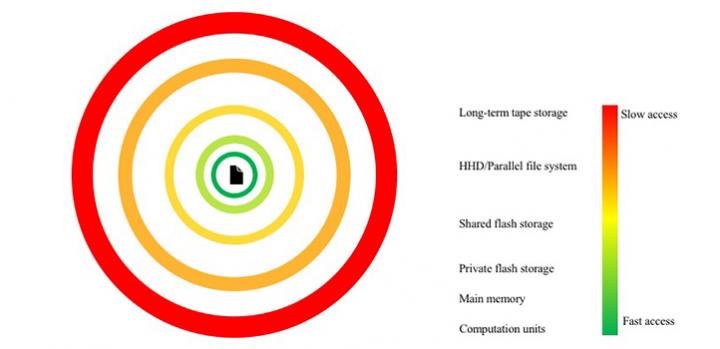
The key challenge in processing big data is the cost and scale of storing the data in memory. The faster the memory, the more expensive it is, and the faster the data need to be moved between computing elements. Because only relatively small capacities of the fastest memory are available on even the most powerful supercomputing platforms, system engineers add successively larger, slower and more remote layers of memory to hold the tera- and petabytes of data typical of big data sets.

“It is in this hostile landscape that our system comes into play by reducing the overhead of moving data in and out of remote storage hardware,” says Ltaief.

Ltaief with colleagues David Keyes and Tariq Alturkestani developed their multilayer buffer system (MLBS) to work proactively to maintain the data as close as possible to the computing hardware by orchestrating data movement among memory layers.

“MLBS relies on a multilevel buffering technique that outsmarts the simulation by making it ‘see’ all the hundreds of petabytes of data as being in fast memory,” says Alturkestani. “The buffering mechanism prevents the application from stalling when it would have needed to access data located on remote storage, allowing the application to proceed at full speed with asynchronous computing operations.”

This synergism provided by MLBS achieved a speedup of 2.5 times for a three-dimensional seismic exploration simulation involving hundreds of petabytes of data movements using KAUST’s Shaheen-2 supercomputer.

“This approach also reduces the energy required to move data to and from remote storage media, which can be hundreds of times higher than the energy to perform a single computation on local memory,” says Ltaief. “Using MLBS, we can mitigate the energy overhead of data movement, which is one of the main goals of our center.”

###

Media Contact
Michael Cusack
[email protected]

Original Source

https://discovery.kaust.edu.sa/en/article/1046/keep-the-data-coming

Related Journal Article

http://dx.doi.org/10.1007/978-3-030-57675-2_17

Tags: Computer ScienceTechnology/Engineering/Computer ScienceTheory/Design
Share12Tweet8Share2ShareShareShare2

Related Posts

Steatosis Drives Liver Metastasis Diversity in CRC — Medicine

Steatosis Drives Liver Metastasis Diversity in CRC

July 2, 2026

Unlocking the Mysteries of Alzheimer’s Disease

July 2, 2026

Pensoft Introduces New Peer-Reviewed Journal of Regeneration to Advance Restorative Biology Across Species

July 2, 2026

Evolution-Inspired Biosensors Revolutionize Lipid Tracking in Real Time

July 2, 2026
Please login to join discussion

POPULAR NEWS

  • Detection of EDCs in Breast Milk and Infant Urine Up to Six Months Highlights Early Exposure Risks

    77 shares
    Share 31 Tweet 19
  • Saying Goodbye to PGY-6: Pediatric Fellowship Realities

    103 shares
    Share 41 Tweet 26
  • New Drug Candidate Developed at McMaster Shows Potential for Treating Brain Cancer

    58 shares
    Share 23 Tweet 15
  • KTU Researchers Explore Ultrasound’s Role in Enhancing Blood Flow Beyond Diagnostics

    53 shares
    Share 21 Tweet 13

About

BIOENGINEER.ORG

We bring you the latest biotechnology news from best research centers and universities around the world. Check our website.

Follow us

Recent News

Steatosis Drives Liver Metastasis Diversity in CRC

Unlocking the Mysteries of Alzheimer’s Disease

Pensoft Introduces New Peer-Reviewed Journal of Regeneration to Advance Restorative Biology Across Species

Subscribe to Blog via Email

Enter your email address to subscribe to this blog and receive notifications of new posts by email.

Join 83 other subscribers
  • Contact Us

Bioengineer.org © Copyright 2023 All Rights Reserved.

Welcome Back!

Login to your account below

Forgotten Password?

Retrieve your password

Please enter your username or email address to reset your password.

Log In
No Result
View All Result
  • Homepages
    • Home Page 1
    • Home Page 2
  • News
  • National
  • Business
  • Health
  • Lifestyle
  • Science

Bioengineer.org © Copyright 2023 All Rights Reserved.