Most children overeat significantly when served large portions of calorie-dense popular foods, according to a Penn State study. The results suggest that manipulating calorie content and portion size can substantially reduce children's overall caloric consumption.
Researchers in the Department of Nutritional Sciences found that caregivers can lower the calorie density (CD) of children's meals by choosing palatable lower-CD, commercially available products, such as un-breaded, grilled chicken pieces and reduced-sugar applesauce.
"With acceptable and readily available products, strategies to reduce calories can be easily implemented in homes and childcare settings, and can be strategically combined with changes in portion size by serving larger portions of lower-CD foods with smaller portions of higher-CD foods," said Barbara Rolls, co-author, professor and the Helen A. Guthrie Chair of Nutritional Sciences. "These strategies that moderate the effects of portion size are practical and effective in reducing calorie intake; however, policy makers and food producers need to provide the resources and products to help parents and caregivers counter pervasive influences."
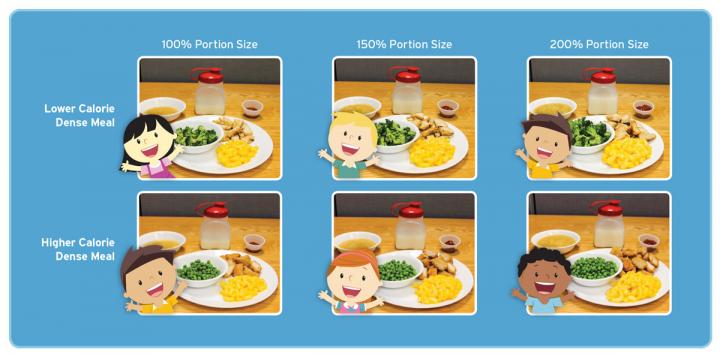
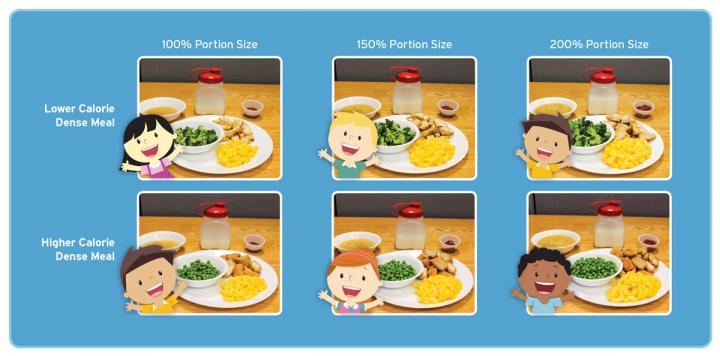
For the study, researchers varied the portion size and CD, or number of calories per bite, for lunches served to children in their normal eating environment.
When served a combination of larger portion and higher CD meals, the children's intake increased by 175 calories, or 79 percent, in a single meal. Few children were able to resist these effects, and increasing portion size and CD of meals promoted excess calorie intake in the majority of children tested.
Researchers recently published their findings in Physiology & Behavior.
"We previously demonstrated that larger portions have a huge impact on children's intake," said Samantha Kling, co-author and doctoral candidate in nutritional sciences. "In this study, we found that serving larger portions of food, along with higher-calorie-density options of those foods, led to the children consuming larger amounts of food and more calories overall."
Lunch was served in three childcare centers once a week for six weeks to 120 children aged 3 to 5 years.
Across the six meals, all items were served at three levels of portion size — 100 percent, 150 percent or 200 percent, and two levels of caloric density — 100 percent or 142 percent.
The lunch menu had either lower-calorie or higher-calorie versions of chicken, macaroni and cheese, vegetables, applesauce, ketchup, and milk. Children's ratings of the foods indicated that the lower-calorie and higher-calorie meals were similarly well liked.
"There is a belief that young kids can self-regulate their food intake," Rolls said. "This study shows those signals are really easy to override."
Strategically moderating the portion size and caloric density of foods typically consumed by children could substantially reduce their caloric intake without affecting acceptability, Rolls said.
###
Other authors of the study include Kathleen Keller, assistant professor of nutritional sciences and food science; and Liane Roe, research nutritionist in nutritional sciences.
The National Institutes of Health through the National Institute of Diabetes and Digestive and Kidney Diseases and the U.S. Department of Agriculture funded this study.
Media Contact
A'ndrea Elyse Messer
[email protected]
814-865-9481
@penn_state
http://live.psu.edu