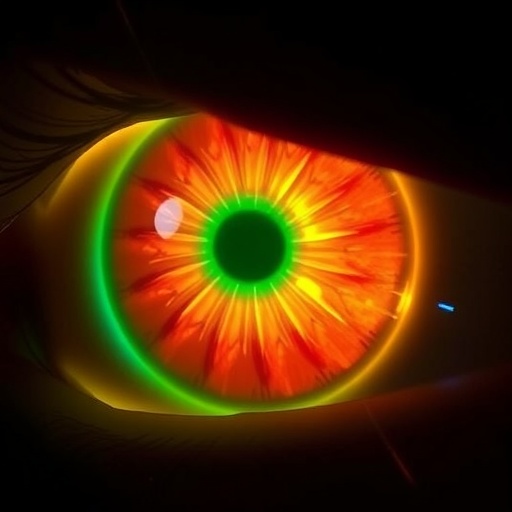
A groundbreaking advancement in the field of ophthalmology has emerged from a team of researchers at the Korea Advanced Institute of Science and Technology (KAIST). This innovative development centers around a revolutionary wireless contact lens that incorporates organic light-emitting diodes (OLEDs) for retinal diagnostics, fundamentally transforming current procedures used in eye care and diagnostics. The implications of this research extend far beyond traditional methods, poised to introduce a new era of ocular health monitoring and treatment.
Electroretinography (ERG) remains a cornerstone in diagnosing retinal disorders. Traditionally reliant on stationary Ganzfeld devices in darkened rooms, ERG has often posed a cumbersome experience for both patients and healthcare professionals. This latest effort not only aims to refine this process but strives to eliminate the spatial and sensory constraints encountered in conventional ERG setups. A key aspect of this innovation is the integration of a flexible OLED with the contact lens design, which allows for efficiency and patient comfort during retinal examinations.
.adsslot_HExGz8QhIX{ width:728px !important; height:90px !important; }
@media (max-width:1199px) { .adsslot_HExGz8QhIX{ width:468px !important; height:60px !important; } }
@media (max-width:767px) { .adsslot_HExGz8QhIX{ width:320px !important; height:50px !important; } }
ADVERTISEMENT
This pioneering research team, spearheaded by Professor Seunghyup Yoo, has meticulously addressed various technological challenges while incorporating an OLED system into the contact lens. Measuring a mere 12.5 μm in thickness—significantly thinner than a human hair—the lens’s design is optimally engineered for both comfort and function. This meticulous attention to detail is fundamental in producing an effective yet unobtrusive device that empowers patients to engage actively during diagnoses.
The wireless aspect of this technology cannot be overstated. By using a 433 MHz resonant frequency for power transmission, the team successfully implemented a robust wireless power system that enhances user experience while walking patients through their ocular tests. Additionally, the incorporation of a wireless controller housed in a sleep mask optimizes the lens’s usability and allows for synchronization with smartphones, further personalizing healthcare experiences.
Extensive testing has verified the effectiveness of the OLED contact lens in practical clinical settings. Animal studies demonstrated that the temperature of a rabbit’s eye wearing the lens remained well within safe limits, significantly mitigating any risk of corneal heat damage. The robustness of the lens’s optical performance was maintained despite exposure to humid environments, solidifying its potential for real-world applications.
Professor Yoo emphasized the significance of this work, labeling the incorporation of flexible OLEDs into wearable contact lens technology a monumental advancement in the field. The implications of this development suggest that further integration of smart contact lens technology into ocular diagnostics and therapies could vastly expand the horizon of digital health applications.
In addition to the scientific community, potential ramifications extend to the varied fields of augmented reality and light-based neurostimulation, suggesting an interdisciplinary approach could yield breakthroughs in managing myopia and other ocular issues. As digital healthcare technology evolves, the adaptability and functionality of this OLED contact lens position it as an essential tool in future ocular innovations.
These researchers have not only paved the way for advancements in retinal diagnostics, but their efforts underline the significance of interdisciplinary collaboration in achieving monumental scientific breakthroughs. The joint efforts of talented professionals across various institutions highlight the importance of diverse expertise in confronting complex challenges in healthcare.
The research findings are detailed in the prominent journal ACS Nano, offering an academic perspective that underpins the broader implications of this cutting-edge technology. By documenting their process and results in this renowned publication, the authors contribute valuable insights to the fields of ophthalmology and biomedical engineering.
This remarkable collaboration exemplifies the potential of modern scientific research to elicit tangible benefits for community health. By merging technology and healthcare, the exploration of OLED contact lenses represents a critical step towards personalized health monitoring solutions that will undoubtedly shape the future of ocular care.
As discussions surrounding smart technology in healthcare proliferate, the importance of continued investment and innovation in this sector is underscored. Developing solutions that enhance the user experience is essential in establishing trust and acceptance of new technologies among patients and practitioners alike. As the world anticipates the rollout of this innovative retinal diagnostic tool, one cannot help but marvel at the profound impact of scientific collaboration on improving health outcomes.
Subject of Research: Retinal diagnostics technology using wireless OLED contact lenses
Article Title: Wireless Organic Light-Emitting Diode Contact Lenses for On-Eye Wearable Light Sources and Their Application to Personalized Health Monitoring
News Publication Date: May 1, 2023
Web References: ACS Nano
References: Not applicable
Image Credits: Credit: KAIST
Keywords
Biomedical engineering, smart contact lenses, retinal diagnostics, electroretinography, organic light-emitting diodes, digital healthcare technology.
Tags: collaboration in ophthalmic technologyelectroretinography improvementsflexible OLED integration in health devicesinnovative ophthalmology advancementsKAIST research in eye carenext-generation ocular health monitoringorganic light-emitting diodes in medicinepatient comfort in eye examinationsretinal diagnostics technologyretinal disorder diagnosis methodstransformative eye care solutionswireless OLED contact lens