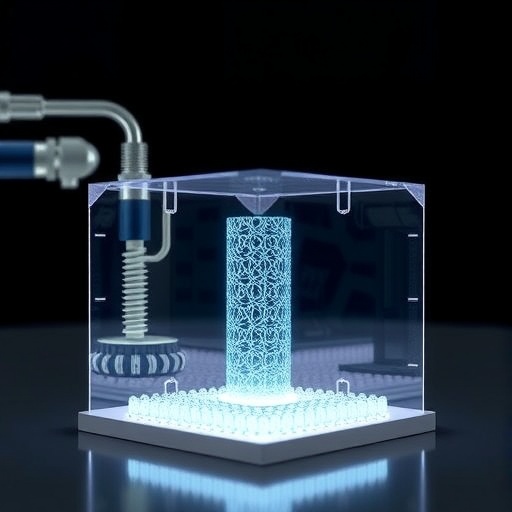
Hydrogen is often described as a clean energy carrier, but producing it at the purity required for fuel cells, industrial reactors, and other technologies is far more complicated than simply generating the gas. Hydrogen typically emerges from production processes mixed with nitrogen, carbon dioxide, methane, and other gases. Removing those impurities efficiently, while consuming as little energy as possible, remains one of the central technical challenges holding back large-scale hydrogen commercialization. Researchers at the Korea Advanced Institute of Science and Technology (KAIST) have now developed a polymer membrane that uses an angstrom-scale molecular network to transport hydrogen selectively, offering a potentially scalable route to high-purity hydrogen separation.
The research team, led by Tae-Hyun Bae of KAIST’s Department of Chemical and Biomolecular Engineering, designed a membrane that combines the manufacturing advantages of polymers with the molecular precision normally associated with crystalline porous materials. Their work introduces a structural concept called the Bridge Connectivity Degree, or BCD, which measures how completely the molecular network inside a polymer membrane has been connected. According to the researchers, this metric helps explain why some crosslinked membranes perform far better than others, even when they appear to contain similar amounts of chemical crosslinking.
The distinction is important because conventional measurements do not necessarily reveal whether a membrane contains continuous pathways capable of separating molecules. Polymer chains can be joined by crosslinkers, but a high overall degree of crosslinking does not automatically mean that the resulting structure forms useful channels. Some crosslinkers may be attached at only one end, leaving molecular pathways incomplete or creating dense regions that impede transport. BCD focuses specifically on the proportion of crosslinkers connected at both ends, allowing researchers to estimate how many of the intended bridges actually contribute to a continuous separation network.
This approach addresses a long-standing compromise in membrane science. Materials such as metal-organic frameworks and covalent organic frameworks can be engineered with highly uniform pores, making them attractive for molecular sieving. Yet fabricating these crystalline materials over large areas without cracks, gaps, or other defects can be difficult. Their rigid pores may also be poorly suited to separating extremely small molecules under realistic operating conditions. Polymer membranes are much easier to manufacture, coat, and scale, but their molecular free volume is usually less precisely controlled. The KAIST team sought to bring a degree of inorganic molecular-sieve design into a processable polymer platform.
To build the membrane, the researchers linked polymer chains with specially selected crosslinkers that assemble into a modular network. The most successful material, named ms-oDMB-DB50, reached a BCD of 73 percent. This high level of bridge connectivity was associated with a substantial improvement in both hydrogen permeability and hydrogen-to-nitrogen selectivity compared with the original DB50 material. Permeability describes how rapidly hydrogen can pass through the membrane, while selectivity indicates how effectively the membrane favors hydrogen over an unwanted gas. Improving both properties simultaneously is particularly valuable because membranes often face a trade-off: structures that allow gas to pass quickly may also permit impurities through.
The researchers attribute the performance increase to the formation of numerous ultramicropores measuring less than 3 angstroms across. An angstrom is one ten-billionth of a meter, a scale comparable to the dimensions of individual atoms and small molecules. Hydrogen molecules are exceptionally small, but carbon dioxide molecules are larger and cannot enter these narrow regions under the conditions examined by the team. The membrane therefore acts not simply as a conventional barrier, but as a molecular filter in which the size and connectivity of free-volume elements determine which gases can move through the material.
To verify that these tiny pathways were genuinely present, the researchers developed what they call a density-probe method. Helium molecules, which are smaller than hydrogen, were used as probes of the membrane’s internal free volume. If helium could access regions that hydrogen could not fully explore, the difference in transport behavior would provide evidence for ultramicropores near the angstrom scale. This experimental strategy gave the team a way to test the membrane’s internal structure indirectly, rather than relying only on theoretical models or bulk measurements. It also connected the membrane’s molecular architecture with its observed gas-separation performance.
The material demonstrated more than laboratory-scale selectivity. In a continuous stability test lasting 100 hours, the membrane maintained its performance without an observed loss in separation efficiency. It also showed a tensile strength approximately twice that of previously reported high-performance polymer membranes. Mechanical durability is critical for industrial gas separation because membranes must withstand pressure differences, handling, module fabrication, and prolonged contact with complex gas streams. A membrane that delivers impressive selectivity but fractures easily or gradually loses its structure would have little practical value, making the combination of molecular precision and physical robustness a significant part of the result.
The study’s authors describe the BCD concept as a possible bridge between the design principles of inorganic porous materials and the manufacturing practicality of polymers. Hongju Lee, the paper’s first author and now a postdoctoral researcher at the Korea Institute of Science and Technology, said that earlier efforts had combined features of both material classes but had not quantified how completely the molecular network was connected. Bae compared the process to stitching polymer chains together with crosslinkers that fit like Lego blocks, creating a selective internal network through which small hydrogen molecules can travel. The researchers believe that measuring network completeness could guide the design of other polymer membranes for gas purification, including systems targeting carbon dioxide, methane, or other industrially important molecules.
Published in Nature Communications, the study could influence how scientists approach hydrogen purification for low-carbon energy systems. Membrane separation generally requires less energy than processes based on cooling, compression, or repeated chemical absorption and regeneration, although real-world energy savings depend on the feed gas, operating pressure, membrane area, and system design. The KAIST membrane is not yet a complete industrial separation plant, and further work will be needed to evaluate its behavior with complex gas mixtures, contaminants, humidity, and longer operating periods. Even so, the combination of a measurable network-connectivity parameter, angstrom-scale transport pathways, high hydrogen selectivity, and demonstrated mechanical strength offers a new framework for designing membranes that could help make clean hydrogen easier to purify and deploy.
Subject of Research: Hydrogen-selective polymer membranes and angstrom-scale molecular-sieve pathways
Article Title: Network completeness enables angstrom-scale transport pathways in polymer membranes
News Publication Date: 13-Aug-2026
Web References: https://doi.org/10.1038/s41467-026-73860-0
References: Lee H., Choi S., Bae T.-H. “Network completeness enables angstrom-scale transport pathways in polymer membranes.” Nature Communications, published 23-Jul-2026. DOI: 10.1038/s41467-026-73860-0
Image Credits: KAIST
Keywords
Hydrogen separation, hydrogen purification, polymer membranes, molecular sieves, angstrom-scale pores, Bridge Connectivity Degree, BCD, gas separation, clean energy, membrane technology, KAIST, Nature Communications