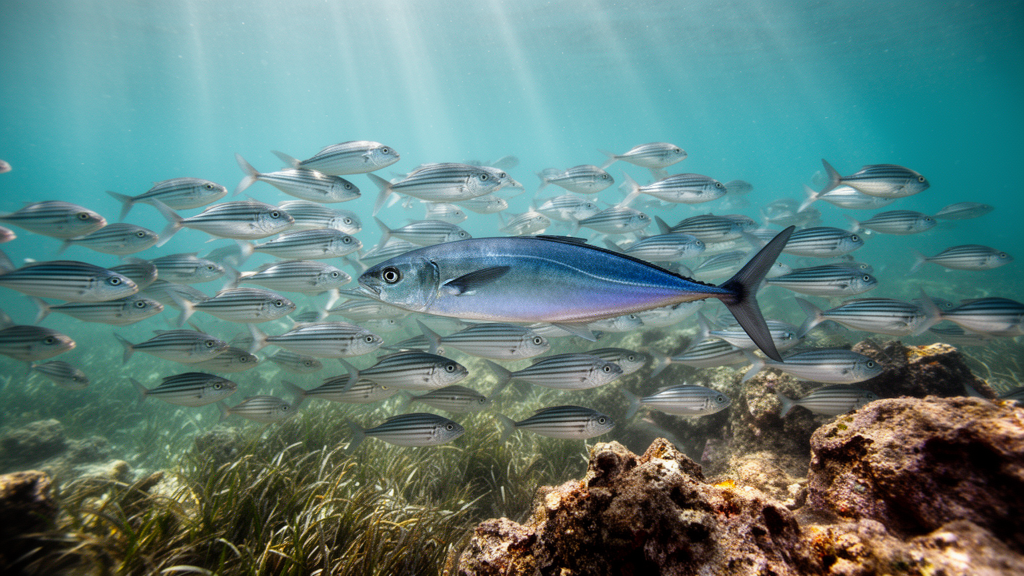
Off the coast of Campania in southern Italy, snorkelling observers have documented something no one had recorded before: juvenile blue runners, Caranx crysos, slipping into schools of juvenile salema porgies, Sarpa salpa, and behaving for all the world like members of the family. The association, observed over twenty hours of transect surveys in the shallow waters of the southern Tyrrhenian Sea during July and August 2025, is the first documented case of this particular pairing anywhere in tropical or temperate waters, and it offers a rare window into the behavioural flexibility of young fish in a temperate Mediterranean nursery habitat.
The study, conducted near the Marine Protected Area of Santa Maria di Castellabate along roughly two kilometres of coastline between Case del Conte and Ogliastro Marina, relied on visual census methods rather than nets or cameras alone. Two observers independently walked, in effect, 30-minute roving transects at depths of just half a metre to two metres from the shoreline, recording data on underwater PVC slates. Over five days, they completed forty transects, ten hours of observation per observer, with four transects in the morning and four in the afternoon or evening each day. Whenever they spotted a heterospecific association, they paused the transect timer and followed the mixed group for ten minutes, continuously monitoring, recording and photographing the interactions.
In total, the observers encountered 195 schools of Sarpa salpa. Among these, 14 schools, or 7.2 percent, contained associated Caranx crysos individuals. The pattern was strikingly size-specific: every single association occurred in schools composed of small individuals, those at or under 15 centimetres total length, where 14 of 154 schools, 9.1 percent, hosted the carangids. Not one of the 41 schools made up of larger salema porgies, above 15 centimetres, contained a blue runner. A Fisher’s exact test confirmed that this difference between size classes was statistically significant, with a p-value of 0.037. Crucially, all the associated Caranx crysos individuals fell into the same size class as the salema porgies they had joined, suggesting that body-size matching is a prerequisite for the association.
The numbers of carangids involved were small but telling. In 11 of the 14 associated schools, a single Caranx crysos was present; two individuals appeared in two schools, and four in one school. Across all observations, 19 individual blue runners were recorded, averaging 1.36 individuals per associated school with a standard deviation of 0.84 and a range of one to four. The frequency of associations did not vary significantly across school abundance classes, ranging from 5.7 percent in the largest schools, those with more than 45 individuals, to 11.1 percent in schools of 16 to 30 fish, and the statistical comparison across abundance categories yielded a p-value of 0.05. Nor did the number of recorded associations differ across the five sampling days, which produced between two and four associations each, or between morning and afternoon-evening periods, which recorded six and eight associations respectively.
What the observers saw once an association formed was a consistent behavioural repertoire with four recurring elements. First, the juvenile blue runners integrated into the salema schools, matching the swimming speed, trajectories and inter-individual distances of their hosts so closely that they effectively became part of the collective. Second, the carangids engaged in opportunistic foraging, hovering near feeding salema porgies and snapping up small benthic organisms and resuspended organic particles stirred into the water column by the hosts’ grazing activity. Third, the hosts responded, though only mildly: salema individuals occasionally chased the intruders briefly, but the carangids typically rejoined the school immediately afterwards. Fourth, when more than one blue runner occupied the same school, the carangids turned aggressively towards each other in short bursts, although no sustained chasing or displacement followed.
Notably, the order of these behaviours was not fixed, varying from one observation to another, and no blue runner was ever seen detaching from a host school during the monitoring periods. Outside of these interspecific interactions, the salema porgies in mixed schools behaved no differently from those in monospecific schools, maintaining the same general swimming speed, feeding activity, turning behaviour and cohesion. Throughout the entire survey, the observers never recorded a Caranx crysos alone, in a school of its own species, or associating with any species other than Sarpa salpa, underscoring how specific and deliberate this association appears to be.
The researchers interpret the interaction as potentially offering the juvenile carangids two main benefits. The first is reduced predation risk. By blending into a heterospecific school and adopting the movement patterns of its members, a young blue runner may gain the classic advantages of group living: dilution of individual risk, predator confusion effects and enhanced collective vigilance. The similarity in body size, coloration and swimming behaviour between the two species likely promotes group cohesion and synchronised movement while simultaneously reducing the oddity effect, the well-known phenomenon whereby individuals that look or behave differently from their group attract disproportionate predator attention. Young Caranx crysos are known to display a more yellowish coloration than adults, at least up to around 14 centimetres, which may make them visually closer to Sarpa salpa and facilitate the mixed-species grouping at precisely the juvenile stages observed.
The second potential benefit is trophic. Sarpa salpa is a gregarious herbivore that grazes selectively in Posidonia oceanica seagrass meadows, and its feeding activity disturbs the substrate and resuspends organic particles and small organisms into the water column. By shadowing feeding hosts, the carangids can exploit these resources, gaining access to food that would otherwise be unavailable or energetically costly to obtain on their own. The researchers also suggest that joining a heterospecific school may reduce the costs of forming a conspecific shoal, particularly heightened foraging competition among carangids. The aggression observed between blue runners sharing the same host school hints that access to the salema shoal is a competitively contested and valuable resource, a pattern previously reported in juvenile parrotfish, where spatial competition within mixed-species groups drives increased aggression among conspecifics.
From the host’s perspective, the interaction appears to be largely tolerated rather than actively resisted. Sarpa salpa showed only brief chasing responses, after which the carangids rapidly rejoined the school, and no persistent exclusion of the blue runners was observed. No clear benefit to the host was detected, and the costs appear low and transient, insufficient to disrupt school cohesion or foraging. The researchers characterise this as a predominantly low-impact interaction from the host’s point of view, aligning with earlier reports of tolerated host-commensal relationships in other fish species. The overall picture is one of commensal-like use of a heterospecific school combined with a degree of behavioural mimicry, though the authors note that juvenile blue runners do not closely match the fine-scale colour patterns of salema porgies; the resemblance rests on broader similarity in body shape, general coloration and size, which may be enough to reduce visual discrimination within the school.
The researchers frame the behaviour as an ontogeny-driven strategy, a transient tactic of early life stages in a species whose juveniles are otherwise associated with structurally complex habitats such as artificial reefs and oil platforms, and whose diet shifts from crustaceans in small individuals to fish in larger ones. Comparable behavioural complexity, including mixed-species shoaling, commensal interactions and social mimicry, has been widely documented in juvenile fishes of tropical coral reefs, but analogous interactions remain poorly explored in temperate systems and are rarely reported in the Mediterranean. The authors caution that their study was designed to characterise behaviour rather than test predictive models, and that the low frequency of the association likely reflects the relative rarity of Caranx crysos compared with its host. Future quantitative work, they suggest, could disentangle the relative roles of visual similarity, social behaviour, predation risk and foraging opportunity in driving this newly documented association, and reveal whether such transient juvenile strategies are more widespread in Mediterranean fish communities than the fine-scale behavioural record currently suggests.
Subject of Research: First documented association between juvenile Caranx crysos and Sarpa salpa schools in the Mediterranean
Article Title: Host‐Associated School Integration and Behaviour Among Juvenile Caranx crysos and Sarpa salpa in a Shallow Mediterranean Habitat
Article References: Basile, V., Brunelli, E., & Mezzasalma, M. (2026). Host‐Associated School Integration and Behaviour Among Juvenile Caranx crysos and Sarpa salpa in a Shallow Mediterranean Habitat. Ecology and Evolution, 16(10), Article e74583. https://doi.org/10.1002/ece3.74583
Image Credits: AI Generated
DOI: 10.1002/ece3.74583
Keywords: Caranx crysos, Sarpa salpa, mixed-species schools, Mediterranean Sea, behavioural mimicry, juvenile fish, commensalism, Posidonia oceanica, opportunistic foraging, nursery habitat, underwater visual census, Tyrrhenian Sea
News Source: Margaret Porter. (October 25, 2026). Juvenile Blue Runner Fish Sneak Into Salema Schools in Mediterranean First. Scienmag.