…
…
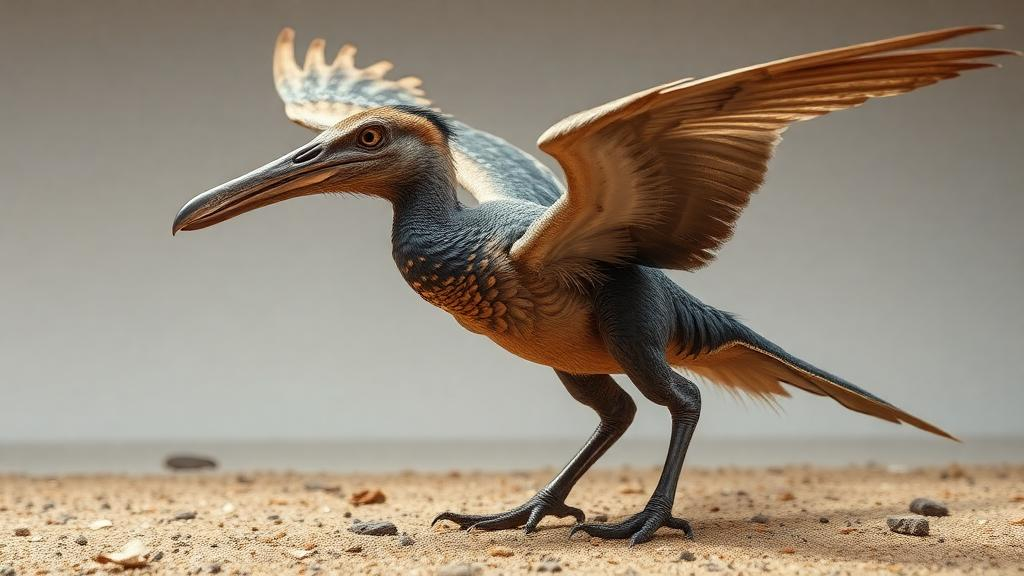
The discovery of Yuezhuornis yangyuanensis from the Zhenghe Fauna of southeastern China adds a genuinely unexpected branch to the earliest chapter of bird evolution. The Late Jurassic remains one of the most poorly sampled intervals in the entire dinosaur–bird transition, even though molecular and morphological clock analyses have long suggested that the lineage leading to modern birds began to radiate during this period. Every new skeleton from this interval therefore carries disproportionate weight, because each one constrains when and how the characteristic features of birds—feathered wings, shortened tails, modified skulls—were assembled. What makes this specimen, catalogued as IVPP V34427 at the Institute of Vertebrate Paleontology and Paleoanthropology in Beijing, so consequential is that it does not fit the expected picture of an early bird at all. Instead of the elongated forelimbs associated with flapping flight, it preserves markedly short arms, a condition more typical of non-avialan theropod dinosaurs that walked the ground on two legs.
The implication drawn by the research team is that Yuezhuornis was terrestrial and flightless, at least in the sense of lacking powered flight. This challenges a long-standing assumption in vertebrate palaeontology: that selection for powered flight was the dominant engine shaping the skeletons of the earliest birds. That assumption has been reinforced by the observation that several aerodynamic features—long forelimbs, feather asymmetry, wing-like hindlimb arrangements—appear to have evolved independently in multiple paravian lineages close to the origin of birds. If a bird that sits near the base of the avialan tree was instead committed to a life on the ground, then the earliest history of birds must have included ecological experimentation of a kind previously documented mainly among their closest dinosaurian relatives, such as dromaeosaurids and troodontids.
The mosaic anatomy of Yuezhuornis is central to this reinterpretation. Its skull combines characters that resemble those of avialans with others that recall troodontids, a group of small, bird-like theropods known for their relatively large brains, serrated teeth, and agile predatory habits. Meanwhile, the postcranial skeleton shows derived traits that align it with birds, yet the feet retain a hyperextensible second pedal digit—the signature ‘sickle claw’ apparatus familiar from deinonychosaurs such as Velociraptor and Deinonychus. This feature is generally interpreted as a predatory or gripping adaptation in terrestrial hunters, and its presence in an early avialan suggests that at least some members of the bird lineage were still using their feet in ways inherited from carnivorous dinosaur ancestors rather than in the perching fashion of modern arboreal birds.
Phylogenetic analyses placing Yuezhuornis among the earliest diverging avialans raise questions about what the common ancestor of all birds looked like. If the earliest branches of the bird tree included both flying forms with long wings and flightless terrestrial forms with short arms, then the ancestral avialan condition becomes harder to pin down. One possibility is that the last common ancestor of birds was itself a versatile, partly terrestrial animal, and that powered flight evolved—or was refined—separately in different early branches. Another is that flightlessness in Yuezhuornis represents a secondary reversal, a lineage that abandoned or never fully acquired the aerial capabilities of its relatives. Either scenario implies a more complicated and branching early history than the classic linear progression from ground-dwelling dinosaur to gliding arborealist to flapping bird.
The Zhenghe Fauna itself deserves attention as a window into this period. Southeastern China has emerged in recent years as a productive source of Late Jurassic terrestrial fossils, complementing the better-known Yanliao and Jehol biotas of northeastern China, which have supplied iconic feathered dinosaurs and early birds such as Anchiornis and the newly described short-tailed birds. The growing diversity of the Zhenghe assemblage indicates that Jurassic ecosystems in what is now China supported multiple distinct vertebrate communities, each preserving different snapshots of the dinosaur–bird transition. Regional faunal differences of this kind matter for macroevolutionary inference, because a fossil record concentrated in one region or environment can bias estimates of when and where key innovations appeared.
Eco-morphometric analyses in the study place Yuezhuornis within a broader comparison of Jurassic paravians, the group that includes birds and their closest relatives. Such analyses quantify how anatomical proportions map onto ecological roles, allowing researchers to ask whether two animals with similar limb proportions likely lived similar lives. The result reported for Yuezhuornis—that its forelimb proportions fall within the range of non-avialan theropods rather than flying birds—supports the terrestrial interpretation quantitatively, not just qualitatively. This kind of ecomorphological framing is increasingly common in palaeobiology because it moves the field beyond simple lists of anatomical similarities toward functional and ecological reconstructions that can be tested against multiple lines of evidence.
The short forelimbs of Yuezhuornis also speak to the tempo of limb evolution near the origin of birds. Previous work has suggested that morphological disparity and rates of limb size evolution were relatively low close to the avialan origin, with the dramatic diversification of bird body plans occurring later, in the Cretaceous. A flightless early avialan with theropod-like arms complicates that picture, because it shows that at least one early bird lineage retained or re-evolved proportions far outside the avian flight apparatus. Whether this reflects a local ecological opportunity—perhaps an environment where ground-dwelling habits were advantageous—or a deeper ancestral condition will require additional fossils from the same and neighbouring faunas.
The cranial evidence is equally significant for understanding how the bird skull took shape. Bird skull evolution is famously modular: the braincase, palate, jaw, and facial bones can evolve at different rates and in different combinations, a pattern described as mosaic evolution. Fossils such as the Cretaceous bird with a dinosaur-like skull described in 2021, and the well-preserved cranial material of Anchiornis, have shown that the transition from a dinosaurian skull to a bird-like one was protracted and piecemeal. Yuezhuornis, with its blend of avialan and troodontid cranial characters, extends this pattern back into the Jurassic and suggests that early birds were still experimenting with cranial architectures that later lineages abandoned. Troodontid-like cranial features in an avialan may also indicate shared dietary or sensory adaptations, since troodontids are often reconstructed as visually acute, possibly omnivorous or predatory animals.
The hyperextensible second toe invites further functional speculation. In dromaeosaurids, this digit is often linked to predation, but hypotheses also include climbing, stability during struggles with prey, and even use in display or defence. Its presence in Yuezhuornis, combined with short arms, paints a picture of an animal whose predatory or manipulative behaviours centred on the hindlimbs. If early avialans retained such pedal specialisations, then the ecological separation between birds and their deinonychosaur relatives during the Jurassic may have been less sharp than traditionally assumed. Some researchers have argued that dromaeosaurids, troodontids, and early birds form a continuum of forms with overlapping ecologies, and Yuezhuornis strengthens that view by sitting morphologically between these groups.
From a broader evolutionary-biology perspective, the study’s conclusion that ‘evolution works intensively’ during the initial diversification of birds echoes a theme now familiar from other major transitions. Just as the earliest mammals experimented with gliding, swimming, and burrowing long before the modern mammal radiations, the earliest birds apparently explored divergent ecological pathways—arboreal flight, terrestrial running, perhaps intermediate strategies—within a few million years of their origin. Ecological diversity early in a lineage’s history, followed by later narrowing or re-expansion, is a pattern documented in numerous fossil groups and has been linked to the opening of new adaptive zones after major evolutionary innovations. For birds, the innovation of flight may have opened aerial niches, but the new fossil shows that ground-based niches remained part of the early avialan repertoire as well.
Methodologically, the study illustrates the increasingly standard toolkit of vertebrate palaeontology. The phylogenetic position of Yuezhuornis was assessed using large character matrices analysed with Bayesian methods, and its ecological profile was evaluated through morphometric comparisons. The authors have made their data matrix, measurements, and analysis code openly available, reflecting a broader movement toward reproducibility in palaeontological research. Open data of this kind allows independent teams to re-run analyses, test alternative character interpretations, and integrate new specimens as they are discovered—particularly valuable for a specimen whose unusual anatomy will surely attract scrutiny. The holotype itself is archived at a major research institution and available for study on request, ensuring that future researchers can re-examine the anatomy directly.
Looking ahead, Yuezhuornis reframes several open questions in early bird evolution. How many of the earliest avialans were flightless, and for how long did flightless lineages persist? Did powered flight arise once near the base of the tree and then be lost in some branches, or multiple times among close relatives, as some analyses of paravian flight capacity have suggested? And what role did the distinct Jurassic ecosystems of eastern Asia play in fostering this diversity? Answering these questions depends on continued discovery in under-sampled faunas such as the Zhenghe, and on refining divergence-time estimates that currently place the origins of major bird lineages deep in the Jurassic despite the scarcity of matching fossils. Yuezhuornis yangyuanensis demonstrates that the earliest birds were not a uniform assemblage of proto-gliders but a genuinely diverse radiation—one that included animals that looked, and probably lived, much more like their dinosaurian ancestors than like anything we would recognise as a bird today.
Subject of Research: Palaeontology
Article Title: Jurassic flightless bird reveals early ecological diversity of avialans
Article References: Xu, L., Wang, M., Lin, G., Dong, L., Deng, K., Xu, X., Du, H., Lin, M., Chen, R., & Zhou, Z. (2026). Jurassic flightless bird reveals early ecological diversity of avialans. Nature, 658(8136), 690-697. https://doi.org/10.1038/s41586-026-10972-z
Image Credits: AI Generated
DOI: 10.1038/s41586-026-10972-z
Keywords: Yuezhuornis yangyuanensis, Jurassic, avialans, bird evolution, palaeontology, Zhenghe Fauna, flightless birds, China, Nature, fossil, flightless, bird
News Source: Gavin Prescott. (October 15, 2026). Jurassic flightless bird reveals early ecological diversity of avialans. Scienmag.