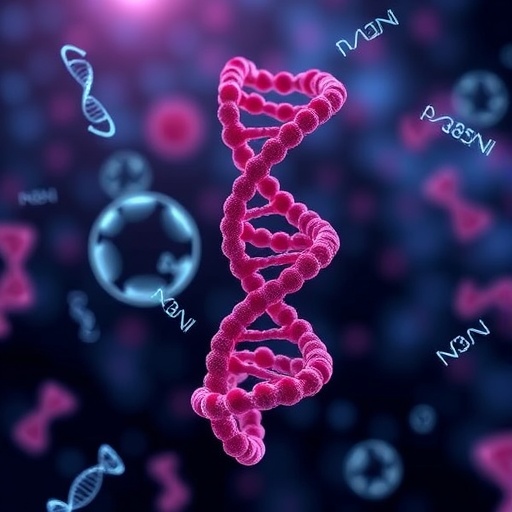
A groundbreaking study published in the prestigious journal Science unveils the profound role that LINE-1 (L1) retrotransposons play in destabilizing the cancer genome. These mobile genetic elements, long dismissed as mere genomic parasites, are now recognized as central architects of genomic chaos in tumors. Cancer genomes marked by instability foster an environment that accelerates malignant progression by providing the cells with extensive genetic variability to evolve, adapt, and resist treatment modalities.
In their comprehensive analysis, researchers focused on tumor genomes displaying abnormally high levels of L1 activity. L1 elements are DNA sequences capable of copying themselves and inserting these copies into new genomic locations, a process known as retrotransposition. Historically, L1 insertions were primarily associated with localized disruptions, such as gene inactivation upon insertion. However, this study reveals that L1 activity can instigate large-scale structural genome rearrangements, seeding widespread architectural genomic chaos beyond simple point mutations or small indels.
Professor José Tubio, coordinating investigator from the Centro de Investigación en Medicina Molecular y Enfermedades Crónicas (CiMUS) at the Universidade de Santiago de Compostela, emphasizes that the influence of L1 retrotransposons on cancer genomes has been seriously underestimated. The paradigm that L1 activity ensues only as a consequence of an already unstable tumor genome is challenged by quantitative evidence indicating that 65% of L1-mediated genomic alterations occur during the early stages of tumor evolution, suggesting a causative role in the onset of genomic instability.
This revelation bears critical implications for cancer biology and therapy. Understanding that L1-induced rearrangements precede hallmark cancer genome events opens new avenues for early molecular diagnosis and intervention strategies. Dr. Bernardo Rodriguez-Martin from the Centre for Genomic Regulation (CRG) in Barcelona, one of the study’s lead authors, highlights the urgent need to dissect the precise temporal and spatial triggers of L1 retrotransposition in tumorigenesis and to develop targeted approaches to mitigate its deleterious effects.
L1 elements are ancient vestiges embedded within mammalian genomes. Comprising approximately 17% of the human genome, with an estimated 500,000 copies, the vast majority of these are inactive “fossils.” Nonetheless, each individual harbors between 150 to 200 potentially active L1 copies capable of retrotransposition. These elements persist as selfish genetic elements that propagate through retrotransposition—a process where RNA transcripts generated from L1 sequences are reverse transcribed and inserted back into the genome at new sites.
The mutagenic capacity of L1 retrotransposition is especially prominent in multiple cancer types, including head and neck, lung, and colorectal carcinomas. Previous research implicated L1 insertions in gene disruption and oncogene activation; yet, the full spectrum of genomic rearrangements driven by L1 remained obscured due to technological limitations. Traditional short-read DNA sequencing methods struggle to reconstruct complex genome rearrangements facilitated by L1, restricting insights into their broader impact on genomic architecture.
Addressing this gap, the researchers leveraged cutting-edge long-read sequencing technologies, which provide continuous DNA sequences spanning tens of thousands of base pairs. This granular resolution enabled the team to characterize the extensive structural modifications instigated by L1, including substantial deletions, translocations, and other chromosomal rearrangements. By studying ten tumors with elevated L1 activity—spanning head and neck squamous cell carcinomas, lung squamous carcinomas, and colorectal adenomas—the team cataloged 6,418 retrotransposition events.
Most of these L1 occurrences represented classic “copy-and-paste” insertions, where a new L1 sequence integrates into a novel genomic locus, potentially disrupting gene function and elongating chromosomes. Notably, many insertions were truncated, diminishing their capacity to retrotranspose further. Crucially, the researchers identified 152 instances of large-scale rearrangements attributable to L1 activity—manifesting as reciprocal chromosome translocations, DNA deletions, and complex reconfiguration—representing a structural rearrangement incidence of 1 in 40 among high-activity tumors.
These large-scale rearrangements are significant in their potential to rewire oncogenic pathways dramatically. Dr. Rodriguez-Martin underscores that while 152 events might appear modest, their occurrence within a small tumor cohort underscores an unexpectedly high structural impact by L1 elements. These findings advocate for integrating long-read sequencing in tumor genomic analyses, especially where conventional short-read methods fail to illuminate underlying mechanisms of tumor behavior and treatment resistance.
Intriguingly, the study uncovered a novel reciprocal translocation mechanism driven by concurrent L1 events on distinct chromosomes. The hypothesis posits that two simultaneous L1 retrotranspositions on separate chromosomes lead to a balanced swap of genomic segments. This process, described metaphorically as “two pages of a book torn out and mutually exchanged and then glued back by L1 sequences,” suggests a hitherto unknown mode of chromosomal rearrangement induced by retrotransposons.
Further investigation into tumor evolution revealed that the majority of L1 activity occurs before whole genome doubling events—a phenomenon where cancer cells duplicate their entire chromosomal complement, often an early step in tumorigenesis. The timing suggests that L1 retrotransposition precipitates genome instability, contributing to the catastrophic genomic rearrangements that set the stage for malignant transformation. Moreover, epigenetic studies indicated that the DNA regions driving L1 retrotransposition tend to be hypomethylated in tumors compared to adjacent non-tumor tissues, implying that epigenetic deregulation may awaken these dormant genetic parasites.
While robust, the study has acknowledged caveats. Its focus on cancers with extreme L1 activity means these revelations might not universally apply to tumors with lower retrotransposition levels, underscoring the need for broader validation across diverse cancer types. Nonetheless, the collaborative effort involving teams from CiMUS, CRG in Barcelona, Université Côte d’Azur in France, the Francis Crick Institute in the UK, and the MD Anderson Cancer Center in the USA sets a fertile groundwork for future explorations.
This research decisively changes the narrative around L1 retrotransposons, positioning them not just as incidental passengers but as active drivers of genomic chaos from the earliest phases of tumor formation. By illuminating how these ancient DNA parasites orchestrate complex genomic rearrangements, scientists have opened a new frontier in cancer genomics, with promising translational implications for detecting and therapeutically targeting cancer’s genomic instability at its roots.
Subject of Research: L1 retrotransposon-induced genomic rearrangements in human cancers
Article Title: Concurrent L1 retrotransposition events promote reciprocal translocations in human tumorigenesis
News Publication Date: 26-Feb-2026
Web References: DOI 10.1126/science.aee4513
Image Credits: Centro de Regulación Genómica
Keywords: Cancer, Genomics, Retrotransposition, Genome instability, Structural rearrangements, Long-read sequencing, LINE-1 elements, Tumor evolution
Tags: cancer genome structural variationDNA parasites and tumor evolutiongenetic variability in cancer cellsgenomic chaos in cancer progressiongenomic instability in tumorsL1 activity and malignant progressionL1-induced genome rearrangementsLINE-1 retrotransposons in cancermobile genetic elements and cancerretrotransposition and tumor developmentrole of retrotransposons in cancer resistancetumor genome sequencing studies