A small peptide derived from a stress-response protein has improved motor performance and extended survival in mice modeling amyotrophic lateral sclerosis, according to a new study published in BMC Medicine. The experimental compound, known as JP1, appeared to act through a molecular pathway that coordinates two major features of ALS biology: oxidative stress and defective autophagy. By activating the Keap1–Nrf2–ARE system, JP1 strengthened antioxidant defenses, restored cellular waste-clearance mechanisms, reduced motor-neuron damage and suppressed signs of inflammation in the spinal cords of transgenic mice. The findings offer a potential therapeutic direction, although the work remains preclinical and has not yet demonstrated safety or efficacy in people with ALS.
ALS is a progressive neurodegenerative disease in which upper and lower motor neurons gradually deteriorate, leading to muscle weakness, paralysis and, ultimately, respiratory failure. Its causes are diverse, but several damaging processes repeatedly appear across disease forms. Misfolded proteins accumulate inside neurons, mitochondria become dysfunctional, inflammatory signals rise and reactive oxygen species damage cellular structures. Autophagy—the system cells use to capture and degrade damaged proteins and organelles—also becomes impaired as disease advances. These processes reinforce one another: oxidative injury can disrupt autophagy, while inefficient autophagy allows damaged mitochondria and toxic protein aggregates to persist. The researchers focused on the Keap1–Nrf2–ARE pathway because it sits at the intersection of antioxidant protection and cellular quality control.
Nrf2 is a transcription factor that normally remains restrained in the cytoplasm by the protein Keap1 and its associated Cul3 ubiquitin-ligase machinery. Under stress, Nrf2 can escape degradation, enter the nucleus and bind antioxidant response elements, or AREs, in DNA. This activates genes such as HMOX1, NQO1 and GPX1, which help neutralize reactive molecules and maintain redox balance. Nrf2 also influences autophagy-related proteins, including LC3 and p62. The study’s central hypothesis was that stimulating this pathway could address both oxidative stress and autophagic failure rather than treating either process in isolation.
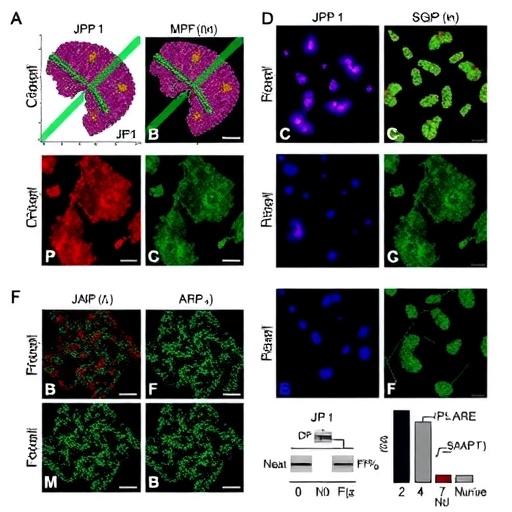
JP1 is a chemically modified oligopeptide derived from the JWA protein, also known as ARL6IP5, which has previously been linked to protection against oxidative injury, DNA damage and inflammation. The peptide sequence is Ac-FPGSDRFGGGG-RGD-NH₂, with an RGD motif designed to recognize integrin αVβ3. Its termini are acetylated and amidated, and the peptide includes a phosphorylated serine. Integrin αVβ3 is a cell-surface receptor involved in adhesion and signaling and has been associated with stress responses in motor neurons. Previous work in cancer and eye-disease models suggested that JP1 can cross biological barriers and interact with αVβ3. In the new study, molecular docking predicted a favorable interaction between JP1 and the integrin, with a calculated binding energy of −7.46 kilocalories per mole, although computational docking alone cannot establish a definitive biological binding mechanism.
The investigators tested JP1 in male SOD1-G93A mice, a widely used model of familial ALS that develops progressive motor impairment, spinal motor-neuron loss, oxidative stress and shortened lifespan. Treatment began at postnatal day 70, before severe symptoms emerged, and continued through disease progression. The animals received daily intraperitoneal injections of 50, 150 or 300 milligrams of JP1 per kilogram of body weight. The middle dose produced the clearest benefit. Mice treated with 150 milligrams per kilogram showed delayed disease onset, better performance on rotarod, grip-strength, pole and gait tests, and longer survival than untreated ALS-model animals. Their average survival increased from approximately 148 days in the model group to about 160 days with JP1. Lower and higher doses did not produce comparable improvements, indicating that the response was not simply proportional to dose.
The treatment did not prevent the animals from losing weight, an important detail because weight loss in ALS can reflect muscle wasting, impaired feeding and broader metabolic dysfunction. This suggests that JP1 primarily protected motor neurons and related pathways rather than correcting every systemic feature of the disease. The researchers reported no detectable deterioration in standard liver or kidney function markers. They also observed lower blood levels of creatine kinase and CK-MB, enzymes associated with muscle injury, along with increased systemic superoxide dismutase activity. These findings point toward reduced muscle damage and improved antioxidant capacity, but the safety assessment was limited to a small animal study and a restricted set of biochemical measurements.
At the cellular level, JP1 appeared to reverse a late-stage collapse in autophagy. In untreated SOD1-G93A mice, autophagic activity was higher at around 90 days but declined at symptomatic and end-stage time points. At 120 days, JP1 increased LC3B-associated autophagic structures and reduced p62, a protein that accumulates when cargo degradation is inefficient. Electron microscopy showed more autophagosomes, fewer abnormal mitochondria, less mitochondrial swelling and better-preserved cristae in treated mice. These observations are consistent with improved autophagic and mitophagic activity, although measurements based on LC3B and p62 can reflect changes in production or degradation. A direct flux assay using lysosomal inhibitors would provide stronger evidence that the entire autophagy pathway, rather than only the abundance of individual markers, was restored.
The proposed signaling mechanism began with increased ERK phosphorylation after JP1 treatment. The researchers reported lower cytoplasmic Keap1 protein and reduced Cul3, together with greater accumulation of Nrf2 in the nucleus. This was accompanied by increased expression of the Nrf2-responsive antioxidant proteins HO-1 and NQO1, higher spinal-cord superoxide dismutase activity and lower levels of malondialdehyde, a marker of lipid peroxidation. JP1 also increased GPX1 expression and reduced NOS2, which encodes a source of nitric oxide-related oxidative stress. Interestingly, JP1 changed Keap1 and Cul3 protein abundance without significantly altering their messenger RNA levels, suggesting post-transcriptional regulation or changes in protein stability.
To test whether Nrf2 was necessary for the protective response, the researchers administered ML385, a pharmacological Nrf2 inhibitor, to a separate group of ALS-model mice. ML385 alone accelerated disease onset, worsened motor performance and shortened survival. When given together with JP1, it largely eliminated the peptide’s benefits: survival, motor behavior, autophagy markers, mitochondrial structure, antioxidant responses and motor-neuron preservation returned toward the untreated ALS-model profile. JP1-treated animals also showed fewer TUNEL-positive apoptotic cells, more surviving motor neurons in Nissl-stained spinal cord sections and a more favorable balance between the pro-apoptotic gene Bax and the anti-apoptotic gene Bcl-2. These reversal experiments support a central role for Nrf2, but they do not exclude contributions from other pathways affected by ML385 or JP1.
The study further linked JP1 treatment to selective changes in inflammatory signaling. ALS-model mice had elevated spinal-cord levels of interleukin-1 beta, interleukin-6, tumor necrosis factor alpha, CCL2 and CCL3. JP1 reduced interleukin-1 beta, CCL2 and CCL3 while increasing the anti-inflammatory cytokine interleukin-10, but it did not significantly change interleukin-6 or tumor necrosis factor alpha. The authors interpret this as a selective immunomodulatory effect rather than broad immune suppression. Transcriptomic and proteomic analyses of spinal cord tissue also showed that JP1-treated mice shifted toward a wild-type molecular profile, with enrichment of antioxidant and autophagy-related pathways. However, the multiomics experiment included only three animals per group, making it useful for generating mechanistic clues but insufficient for definitive conclusions about biological variability.
The researchers also examined JWA expression in human ALS datasets and found that its messenger RNA levels were lower in patients than in healthy controls. Higher expression was associated with limb-onset disease compared with bulbar-onset disease, and patients in a high-expression group had a more favorable survival pattern. In SOD1-G93A mice, JWA expression decreased as disease progressed. These observations suggest that JWA could become a biomarker or therapeutic target, but the human analyses were based on existing transcriptomic datasets, including blood and small tissue cohorts, rather than prospective clinical samples. They cannot establish that reduced JWA causes ALS progression or that restoring its activity would benefit patients.
JP1 therefore emerges from the study as a promising candidate for further investigation, not as an established ALS treatment. The compound’s apparent ability to reach spinal motor neurons, activate Nrf2 and coordinate antioxidant defense with autophagic clearance addresses several interconnected mechanisms of neurodegeneration. Yet important questions remain about its pharmacokinetics, long-term toxicity, optimal delivery, interaction with existing ALS therapies and effectiveness in models carrying mutations such as C9orf72 or FUS. The authors also acknowledge that the structural basis of JP1 binding to αVβ3 remains unresolved. Larger, independently replicated animal studies, rigorous autophagy-flux experiments and clinical-grade safety testing will be necessary before the peptide can be considered for human trials.
Subject of Research: JP1 peptide as a potential treatment for amyotrophic lateral sclerosis through modulation of oxidative stress, autophagy and motor-neuron survival.
Article Title: JP1 peptide modulates oxidative stress and autophagy via Keap1-Nrf2-ARE in ALS model mice.
Article References: Zhang Y, Liu Y, Shi S, et al. “JP1 peptide modulates oxidative stress and autophagy via Keap1-Nrf2-ARE in ALS model mice.” BMC Medicine. 2026;24:460.
Image Credits: AI Generated
DOI: 10.1186/s12916-026-05119-w
Keywords: Amyotrophic lateral sclerosis; ALS; JP1 peptide; JWA; ARL6IP5; Keap1; Nrf2; ARE; oxidative stress; autophagy; mitophagy; motor neurons; integrin αVβ3; SOD1-G93A mice.
Tags: ALS therapyautophagy regulation in ALSinflammation in spinal cordKeap1-Nrf2-ARE pathwaymitochondrial dysfunction in ALSmotor neuron survival strategiesoxidative stress in neurodegenerationpeptide-based neuroprotectionpreclinical ALS researchreactive oxygen species in neurodegenerative diseasesstress-response proteins in neurodegenerationtherapeutic targets for ALS