By treating posture classification as an auxiliary task alongside weight estimation, the proposed network, WPMNet, addresses a critical limitation in previous computer vision methods that relied heavily on standard standing postures. The study demonstrates that integrating posture-aware features reduces estimation errors and narrows performance gaps across diverse body positions, offering a more robust tool for precision livestock management.
The motivation for this research stems from the increasing demand for efficient monitoring in intensive pig farms. Manual weighing is labor-intensive and inefficient, while existing image-based methods often fail when pigs are not in a standard standing position. The authors note that standing posture accounts for only a small fraction of a pig’s daily activity. Previous studies using morphological features or raw image data typically assumed a fixed posture, leading to degraded performance when pigs were lying down. This study aims to bridge that gap by modeling the interaction between body shape and posture, allowing the system to estimate weight accurately regardless of whether the animal is standing, lying on its abdomen, or lying on its side.
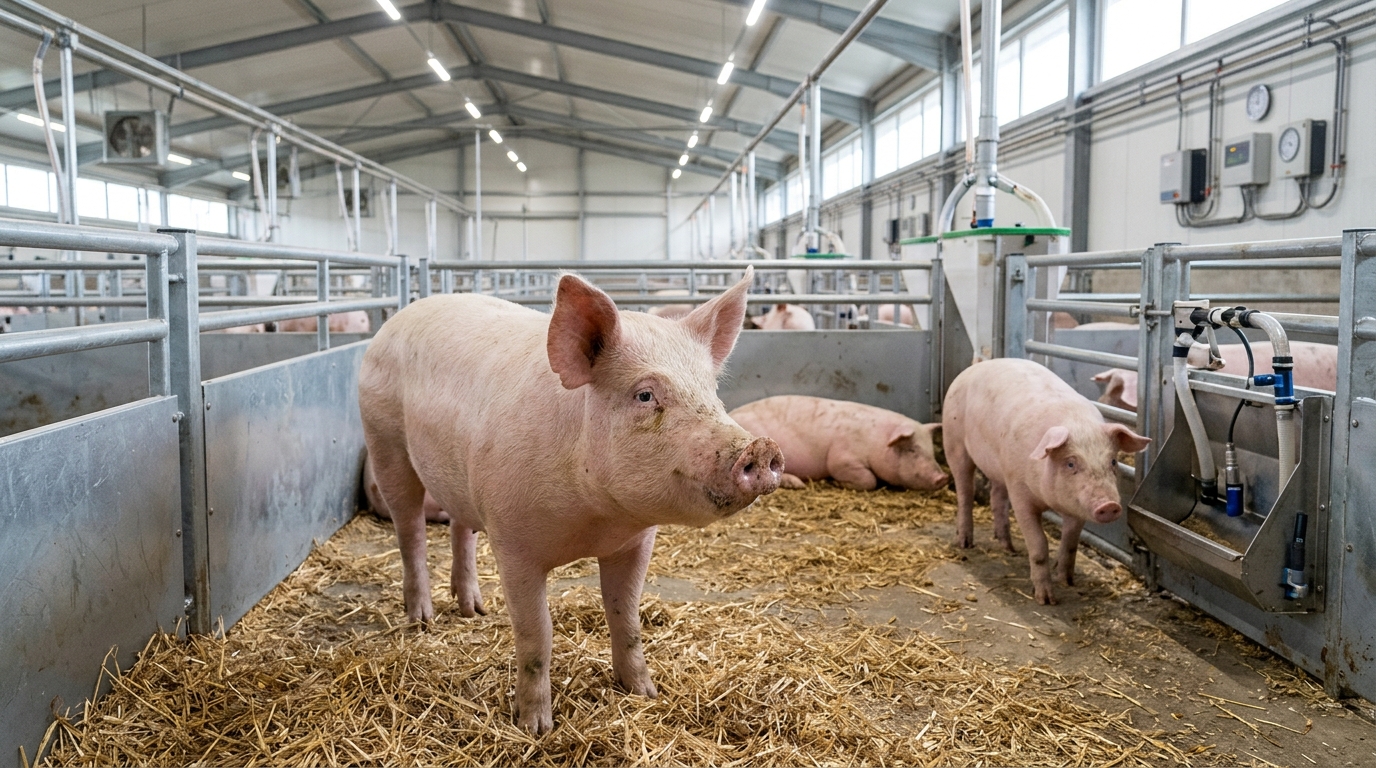
To construct a dataset suitable for this posture-aware analysis, the research team collected data from a pig farm in Chongqing, China, between July and September 2023. The experiment involved 147 Landrace pigs with body weights ranging from 50 to 116 kg. Using Microsoft Azure Kinect DK cameras mounted approximately 2.4 meters above the pens, the researchers captured aligned RGB and depth images at a rate of one frame per second. Each pen housed a single pig to avoid occlusion, allowing the animals to move and change posture freely without physical restraint.
The dataset was carefully annotated with both weight and posture labels. Weight annotations were derived by interpolating between manual weighing records, assuming linear weight changes throughout the day. Posture labels were categorized into three typical finishing pig postures: standing, abdominal lying, and lateral lying. The dataset was split into training, validation, and test sets at the individual pig level to prevent data leakage, ensuring that frames from the same pig did not appear in multiple subsets. This individual-level split provides a more reliable evaluation of the model’s generalization capability compared to random frame-based splits. The posture distribution across the subsets was balanced, with standing, abdominal lying, and lateral lying postures each comprising roughly one-third of the data.
The proposed WPMNet architecture consists of three main blocks: feature extraction, feature processing, and task-specific prediction heads. For feature extraction, the network processes RGB and depth images through parallel ResNet50 branches. Instead of concatenating the inputs, the model uses a Cross-Modal Feature Rectification Module (CM-FRM) to fuse features at intermediate stages. This allows spatial and channel-wise information from one modality to refine the representation of the other. The feature processing block employs a Hierarchical Attention Integration Module (HAIM) to combine multi-scale features from different backbone levels. This module integrates low-level geometric cues, such as body contours, with high-level semantic cues, such as posture status, to create a more expressive representation for the prediction tasks.
The core innovation lies in the task-specific heads, which implement the weight-posture joint modeling approach. The study compares three head configurations: a baseline weight regression head (SWRH), a coupled weight-posture multitask head (C-WPMH), and a decoupled weight-posture multitask head (D-WPMH). The C-WPMH shares features between the weight regression and posture classification tasks, allowing posture features to directly modulate the weight estimation path. In contrast, the D-WPMH treats the two tasks as parallel and independent, using separate branches to reduce potential interference. The study found that both posture-aware heads outperformed the baseline SWRH across all tested backbones, confirming the benefit of incorporating posture information. The D-WPMH generally achieved the best performance in early training stages, while the C-WPMH showed superior accuracy when the posture classification branch reached high reliability.
Experimental results demonstrate that the proposed WPMNet significantly outperforms state-of-the-art methods. When evaluated on the test set, the model achieved a mean absolute error (MAE) of 5.581 kg, a mean absolute percentage error (MAPE) of 7.122%, a root mean squared error (RMSE) of 7.487 kg, and a coefficient of determination (R²) of 0.759. These metrics represent a substantial improvement over the strongest reproduced baseline, which had an MAE of 6.663 kg and an R² of 0.470. The proposed method reduced the MAE by 16.24% and the RMSE by 32.52% compared to this baseline. The ablation study further revealed that using RGB-D input outperformed single-modality inputs, with RGB-D reducing the MAE by approximately 1.9% compared to RGB-only data. Intermediate feature fusion also proved superior to early or late fusion strategies, yielding a lower MAE of 5.82 kg.
The impact of posture diversity on model performance was also analyzed. Models trained on a combination of standing and lateral lying postures achieved the best overall results, reducing the MAE by 5.5% compared to models trained solely on standing postures. Interestingly, including all three postures did not lead to further improvement but ranked second, possibly due to the increased complexity and occlusion associated with the abdominal lying posture. However, including all postures significantly enhanced the model’s applicability in real-world farming environments where posture variability is unavoidable. The study highlights that the effectiveness of posture-aware learning depends on both the modeling strategy and the diversity of the training data. A strong positive correlation was observed between the F1 score of the posture classification branch and the reduction in weight estimation error, indicating that accurate posture recognition directly contributes to better weight prediction.
Despite the promising results, the study acknowledges several limitations. The image-level weight labels were estimated based on the assumption of linear weight changes between manual weighing records, which may not fully capture short-term fluctuations caused by feeding or drinking. This assumption could introduce label noise into the regression task. Additionally, the dataset was collected from a single breed, Landrace pigs, in one specific farming environment. The model may experience performance degradation when applied to different breeds, housing conditions, or lighting environments. The single-pig acquisition setting also meant that the study could not assess inter-pig occlusion or individual identification in group-housed pens. Future work will focus on expanding the dataset with more diverse samples and additional posture categories to enhance robustness and generalizability.
The authors suggest that lightweight model design and deployment optimization should be further investigated in future work. Nevertheless, the study provides a significant step forward in precision livestock farming by demonstrating that joint modeling of weight and posture can lead to more accurate and robust body weight estimation. This approach offers a practical solution for the urgent need for automatic and accurate monitoring tools in modern intensive pig farms, ultimately contributing to improved efficiency and animal welfare.
Subject of Research: Deep learning for pig body weight estimation using joint weight-posture modeling
Article Title: Weight-posture joint modeling for body weight estimation of unconstrained pigs
Article References: Xin, P., Wang, H., Ma, J., Liang, C., Ma, H., Wang, C., Cao, J., & Yang, P. (2026). Weight-posture joint modeling for body weight estimation of unconstrained pigs. Smart Agricultural Technology, 15, Article 102679. https://doi.org/10.1016/j.atech.2026.102679
Image Credits: AI Generated
DOI: 10.1016/j.atech.2026.102679
Keywords: pig farming, computer vision, deep learning, body weight estimation, posture recognition, precision livestock, RGB-D imaging, agricultural technology, Weight-posture, joint, modeling, body
News Source: Blake Davidson. (November 7, 2026). Joint Modeling Improves Pig Weight Estimation Across Postures. Scienmag.