• HOME
  • NEWS
  • EXPLORE
    • CAREER
      • Companies
      • Jobs
    • EVENTS
    • iGEM
      • News
      • Team
    • PHOTOS
    • VIDEO
    • WIKI
  • BLOG
  • COMMUNITY
    • FACEBOOK
    • INSTAGRAM
    • TWITTER
Saturday, February 7, 2026
BIOENGINEER.ORG
No Result
View All Result
  • Login
  • HOME
  • NEWS
  • EXPLORE
    • CAREER
      • Companies
      • Jobs
        • Lecturer
        • PhD Studentship
        • Postdoc
        • Research Assistant
    • EVENTS
    • iGEM
      • News
      • Team
    • PHOTOS
    • VIDEO
    • WIKI
  • BLOG
  • COMMUNITY
    • FACEBOOK
    • INSTAGRAM
    • TWITTER
  • HOME
  • NEWS
  • EXPLORE
    • CAREER
      • Companies
      • Jobs
        • Lecturer
        • PhD Studentship
        • Postdoc
        • Research Assistant
    • EVENTS
    • iGEM
      • News
      • Team
    • PHOTOS
    • VIDEO
    • WIKI
  • BLOG
  • COMMUNITY
    • FACEBOOK
    • INSTAGRAM
    • TWITTER
No Result
View All Result
Bioengineer.org
No Result
View All Result
Home NEWS Science News Chemistry

Johns Hopkins scientists model Saturn’s interior

Bioengineer by Bioengineer
May 5, 2021
in Chemistry
Reading Time: 2 mins read
0
IMAGE
Share on FacebookShare on TwitterShare on LinkedinShare on RedditShare on Telegram

Researchers simulate conditions necessary for planet’s unique magnetic field
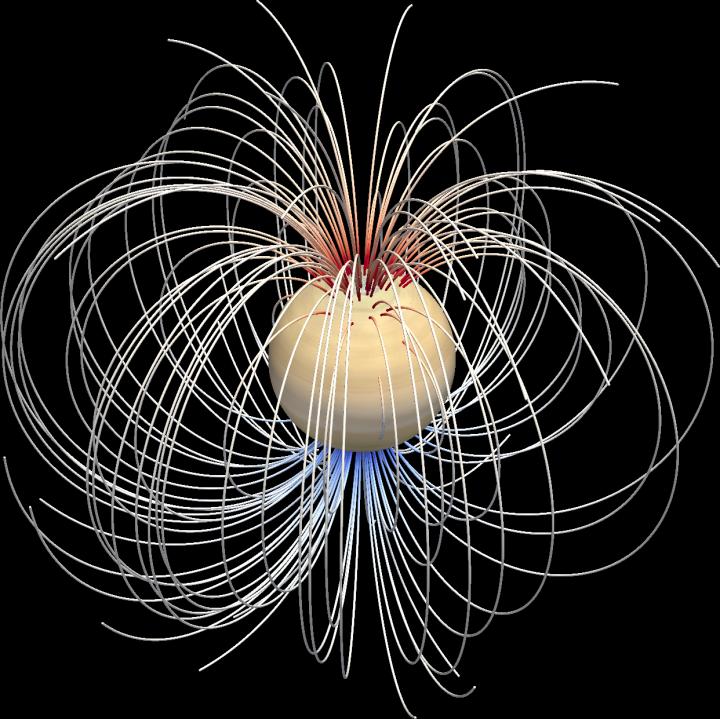
IMAGE

Credit: Ankit Barik/Johns Hopkins University

New Johns Hopkins University simulations offer an intriguing look into Saturn’s interior, suggesting that a thick layer of helium rain influences the planet’s magnetic field.

The models, published this week in AGU Advances, also indicate that Saturn’s interior may feature higher temperatures at the equatorial region, with lower temperatures at the high latitudes at the top of the helium rain layer.

It is notoriously difficult to study the interior structures of large gaseous planets, and the findings advance the effort to map Saturn’s hidden regions.

“By studying how Saturn formed and how it evolved over time, we can learn a lot about the formation of other planets similar to Saturn within our own solar system, as well as beyond it,” said co-author Sabine Stanley, a Johns Hopkins planetary physicist.

Saturn stands out among the planets in our solar system because its magnetic field appears to be almost perfectly symmetrical around the rotation axis. Detailed measurements of the magnetic field gleaned from the last orbits of NASA’s Cassini mission provide an opportunity to better understand the planet’s deep interior, where the magnetic field is generated, said lead author Chi Yan, a Johns Hopkins PhD candidate.

By feeding data gathered by the Cassini mission into powerful computer simulations similar to those used to study weather and climate, Yan and Stanley explored what ingredients are necessary to produce the dynamo–the electromagnetic conversion mechanism–that could account for Saturn’s magnetic field.

“One thing we discovered was how sensitive the model was to very specific things like temperature,” said Stanley, who is also a Bloomberg Distinguished Professor at Johns Hopkins in the Department of Earth & Planetary Sciences and the Space Exploration Sector of the Applied Physics Lab. “And that means we have a really interesting probe of Saturn’s deep interior as far as 20,000 kilometers down. It’s a kind of X-ray vision.”

Strikingly, Yan and Stanley’s simulations suggest that a slight degree of non-axisymmetry could actually exist near Saturn’s north and south poles.

“Even though the observations we have from Saturn look perfectly symmetrical, in our computer simulations we can fully interrogate the field,” said Stanley.

Direct observation at the poles would be necessary to confirm it, but the finding could have implications for understanding another problem that has vexed scientists for decades: how to measure the rate at which Saturn rotates, or, in other words, the length of a day on the planet.

###

This project was conducted using computational resources at the Maryland Advanced Research Computing Center (MARCC).

Media Contact
Kait Howard
[email protected]

Original Source

https://releases.jhu.edu/2021/05/05/johns-hopkins-scientists-model-saturns-interior/

Related Journal Article

http://dx.doi.org/10.1029/2020AV000318

Tags: Geophysics/GravityPlanets/MoonsSpace/Planetary Science
Share12Tweet8Share2ShareShareShare2

Related Posts

blank

Breakthrough in Environmental Cleanup: Scientists Develop Solar-Activated Biochar for Faster Remediation

February 7, 2026
blank

Cutting Costs: Making Hydrogen Fuel Cells More Affordable

February 6, 2026

Scientists Develop Hand-Held “Levitating” Time Crystals

February 6, 2026

Observing a Key Green-Energy Catalyst Dissolve Atom by Atom

February 6, 2026
Please login to join discussion

POPULAR NEWS

  • Robotic Ureteral Reconstruction: A Novel Approach

    Robotic Ureteral Reconstruction: A Novel Approach

    82 shares
    Share 33 Tweet 21
  • Digital Privacy: Health Data Control in Incarceration

    63 shares
    Share 25 Tweet 16
  • Study Reveals Lipid Accumulation in ME/CFS Cells

    57 shares
    Share 23 Tweet 14
  • Breakthrough in RNA Research Accelerates Medical Innovations Timeline

    53 shares
    Share 21 Tweet 13

About

We bring you the latest biotechnology news from best research centers and universities around the world. Check our website.

Follow us

Recent News

Digital Health Perspectives from Baltic Sea Experts

Florida Cane Toad: Complex Spread and Selective Evolution

Exploring Decision-Making in Dementia Caregivers’ Mobility

Subscribe to Blog via Email

Enter your email address to subscribe to this blog and receive notifications of new posts by email.

Join 73 other subscribers
  • Contact Us

Bioengineer.org © Copyright 2023 All Rights Reserved.

Welcome Back!

Login to your account below

Forgotten Password?

Retrieve your password

Please enter your username or email address to reset your password.

Log In
No Result
View All Result
  • Homepages
    • Home Page 1
    • Home Page 2
  • News
  • National
  • Business
  • Health
  • Lifestyle
  • Science

Bioengineer.org © Copyright 2023 All Rights Reserved.