In a landmark achievement for experimental particle physics, the Jiangmen Underground Neutrino Observatory (JUNO) collaboration, spearheaded by the Institute of High Energy Physics of the Chinese Academy of Sciences, has announced its first major physics result. Published as the cover article in the prestigious journal Nature on June 10, 2026, this breakthrough stems from an extensive analysis of data collected over 59 days between August 26 and November 2, 2025. By meticulously interrogating neutrino oscillation patterns, JUNO scientists have succeeded in reducing the uncertainties in two critical oscillation parameters by a factor of 1.6 compared to the best combined measurements from previous experiments spanning decades.
Neutrinos, elusive elementary particles possessing neither electric charge nor substantial mass, interact with matter so feebly that they traverse vast stretches of material without deflection or energy loss. This near-invisibility has made neutrinos among the least understood particles in the Standard Model of particle physics. JUNO represents one of the most ambitious efforts ever undertaken to illuminate the properties of neutrinos with unprecedented precision and depth.
Launched in August 2025, JUNO’s primary scientific motivation is to determine the neutrino mass ordering—a fundamental question concerning whether the three known neutrino mass states are arranged in a normal hierarchy or an inverted one. Beyond this central goal, JUNO is engineered to measure three of the six neutrino mixing parameters with precision better than 1 percent, an extraordinary feat that allows for stringent tests of the three-flavor neutrino oscillation paradigm. Additionally, JUNO is poised to study a variety of neutrino sources, including those generated by supernova explosions, terrestrial radioactivity (geo-neutrinos), solar processes, and atmospheric interactions, potentially unveiling new physics beyond current theoretical frameworks.
Experts in neutrino physics have lauded the study as a definitive demonstration of JUNO’s superior detector performance and robust analysis techniques. According to reviewers, the findings firmly establish JUNO as a cornerstone experiment in the burgeoning precision era of neutrino oscillation physics. The improved measurements feed directly into global oscillation fits, refining theoretical models and enhancing the prospects for resolving the mass ordering conundrum. Moreover, JunO’s cutting-edge results promise to anchor future exploratory efforts, reinforcing confidence in our understanding of neutrino behavior.
The significance of JUNO’s findings drew wide attention in the scientific community, prompting Nature to publish a dedicated News & Views commentary. The article underscored the importance of neutrino physics in developing a comprehensive picture of matter and fundamental forces at the smallest scales. The successful detector commissioning and the promising first results herald a new chapter in neutrino research, one characterized by high-precision oscillation measurements that will deepen insights into these enigmatic particles’ inherent properties.
Earlier in April 2026, the detailed performance achievements of JUNO’s detector were featured as the cover story in Chinese Physics C. Nobel Laureate Prof. Arthur McDonald, recognized for discovering solar neutrino oscillations, praised JUNO’s unparalleled accomplishments in achieving remarkable radiopurity, energy resolution, and long-term detector stability. The experiment’s operational status affirms its readiness to tackle ambitious physics targets, including the neutrino mass ordering, oscillation parameter determination, and neutrino detection from diverse astrophysical and geological sources.
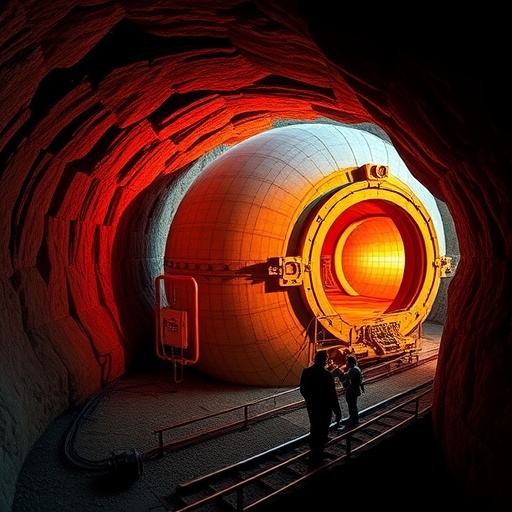
Physically situated 700 meters underground to mitigate cosmic ray interference, JUNO’s central detector comprises an immense 20,000-ton liquid scintillator housed within a 35.4-meter wide acrylic sphere. This sphere is suspended inside a 44-meter deep water pool, itself supported by a 41.1-meter diameter stainless steel truss structure. The detector architecture integrates two arrays of photomultiplier tubes (PMTs), featuring 20,000 large 20-inch units and 25,600 smaller 3-inch devices, coupled with sophisticated front-end electronics, cabling networks, anti-magnetic coils, and precision optical panels designed to capture scintillation light with maximal efficiency.
Each PMT operates in concert, detecting the faint bursts of light produced when neutrinos interact with the liquid scintillator. These interactions release photons that are swiftly converted to electrical signals, enabling JUNO to reconstruct the energy and timing of neutrino events with exceptional accuracy. Detailed signal processing and calibration ensure that the energy resolution reaches the design goal, permitting subtle oscillation patterns to be discerned amidst background noise.
Since data-taking commenced in August 2025, JUNO has maintained stable operational efficiency and high data quality, with over nine months of continuous running. This initial period has not only demonstrated the experiment’s technical viability but also generated a wealth of neutrino interaction data that will fuel a cascade of subsequent discoveries. As the collaboration continues to accumulate data and refine its analyses, a series of new results is anticipated to emerge throughout the summer of 2026, promising to unravel further neutrino mysteries.
JUNO’s scientific potential extends far beyond its primary goals. By accessing neutrinos from supernova bursts, the detector can offer real-time astronomical observations of these catastrophic events, contributing to multimessenger astronomy. Measurement of geo-neutrinos provides a unique probe into the Earth’s interior radiogenic heat production, influencing models of terrestrial dynamics. Precise solar neutrino observations help clarify solar fusion processes and neutrino interaction cross sections, while atmospheric neutrino studies can reveal new oscillation phenomena and test for possible deviations from standard three-flavor mixing.
This comprehensive approach to neutrino research places JUNO at the forefront of particle physics and astrophysics, emphasizing the interplay between sophisticated detector technology and theoretical insights. The collaboration’s success validates years of international effort and serves as an inspiration for future experiments aiming to explore fundamental physics questions with even greater finesse.
As JUNO’s results continue to accumulate, the scientific community eagerly anticipates answers to open questions pivotal to our understanding of the universe’s most elusive constituents. The experiment’s advancements mark a profound stride toward decoding neutrino properties, highlighting the remarkable progress achievable through cutting-edge instrumentation, cross-disciplinary collaboration, and persistent ingenuity.
Subject of Research:
Neutrino oscillation parameters and neutrino mass ordering determination.
Article Title:
10.1038/s41586-026-10538-z
News Publication Date:
10-Jun-2026
Web References:
https://doi.org/10.1038/s41586-026-10538-z
https://www.nature.com/articles/d41586-026-01585-7
https://iopscience.iop.org/article/10.1088/1674-1137/ae3dc1
References:
JUNO Collaboration, “High-precision measurement of neutrino oscillation parameters with the Jiangmen Underground Neutrino Observatory,” Nature, June 2026.
Image Credits:
Credit JUNO Collaboration
Keywords
Particle physics, neutrino oscillation, neutrino mass ordering, liquid scintillator detector, photomultiplier tubes, neutrino mixing parameters, JUNO experiment, high-precision measurement, neutrino detectors, neutrino astrophysics, neutrino research, neutrino mass hierarchy
Tags: advanced neutrino measurement techniquesexperimental particle physics 2026Institute of High Energy Physics Chinese Academy of SciencesJiangmen Underground Neutrino ObservatoryJUNO neutrino oscillation breakthroughNature journal particle physics publicationneutrino detection precisionneutrino mass hierarchy researchneutrino mass ordering determinationneutrino oscillation parameter reductionneutrino oscillation pattern analysisunderground neutrino experiments China