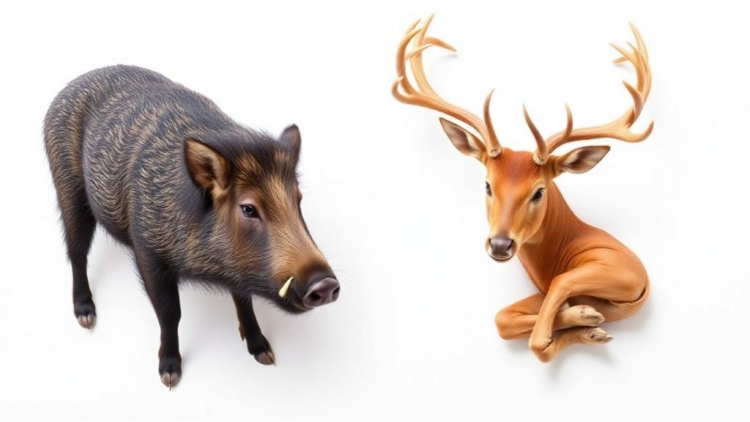
Every year, Japan culls well over a million wild sika deer and wild boar to protect farmland and forests, yet only around twelve percent of those animals ever reach a game-meat processing facility. The rest of the animal, including organs and offcuts that livestock industries routinely turn into food, is largely discarded. A new exploratory study published in Food Science of Animal Resources asks a deceptively simple question: if cattle and pig viscera can yield nutritious, bioactive protein, could the same be true for the deer and boar that Japan is already culling anyway? The answer, based on a systematic screen of eight tissues across four species, is a cautious but intriguing yes, with a few tissues standing out as particularly promising candidates for value-added use.
The research team, led by Hikaru Ogi and Yoko Ichikawa of the University of Shizuoka together with colleagues at Tokoha University and Sagami Women’s University, obtained heart, stomach, liver, spleen, small intestine, large intestine, loin, and round samples from five wild-caught female sika deer and five wild-caught female wild boar, each estimated at three years of age, processed at a licensed facility in western Shizuoka Prefecture. The animals had been captured by licensed hunters as part of legally authorized population management, entirely independently of the study. For comparison, the researchers purchased matching tissues from three cattle and three pigs from a Shizuoka meat supplier. All samples were freeze-dried, pulverized, and stored frozen before analysis.
To simulate what happens when meat is cooked and eaten, the team applied a standardized in vitro digestion pipeline. Half a gram of each freeze-dried sample was mechanically disrupted with beads, heated at 70 degrees Celsius for 30 minutes to mimic cooking, and then subjected to two hours of gastric digestion with pepsin at pH 1.8, followed by two hours of intestinal digestion with trypsin and pancreatin. Enzymes were added at a nominal enzyme-to-protein ratio of 1:1,000, with the protein estimate derived from ultraviolet absorbance at 280 nanometers. After digestion, enzymes were heat-inactivated, and the soluble fraction was filtered for analysis. This common framework meant that every tissue from every species passed through exactly the same cooking and digestive gauntlet, allowing apples-to-apples comparisons across thirty-two species-tissue combinations.
The researchers measured three things: how much soluble protein and peptide material each digest released, how effectively that material scavenged DPPH free radicals, and how strongly it inhibited angiotensin-converting enzyme, or ACE, the enzyme that raises blood pressure. Soluble protein and peptide concentrations were estimated using the Waddell spectrophotometric method, which calculates concentration from the difference in absorbance at 215 and 225 nanometers. Both biological activities were expressed as IC50 values, the concentration of estimated soluble protein or peptide needed to achieve fifty percent of maximal effect, with lower values indicating greater potency. Statistical comparisons used Kruskal-Wallis tests followed by Dunn’s multiple-comparison tests with Holm adjustment, treating each tissue-outcome pair as a separate exploratory endpoint.
The yield results were strikingly tissue dependent. Wild boar stomach released roughly 27 milligrams of estimated soluble protein or peptide per gram of wet tissue, nearly triple the roughly 10 milligrams from sika deer stomach. Wild boar liver yielded about 34 milligrams per gram, significantly more than both sika deer liver at around 11 and cattle liver at under 10. Wild boar round outperformed pig round by nearly sevenfold, at about 34 versus 5 milligrams per gram. Yet the pattern reversed elsewhere: wild boar small intestine yielded less soluble material than pig small intestine, and sika deer spleen yielded less than both wild boar and cattle spleen. No significant differences appeared in heart or large intestine. An enzyme-only blank run through the same procedure produced a negligible concentration of 0.059 milligrams per milliliter, suggesting the digestive enzymes themselves contributed little to the measured signal.
When it came to antioxidant activity, wild boar emerged as the clear winner. The DPPH IC50 for wild boar liver digest was 9.38 milligrams per milliliter, significantly lower than the 44.02 milligrams per milliliter observed for cattle liver, meaning far less material was needed to neutralize half of the synthetic radicals. Wild boar loin also outperformed, with an IC50 of 16.53 milligrams per milliliter compared with 35.82 for sika deer loin and 58.10 for cattle loin. These findings align with a growing body of literature showing that meat proteins generate antioxidant peptides during digestion, and that such peptides are rich in hydrophobic and aromatic amino acids like leucine, tryptophan, and histidine, which can donate electrons or hydrogen atoms to radicals. The authors caution, however, that because sample-specific absorbance at 520 nanometers was not corrected with blanks, pigments in colored visceral digests may have influenced the measurements.
ACE inhibition told a different story. Here the standout was sika deer spleen, whose digest showed an IC50 of 3.10 milligrams per milliliter, significantly lower than the 19.48 milligrams per milliliter of wild boar spleen. Notably, sika deer spleen had produced less soluble material than wild boar spleen, yet inhibited ACE far more potently, a mismatch that underscores a central theme of the study: quantity of digestible protein does not predict bioactivity. ACE-inhibitory potency depends heavily on peptide molecular weight, hydrophobicity, charge, and especially the amino acid sequence near the C-terminus, which determines how well a peptide fits into the enzyme’s active site. Previous work has identified ACE-inhibitory peptides such as KAPVA and PTPVP in pork digests, and antihypertensive effects have been demonstrated in hypertensive rats, so the possibility that wild-game digests contain similar sequences is plausible, though not yet proven.
Indeed, the disconnect between yield and activity is perhaps the study’s most important conceptual contribution. Screening tissues solely on how much soluble protein they release would have missed sika deer spleen, a low-yield, high-activity tissue, and would have overrated others. The authors argue that this justifies activity-guided fractionation as the next step: isolating the active components from wild boar liver, wild boar loin, and sika deer spleen, identifying peptide sequences by liquid chromatography-tandem mass spectrometry, confirming activity with synthetic peptides, and eventually testing physiological effects in cells and animals. For a peptide to lower blood pressure in a living body, it must survive intestinal digestion, cross the epithelial barrier, remain stable in circulation, and reach its target, hurdles that many in vitro hits never clear.
The study is candid about its limitations. Sample sizes were small and unequal, with five wild animals but only three cattle and three pigs per tissue, limiting statistical power, and non-significant comparisons cannot be read as evidence of equivalence. The wild and domesticated groups also differed in diet, rearing conditions, and postmortem handling, so differences cannot be attributed to species alone. Enzyme dosing was based on an absorbance estimate rather than a direct protein measurement, the Waddell method can be confounded by UV-absorbing compounds in organ digests, and no reference compounds like Trolox or captopril were run alongside. Some undiluted samples even produced calculated ACE inhibition above one hundred percent, though IC50 values were computed only from concentrations bracketing the fifty percent mark.
Even with those caveats, the study opens a genuinely novel avenue. Japan’s deer and boar culls produce a vast, underused biomass, and if organs like wild boar liver or deer spleen can be shown to contain functional peptides, they could become ingredients for health-oriented foods rather than waste. The authors are explicit that this was a screening exercise, not a demonstration of health benefits, but it provides the systematic baseline that future characterization work can build on. In a country grappling simultaneously with wildlife overpopulation, food sustainability, and an aging population’s cardiovascular health, the idea that pest control could feed a functional-food industry is exactly the kind of unexpected connection that makes food science worth watching.
Subject of Research: Bioactive peptide yield and antioxidant and ACE-inhibitory activities of in vitro digests of wild sika deer and wild boar tissues compared with cattle and pig tissues in Japan
Article Title: Exploratory screening of wild-game tissues in Japan toward value-added utilization: estimated soluble protein/peptide yields and DPPH radical-scavenging and ACE-inhibitory activities after in vitro digestion
Article References: Exploratory screening of wild-game tissues in Japan toward value-added utilization: estimated soluble protein/peptide yields and DPPH radical-scavenging and ACE-inhibitory activities after in vitro digestion. (n.d.). https://doi.org/10.1007/s44463-026-00118-0
Image Credits: AI Generated
DOI: 10.1007/s44463-026-00118-0
Keywords: wild game meat, sika deer, wild boar, bioactive peptides, in vitro digestion, DPPH radical scavenging, ACE inhibition, visceral organs, value-added utilization, functional foods, food science, Japan
Cite Scienmag News
APA MLA Chicago
Daisy Hatcher. (October 1, 2026). Japan’s Wild Boar and Deer Offal Could Become Functional Foods, New Screening Suggests. Scienmag. https://scienmag.com/japans-wild-boar-and-deer-offal-could-become-functional-foods-new-screening-suggests/
Daisy Hatcher. “Japan’s Wild Boar and Deer Offal Could Become Functional Foods, New Screening Suggests.” Scienmag, 1 October 2026, https://scienmag.com/japans-wild-boar-and-deer-offal-could-become-functional-foods-new-screening-suggests/. Accessed 1 October 2026.
Daisy Hatcher. “Japan’s Wild Boar and Deer Offal Could Become Functional Foods, New Screening Suggests.” Scienmag. October 1, 2026. https://scienmag.com/japans-wild-boar-and-deer-offal-could-become-functional-foods-new-screening-suggests/
Copy citation Download RIS
Tags: ACE inhibitionbioactive peptidesbioactive proteins from deer and boar organsDPPH radical scavengingenvironmental impact of wild game culling andexploration of offal-based functional foods in Japanfood sciencefood science research on game animal tissuesfunctional foodsin vitro digestioninnovative food applications for wild animal visceraJapanJapan wild boar and deer meat processingnutritional analysis of wild sika deer and wild boar organspotential functional foods from wild game offalssika deersustainable use of wild animal byproductsvalue-added processing of wild game offalvalue-added utilizationvisceral organswild boarwild game animal offal utilizationwild game meat