A single-center, two-arm pilot and feasibility randomized controlled trial will evaluate the in-person Italian adaptation of the UCLA PEERS program for adolescents with autism spectrum disorder in routine tertiary care, while examining electroencephalography markers as exploratory predictors of treatment response. The protocol reports that 18 of the planned 36 participants had completed post-treatment assessment by manuscript submission, but the study is not powered to determine efficacy.
The trial is being conducted at IRCCS Fondazione Stella Maris in Pisa and will enroll 36 adolescents aged 11 to 13 years. Eligibility requires an autism spectrum disorder diagnosis under DSM-5-TR criteria, a WISC-IV Full-Scale IQ above 85, difficulties developing or maintaining peer relationships, sufficient motivation to participate and at least one caregiver willing to attend parallel sessions. Exclusions include severe psychiatric conditions that would substantially interfere with participation and clinically significant oppositional or aggressive behavior that would prevent safe group participation. ADHD, anxiety disorders and specific learning disorders are permitted as comorbidities.
Participants will be randomized in blocks of four, with two assigned to PEERS and two to treatment as usual in each block. The sequence will be generated by an independent researcher, and allocation will remain concealed until baseline assessments are complete. Participants and therapists cannot be blinded, but outcome assessors and independent coders of the video-recorded ADOS–BOSCC interactions will remain unaware of treatment assignment and assessment time point.
The intervention consists of 16 weekly group sessions lasting approximately 90 minutes. The 18 adolescents assigned to PEERS will be organized into three closed cohorts of six, with sessions delivered by a team of four therapists, three formally certified in UCLA PEERS for Adolescents. Instruction combines didactic teaching, Socratic questioning, modelling, role-play, behavioral rehearsal and feedback on skills such as conversation, electronic communication, conflict resolution, reputation management and handling teasing or bullying. Caregivers attend parallel sessions and receive coaching strategies for supporting skill practice between meetings. Three structured remote contacts with teachers are also planned to support transfer to the school setting.
Therapists will complete a session-by-session adherence checklist based on the PEERS manual. Approximately 20% of sessions will be randomly selected for video recording and independent rating by a PEERS-trained clinician who is not involved in treatment delivery. The control group will continue treatment as usual, which may include individual therapy, educational support and medication, but not a structured manualized group program comparable to PEERS. Concomitant clinical, educational and pharmacological care will be recorded and monitored, with medication required to have been stable for at least four weeks before randomization.
Feasibility is the trial’s primary focus. The prespecified criteria are recruitment of 36 participants within 12 months, retention of at least 80% at post-treatment assessment, session attendance of at least 75% and delivery of at least 80% of core intervention components. The principal clinical measure is the Quality of Socialization Questionnaire-Revised, completed separately by parents and adolescents. Its Social Initiative and Social Reciprocity dimensions will be analyzed separately for each informant, without a composite total score. Secondary and supportive measures include the TASSK-R, SRS-2, Stanford Social Dimensions Scale, Social Anxiety Scale for Adolescents, ADOS–BOSCC, Child Behavior Checklist and Youth Self-Report.
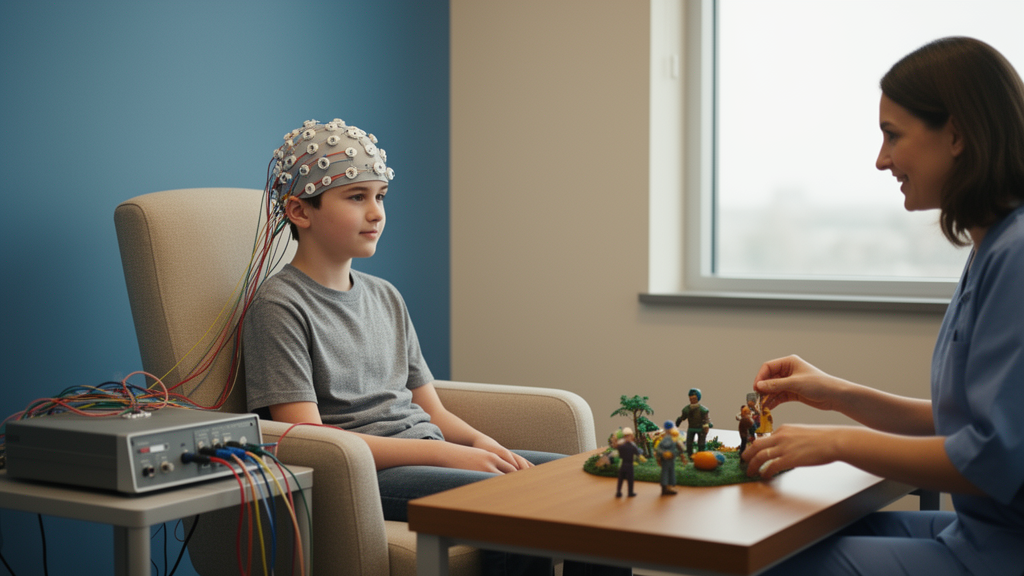
At baseline and after the 16-week intervention, EEG will be recorded during a gesture–word integration task. Participants will view communicative gestures followed by written words that are semantically congruent or incongruent with the gesture and make an online congruency judgment. The N400 congruency effect will be calculated as the mean event-related potential amplitude for incongruent trials minus that for congruent trials during a prespecified 400–600 millisecond interval at the Cz, CPz and Pz electrodes. Participants need at least 50 artifact-free trials in each condition for inclusion in the ERP analysis.
The N400 measure is not a clinical outcome. Baseline values will be examined as an exploratory predictor and moderator of clinical change, and the protocol states that larger congruency effects have reflected stronger engagement of semantic-integration mechanisms in prior adult research. The planned Group × Time × N400 interaction is hypothesis-generating rather than confirmatory, particularly because the active group is small and some participants may not meet the trial requirements for ERP analysis. The authors will emphasize effect estimates and 95% confidence intervals and state that any observed association would require independent replication.
The design has several limitations. It is a single-center study with 36 participants, so treatment-effect estimates will be preliminary and may not generalize to other services. The IQ threshold excludes adolescents with intellectual disability as well as some participants with borderline or low-average cognitive functioning. Italian research translations, rather than formally validated adaptations, will be used for the TASSK-R and SSDS. Informal social-skills coaching outside the recorded service-use log cannot be completely ruled out in the control group. The trial was approved by the Meyer Hospital institutional review board, registered as NCT07207213 and funded through Italy’s National Recovery and Resilience Plan. Recruitment was ongoing at submission, with completion of recruitment, intervention delivery and post-treatment assessments expected by April 2027.
Subject of Research: Pilot randomized trial of in-person UCLA PEERS for autistic adolescents with exploratory EEG response measures
Article Title: In-person UCLA-PEERS® program for adolescents with autism spectrum disorder in Italy: study protocol for a pilot and feasibility randomized controlled trial with pragmatic features and exploratory EEG markers of treatment response
Article References: Narzisi, A., Fabbri-Destro, M., Foti, E., Cristofani, C., Manetti, G., Accorinti, I., Muccio, R., Berloffa, S., Fantozzi, P., Valente, E., Viglione, V., Avanzini, P., Carta, A., Sotgiu, S., Bartolini, E., Milone, A., & Masi, G. (2026). In-person UCLA-PEERS® program for adolescents with autism spectrum disorder in Italy: study protocol for a pilot and feasibility randomized controlled trial with pragmatic features and exploratory EEG markers of treatment response. Frontiers in Psychiatry, 17, Article 1988518. https://doi.org/10.3389/fpsyt.2026.1988518
Image Credits: AI Generated
DOI: 10.3389/fpsyt.2026.1988518
Keywords: UCLA PEERS, autism spectrum disorder, adolescents, pilot randomized trial, feasibility, electroencephalography, N400, social functioning, Italy, In-person, UCLA-PEERS, program
News Source: Ophelia Keating. (October 21, 2026). Italian pilot trial protocol evaluates in-person UCLA PEERS program and exploratory EEG response markers. Scienmag.