Updated best-practices illustrated manual offers practical, science-based guidance on building biodegradable FADs
Credit: ISSF
The International Seafood Sustainability Foundation (ISSF) has published a best-practices guide — based on years of ISSF scientific research and fleet collaboration worldwide, including at skippers workshops — to help tuna fishers accelerate their use of fish aggregating device (FAD) designs with the least possible impact on the marine ecosystem.
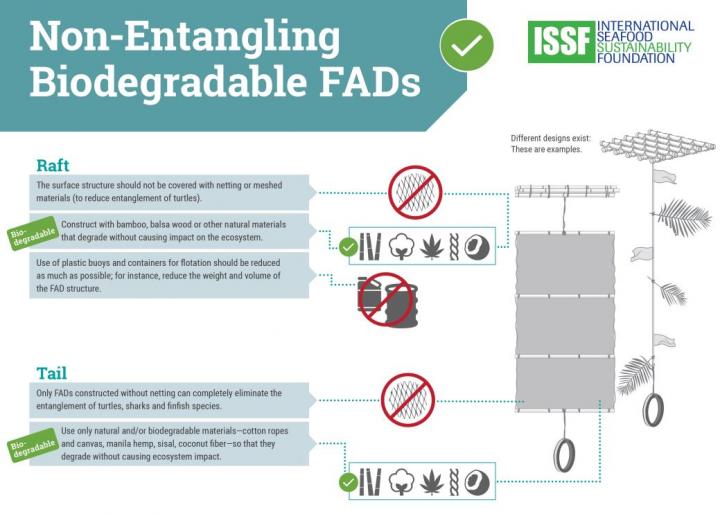
The ISSF Non-Entangling and Biodegradable FADs Guide is the first manual to show, through detailed illustrations, non-entangling (NE) FAD raft and tail designs made with biodegradable materials.
By not using netting in FADs, tuna-vessel owners and fishers can prevent the entanglement and “bycatch” of sharks, sea turtles, and other non-target marine species — a serious issue addressed in the guide. In addition, by choosing vegetal instead of plastic-derived materials for FADs, fishers can avoid contributing to the ocean pollution caused by discarded fishing gear. A study estimated that 10% of FADs deployed in tuna fisheries end up stranded and can ensnare sharks and turtles as they drift, a phenomenon known as “ghost fishing.” (Maufroy et al. 2015)
A Resource for Sustainable Fishing Stakeholders
ISSF’s Non-Entangling and Biodegradable FADs Guide also summarizes Regional Fisheries Management Organization (RFMO) requirements for FAD designs. For example, as of 2018, four tuna RFMOs require tuna fishers to use NE designs for FADs; however, they only encourage, rather than require, fishers to use biodegradable materials.
“Through our long-running Skippers Workshop program with purse-seine fishers, we’ve observed their growing commitment to better protect marine species and habitats — and their willingness to switch to NE FADs as a necessary step,” says Dr. Victor Restrepo, ISSF’s Vice President of Science. “With help from practical resources like this guide, fishers can make progress in using biodegradable materials for NE FAD designs — and we also hope to see RFMOs require fully non-entangling and biodegradable designs for FAD fishers.”
The Non-Entangling and Biodegradable FADs Guide, which was authored by ISSF scientists with input from ISSF’s Scientific Advisory Committee and Bycatch Steering Committee, can assist RFMO and government policymakers in adopting more rigorous, science-based measures for lower-impact FAD designs.
The guide can be downloaded in English from the ISSF site. Later this fall, Chinese (Traditional and Simplified), Japanese, Korean, French, Indonesian, Spanish, Tagalog and Vietnamese versions will be published. This is the second update of the ISSF NE FAD guide since it was first published in 2012.
ISSF’s 10th anniversary timeline highlights a decade of achievements in FAD research, from a November 2009 bycatch-mitigation workshop to current biodegradable FAD pilot studies in four RFMO regions.
###
About the International Seafood Sustainability Foundation (ISSF)
The International Seafood Sustainability Foundation (ISSF) is a global coalition of scientists, the tuna industry and World Wildlife Fund (WWF) — the world’s leading conservation organization — promoting science-based initiatives for the long-term conservation and sustainable use of tuna stocks, reducing bycatch and promoting ecosystem health. Helping global tuna fisheries meet sustainability criteria to achieve the Marine Stewardship Council certification standard — without conditions — is ISSF’s ultimate objective. In 2019, ISSF celebrated a “Decade of Discovery” as the organization completed its tenth year of scientific research, advocacy and industry engagement. To learn more, visit https:/
Media Contact
Alexandra Hernandez
[email protected]
Original Source
https:/