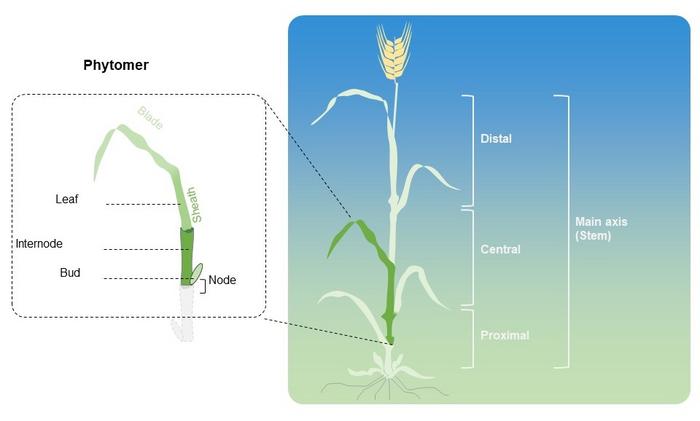
Plant architecture is the outcome of several successive developmental processes that can be classified into two events: organogenesis and extension. Organogenesis stems from the meristems (stem cells) that give rise to different types of organs (e.g., leaves and flowers) and axillary buds, plus the subtending internodes. These organs form a functional unit called phytomer. It iterates and extends itself for several rounds until the apex either aborts or terminates into a specialized structure.
Credit: IPK Leibniz Institute
Plant architecture is the outcome of several successive developmental processes that can be classified into two events: organogenesis and extension. Organogenesis stems from the meristems (stem cells) that give rise to different types of organs (e.g., leaves and flowers) and axillary buds, plus the subtending internodes. These organs form a functional unit called phytomer. It iterates and extends itself for several rounds until the apex either aborts or terminates into a specialized structure.
In this context, the main body axis of barley represents a continuous segmentation of phytomers wherein both vegetative and reproductive organs co-exist at opposite ends. Nonetheless, how phytomer initiation and elongation are coordinated remains poorly understood. Therefore, the research team systematically investigated phytomer initiation and elongation by focusing on node number and internode length in the vegetative culms and reproductive spikes of barley.
“By measuring 15,000 data points representing phytomer length and number from 2,500 individual barley plants of broad genetic diversity, we have uncovered a previously unrecognized universal internode elongation pattern along the main axis”, explains Dr. Yongyu Huang, first author of the study. “The internode elongation pattern clearly divides the main body axis into three subzones from head to tail, regardless of the phytomer number”, says Dr. Yongyu Huang. “We termed these three subzones as proximal, central and distal internodes, respectively, and were able to explicitly dissect each of their genetic compositions.”
In their work, the researchers were able to identify both known and new genomic loci that affect barley internode elongation. One striking example is the flowering time gene PHOTOPERIOD1 that is repurposed to specify proximal internode length via the gibberellic acid (GA) pathway. GA is a hormone required for internode elongation. In 1960s, Green Revolution “semi-dwarfing” gene mutations that modified the GA hormone system have reduced plant heights of both wheat and rice, enabling them to be cultivated at higher planting densities while preventing lodging. “A major environmental disadvantage of the introduction of semi-dwarfed cultivars, however, was the high usage of chemical fertilizer to maintain inflorescence fertility when biomass is reduced”, says Dr. Yongyu Huang. Today, barley is still considered to be less lodging tolerant. “Our study shows that shorter proximal internodes are associated with higher floral organ survival.” This suggests that by reallocating resources from proximal internodes to floral organs during early developmental stages, it is likely to maintain inflorescence fertility while being semi-dwarfed, thereby preventing lodging.
Moreover, the researchers found that different locally adapted barley populations exhibit different proximal internodes lengths, while the distal ones remain the same. “In plant communities, a dense canopy can lead to distinct microclimates from proximal to distal”, says Prof. Dr. Thorsten Schnurbusch, head of IPK’s research group “Plant Architecture” and Professor for “Developmental Genetics of Crop Plants” at Martin Luther University Halle-Wittenberg. “This can vary over the vertical space, resulting in the dynamic elongation of distinct internodes.”
Journal
Molecular Biology and Evolution
DOI
10.1093/molbev/msae011/7578427
Article Title
Dynamic phytomeric growth contributes to local adaptation in barley
Article Publication Date
19-Jan-2024