

• HOME
  • NEWS
  • EXPLORE
    • CAREER
      • Companies
      • Jobs
    • EVENTS
    • iGEM
      • News
      • Team
    • PHOTOS
    • VIDEO
    • WIKI
  • BLOG
  • COMMUNITY
    • FACEBOOK
    • INSTAGRAM
    • TWITTER
Sunday, October 4, 2026
BIOENGINEER.ORG
No Result
View All Result
  • Login
  • HOME
  • NEWS
  • EXPLORE
    • CAREER
      • Companies
      • Jobs
        • Lecturer
        • PhD Studentship
        • Postdoc
        • Research Assistant
    • EVENTS
    • iGEM
      • News
      • Team
    • PHOTOS
    • VIDEO
    • WIKI
  • BLOG
  • COMMUNITY
    • FACEBOOK
    • INSTAGRAM
    • TWITTER
  • HOME
  • NEWS
  • EXPLORE
    • CAREER
      • Companies
      • Jobs
        • Lecturer
        • PhD Studentship
        • Postdoc
        • Research Assistant
    • EVENTS
    • iGEM
      • News
      • Team
    • PHOTOS
    • VIDEO
    • WIKI
  • BLOG
  • COMMUNITY
    • FACEBOOK
    • INSTAGRAM
    • TWITTER
No Result
View All Result
Bioengineer.org
No Result
View All Result
Home NEWS Science News Biology

Invisible needles

Bioengineer by Bioengineer
August 28, 2018
in Biology
Reading Time: 2 mins read
0
Share on FacebookShare on TwitterShare on LinkedinShare on RedditShare on Telegram
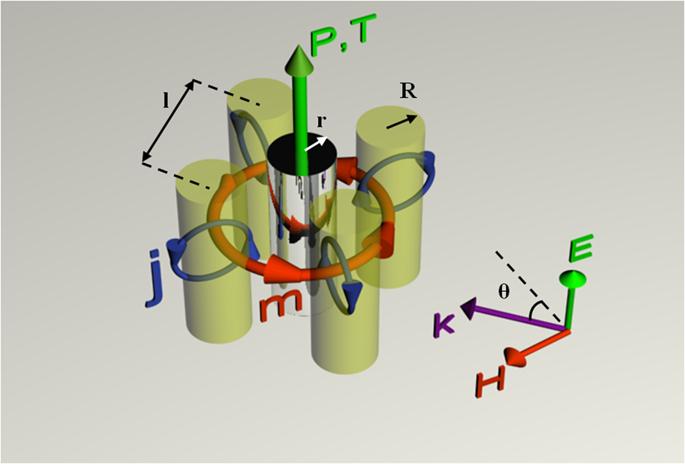
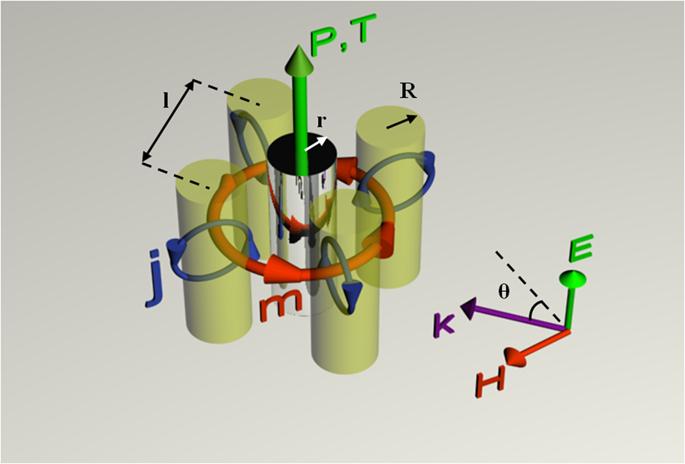
IMAGE

Credit: © NUST MISIS

An international research group of scientists from Politecnico di Torino (Italy) and NUST MISIS (Russia) has developed a model of a new metamaterial, which will improve the accuracy of nano-sensors in optics and biomedicine by cloaking them from external radiation. The article reporting the results has been recently published in Scientific Reports, a high rank, prestigious interdisciplinary journal, edited by Nature Publishing House.

The development of a new cloaking metamaterial for nano-sensors is carried out within the framework of the Italian-Russian project ANASTASIA (Advanced Non-radiating Scattering Tenuously Architectures And Sustaining Invisible Anapoles), funded with 50,000 Euro by Compagnia di San Paolo in the framework of Joint Projects for the Internationalization of Research (Bando internalizzazione della ricerca, 2017) announced by Politecnico di Torino. The aim of the project is to model and then prototype a metamaterial, which will make nano-scale objects invisible in the uncovered THz frequency range. On the part of Politecnico di Torino, Professor Ladislau Matekovits heads the research group, while Professor Alexey Basharin leads the Russian team. In the research, 4 PhD students and other young professionals are also involved.

A cylinder of perfect electric conductor (PEC) with radius r=2.5 μm has been considered in order to imitate a nano-sensor. Being metallic, it possesses very high wave scattering, allowing to carry out calculations for the maximum possible level of re-radiation. The modeling was performed in THz range, which stands between infrared and microwave bands.

The key element of the new metamaterial is a metamolecule (Fig. 1), consisting of four dielectric lithium tantalate (LiTaO3) cylinders, r=5 μm. Serving as a coating for a nano-sensor, dielectrics interact with radiation, exciting non-radiating anapole mode. Separated from each other, all the elements radiate and distort the electric and magnetic fields (Fig. 2 a, b), but when considered all together the object becomes invisible for an external observer (Fig. 2 c).

Apart from the used LiTaO3, depending on the field of application, other materials can be considered. For example, in nano-optics it would be possible to work with silicon and germanium, while in biomedical sensoring biocompatible sodium chloride would be a possible alternative.

The next research stage, which is the experimental characterization of a prototype of the proposed structure in vitro, is scheduled for this autumn.

Concurrently, interests in creating configurations by using proper materials, e.g., graphene, and geometrical arrangements that are only transparent at certain wavelengths and/or angles of incidence are targeted. The challenge set by scientists from Politecnico di Torino and NUST MISIS is to generalize the experience to develop a theory which can be used to model and then assemble metamaterials that will cloak nano-scaled objects at all the wavelengths and at any angles.

###

Media Contact

Lyudmila Dozhdikova
[email protected]
7-495-647-2309

http://en.misis.ru/

Original Source

http://en.misis.ru/university/news/science/2018-08/5561/ http://dx.doi.org/10.1038/s41598-018-30935-3


Share13Tweet8Share2ShareShareShare2

Related Posts

Gene Activity Comes in Bursts: Epigenetics Reshapes the Picture of Transcriptional Noise

Gene Activity Comes in Bursts: Epigenetics Reshapes the Picture of Transcriptional Noise

October 4, 2026
Ancient Microbes Filmed Crawling Reveal Deep Roots of Complex Cell Movement

Ancient Microbes Filmed Crawling Reveal Deep Roots of Complex Cell Movement

October 4, 2026

Sheep Gene ZNF280B Emerges as a Master Switch for Muscle Growth and Meat Yield

October 4, 2026

YouTube’s Alzheimer’s Videos Are Mostly Reliable, But Caregivers Are Left Behind

October 4, 2026
Please login to join discussion

POPULAR NEWS

  • Alloys That Shrink Their Own Grains: New PIX Mechanism Refines Metals With Heat Alone

    Alloys That Shrink Their Own Grains: New PIX Mechanism Refines Metals With Heat Alone

    29 shares
    Share 12 Tweet 7
  • Endurance Exercise Reshapes the Liver in Males and Females Through Distinct Molecular Routes

    29 shares
    Share 12 Tweet 7
  • Single Transcription Factor PU.1 Rapidly Converts Fibroblasts into Macrophage-Lineage Cells

    29 shares
    Share 12 Tweet 7
  • New Scale Measures How Ready Nurse Educators Really Are for the AI Era

    29 shares
    Share 12 Tweet 7

About

We bring you the latest biotechnology news from best research centers and universities around the world. Check our website.

Follow us

Recent News

Alloys That Shrink Their Own Grains: New PIX Mechanism Refines Metals With Heat Alone

Endurance Exercise Reshapes the Liver in Males and Females Through Distinct Molecular Routes

Single Transcription Factor PU.1 Rapidly Converts Fibroblasts into Macrophage-Lineage Cells

Subscribe to Blog via Email

Enter your email address to subscribe to this blog and receive notifications of new posts by email.

Join 85 other subscribers
  • Contact Us

Bioengineer.org © Copyright 2023 All Rights Reserved.

Welcome Back!

Login to your account below

Forgotten Password?

Retrieve your password

Please enter your username or email address to reset your password.

Log In
No Result
View All Result
  • Homepages
    • Home Page 1
    • Home Page 2
  • News
  • National
  • Business
  • Health
  • Lifestyle
  • Science

Bioengineer.org © Copyright 2023 All Rights Reserved.
